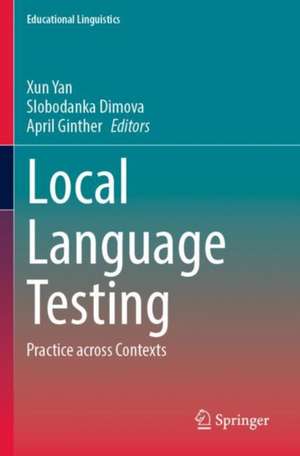
Local Language Testing: Educational Linguistics, cartea 61
Editat de Xun Yan, Slobodanka Dimova, April Gintheren Limba Engleză Paperback – 20 iul 2024
Din seria Educational Linguistics
- 18%
 Preț: 995.12 lei
 - 15%
 Preț: 672.13 lei
 - 18%
 Preț: 985.13 lei
 - 15%
 Preț: 732.40 lei
 - 18%
 Preț: 947.98 lei
 - 15%
 Preț: 607.55 lei
 - 15%
 Preț: 606.71 lei
 - 15%
 Preț: 604.33 lei
 - 31%
 Preț: 547.95 lei
 - 18%
 Preț: 904.19 lei
 - 32%
 Preț: 544.85 lei
 - 31%
 Preț: 551.19 lei
 - 15%
 Preț: 608.21 lei
 - 15%
 Preț: 608.84 lei
 - 18%
 Preț: 932.18 lei
 - 15%
 Preț: 608.60 lei
 - 15%
 Preț: 609.05 lei
 -
 Preț: 402.76 lei
 - 15%
 Preț: 668.10 lei
 -
 Preț: 406.90 lei
 - 15%
 Preț: 672.68 lei
 - 18%
 Preț: 930.10 lei
 -
 Preț: 406.37 lei
 - 18%
 Preț: 753.87 lei
 - 15%
 Preț: 608.60 lei
 - 18%
 Preț: 1153.67 lei
 - 15%
 Preț: 725.11 lei
 - 15%
 Preț: 724.43 lei
 - 18%
 Preț: 1153.02 lei
 - 18%
 Preț: 755.34 lei
 - 24%
 Preț: 903.13 lei
 - 18%
 Preț: 755.34 lei
 - 15%
 Preț: 558.32 lei
 - 18%
 Preț: 1155.80 lei
 - 18%
 Preț: 907.25 lei
Preț: 1012.02 lei
Preț vechi: 1331.61 lei
-24%
Puncte Express: 1518
Carte tipărită la comandă
Livrare economică 23-28 noiembrie
Livrare prin curier în România Termenul estimat este afișat lângă disponibilitate.
Transport gratuit pentru acest produs Plată online sau ramburs, în funcție de opțiunile comenzii.
Retur gratuit în 14 zile Comandă securizată și suport în română.
Specificații
ISBN-13: 9783031335433
ISBN-10: 3031335430
Pagini: 260
Dimensiuni: 155 x 235 x 15 mm
Greutate: 0.4 kg
Editura: Springer
Colecția Educational Linguistics
Seria Educational Linguistics
ISBN-10: 3031335430
Pagini: 260
Dimensiuni: 155 x 235 x 15 mm
Greutate: 0.4 kg
Editura: Springer
Colecția Educational Linguistics
Seria Educational Linguistics
V-ar putea interesa
-
 Preț: 348.95 lei
 -
 -18%Preț: 1307.12 lei1594.05 lei
 -
 -18%Preț: 1131.43 lei1379.80 lei
 -
 Preț: 445.55 lei
 -
 -18%Preț: 1128.63 lei1376.37 lei
 -
 Preț: 233.74 lei
 -
 Language Policy and Planning in Universities: Teaching, research and administrationAnthony J. LiddicoatPreț: 427.39 lei
 -
 -15%Preț: 421.73 lei496.16 lei
 -
 -18%Preț: 1122.50 lei1368.90 lei
 -
 -18%Preț: 1110.28 lei1354.00 lei
 -
 Theories in Second Language Acquisition: An IntroductionBill VanPattenPreț: 494.43 lei
 -
 PrepositionsJean Yates, Ph.D.Preț: 136.86 lei
 -
 Preț: 532.42 lei
Cuprins
Preface
Acknowledgements
Chapter 1: Introduction
Why local tests?
Introduction
Our tests
Contexts and problem solving
Large-scale language tests and academic language testing
Organization of the rest of this volume
Further reading
References
Chapter 2: Local tests, local contexts
Introduction
Local contexts and test purpose – decisions about test-takers
Linking test purpose to instructional outcomes
Further reading
References
Chapter 3: Local test development
Introduction
Planning test development
Test design
Technical manuals
Summary
Further reading
References
Chapter 4: Test tasks
Introduction
Discrete-point lexico-grammar items
Integrative measures of general language ability
Skill-based performance assessments
Summary
Further reading
References
Chapter 5: Local test delivery
Introduction
Digital devices
Production of traditional and digitally delivered tests: what does it take?
Opportunities for innovative task design
Test administration
Selection of test delivery format: what to consider
Summary
Further reading
References
Chapter 6: Scaling
Introduction
Why do we need a rating scale?
Different types of rating scales
Approaches to scale development and validation
Issues to consider during scale validation
Unique challenges and opportunities for scaling in local testing contexts
Summary
Further reading
References
Chapter 7: Raters and rater training
Introduction
The promise and perils of rater-mediated language assessment
Rater behavior: a catalog of rater effects
Why do we need rater training? Does it really work?
Best practice for rater training
Summary
Further reading
References
Chapter 8: Data collection, management, and score reporting
Introduction
Data flow
Data storage
Data management
Data uses
Summary
Further reading
References
Chapter 9: Reflections
Introduction
Some reflections on the revision of the TOEPAS
Some reflections on the EPT scale revision process
Some reflections on the development of the OEPT
Conclusions
References
Appendix A
Index
Acknowledgements
Chapter 1: Introduction
Why local tests?
Introduction
Our tests
Contexts and problem solving
Large-scale language tests and academic language testing
Organization of the rest of this volume
Further reading
References
Chapter 2: Local tests, local contexts
Introduction
Local contexts and test purpose – decisions about test-takers
Linking test purpose to instructional outcomes
Further reading
References
Chapter 3: Local test development
Introduction
Planning test development
Test design
Technical manuals
Summary
Further reading
References
Chapter 4: Test tasks
Introduction
Discrete-point lexico-grammar items
Integrative measures of general language ability
Skill-based performance assessments
Summary
Further reading
References
Chapter 5: Local test delivery
Introduction
Digital devices
Production of traditional and digitally delivered tests: what does it take?
Opportunities for innovative task design
Test administration
Selection of test delivery format: what to consider
Summary
Further reading
References
Chapter 6: Scaling
Introduction
Why do we need a rating scale?
Different types of rating scales
Approaches to scale development and validation
Issues to consider during scale validation
Unique challenges and opportunities for scaling in local testing contexts
Summary
Further reading
References
Chapter 7: Raters and rater training
Introduction
The promise and perils of rater-mediated language assessment
Rater behavior: a catalog of rater effects
Why do we need rater training? Does it really work?
Best practice for rater training
Summary
Further reading
References
Chapter 8: Data collection, management, and score reporting
Introduction
Data flow
Data storage
Data management
Data uses
Summary
Further reading
References
Chapter 9: Reflections
Introduction
Some reflections on the revision of the TOEPAS
Some reflections on the EPT scale revision process
Some reflections on the development of the OEPT
Conclusions
References
Appendix A
Index
Notă biografică
Xun Yan received his Ph.D. in Second Language Studies from Purdue University in 2015. He is an Assistant Professor of Linguistics, Second Language Acquisition and Teacher Education (SLATE), and Educational Psychology at University of Illinois at Urbana-Champaign, where he is also the coordinator of the English Placement Test (EPT). He is the president of the Midwest Association of Language Testers in the US. He currently serves as an editorial board member of the journals Language Testing, TESOL Quarterly, Studies in Educational Evaluation, and Language Teaching Research Quarterly. He teaches graduate courses in Language Testing, Second Language Acquisition, and TESOL Methodology. His current research interests include the development and quality control of post-admission language assessments, scale development and validation, rater performance and training, assessment literacy for language teachers, and test score use in educational settings.
Slobodanka Dimova received her Ph.D. in English as a Second Language from Purdue University in 2005. She is an Associate Professor in Language Testing and the coordinator of the Test of Oral English Proficiency for Academic Staff (TOEPAS) at the University of Copenhagen, Denmark. She currently serves as the Book Review Editor for the journal Language Testing, a member of the Executive Committee of the European Association of Language Testing and Assessment (EALTA), and a member of the Editorial Board of the Journal of English Medium Instruction. She teaches graduate courses in Language Testing, Second Language Acquisition, Research Methods, and Oral Production in L2. Her current research interests include rater training and rater behavior for oral proficiency tests, the development and validation of scales for performance-based tests, the use of technology in language testing and assessment, the policies and practices related to the implementation of English-medium instruction (EMI) programs at non-Anglophone universities.
April Ginther received her Ph.D. in Educational Linguistics from the University of New Mexico in 1994. She is a Professor of English, the Director of The Oral English Proficiency Program, and the Director of The Purdue Language and Cultural Exchange at Purdue University in West Lafayette, Indiana. For both the OEPP and PLaCE, she supervised the development of local tests, the Oral English Proficiency Test (OEPT) and the Assessment of College English, International (ACE-In). From 2012-2017, she was the co-editor of the journal Language Testing. She teaches graduate courses in the Second Language Studies Program and regularly offers two seminars: Quantitative Research Design and Language Testing and Assessment. Her current research interests include rater training, the development of second language reading and speaking fluency, and the development, implementation, and evaluation of university programs promoting internationalization and English language learning.
April Ginther received her Ph.D. in Educational Linguistics from the University of New Mexico in 1994. She is a Professor of English, the Director of The Oral English Proficiency Program, and the Director of The Purdue Language and Cultural Exchange at Purdue University in West Lafayette, Indiana. For both the OEPP and PLaCE, she supervised the development of local tests, the Oral English Proficiency Test (OEPT) and the Assessment of College English, International (ACE-In). From 2012-2017, she was the co-editor of the journal Language Testing. She teaches graduate courses in the Second Language Studies Program and regularly offers two seminars: Quantitative Research Design and Language Testing and Assessment. Her current research interests include rater training, the development of second language reading and speaking fluency, and the development, implementation, and evaluation of university programs promoting internationalization and English language learning.
Textul de pe ultima copertă
This book describes language testing practices that exist in the intermediate space between large-scale standardized testing and classroom assessment, an area that is rarely addressed in language testing literature. Drawing empirical research on a variety of languages, the volume discusses local language tests’ ability to represent local contexts and values, explicitly and purposefully embed test results within instructional practice, and provide data for program evaluation and research. Although local testing practices have been grounded in the theoretical principles of language testing, the authors in this volume supplement the theoretical content with practical examples of how local tests can be designed to effectively function within and across different institutional contexts.
Caracteristici
Targets a wide readership including researchers, teachers and students with the need to develop local language tests Illustrates local testing research and practices across linguistic cultural socio-political and geographical contexts Covers practical topics directly applicable to test development validation and use