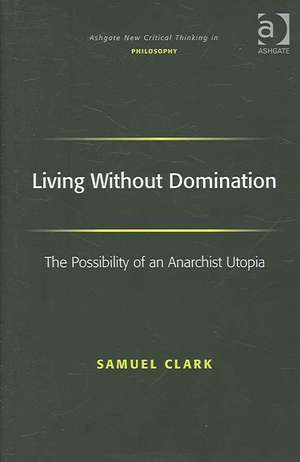
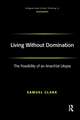
Living Without Domination: The Possibility of an Anarchist Utopia: Ashgate New Critical Thinking in Philosophy
Autor Samuel Clarken Limba Engleză Hardback – 28 ian 2007
Din seria Ashgate New Critical Thinking in Philosophy
- 15%
 Preț: 499.99 lei
 - 15%
 Preț: 473.86 lei
 - 15%
 Preț: 439.90 lei
 - 15%
 Preț: 479.54 lei
 - 15%
 Preț: 432.92 lei
 - 15%
 Preț: 439.90 lei
 - 18%
 Preț: 1112.48 lei
 - 15%
 Preț: 466.89 lei
 - 18%
 Preț: 1112.48 lei
 - 15%
 Preț: 439.90 lei
 - 18%
 Preț: 1254.12 lei
 - 15%
 Preț: 434.37 lei
 - 18%
 Preț: 1112.48 lei
 -
 Preț: 437.63 lei
 - 18%
 Preț: 1117.25 lei
 - 18%
 Preț: 1117.60 lei
 - 15%
 Preț: 449.21 lei
 - 15%
 Preț: 439.90 lei
 - 15%
 Preț: 473.86 lei
 - 18%
 Preț: 1117.25 lei
 - 15%
 Preț: 466.31 lei
 -
 Preț: 470.81 lei
 - 18%
 Preț: 1257.99 lei
 - 25%
 Preț: 1097.30 lei
 - 11%
 Preț: 354.16 lei
 - 21%
 Preț: 398.08 lei
 - 25%
 Preț: 1098.82 lei
 - 25%
 Preț: 1100.55 lei
 - 21%
 Preț: 373.55 lei
 - 22%
 Preț: 370.33 lei
 - 25%
 Preț: 1099.99 lei
 - 22%
 Preț: 423.82 lei
Preț: 1248.98 lei
Preț vechi: 1523.15 lei
-18%
Puncte Express: 1873
Carte tipărită la comandă
Livrare economică 19 noiembrie-03 decembrie
Livrare prin curier în România Termenul estimat este afișat lângă disponibilitate.
Transport gratuit pentru acest produs Plată online sau ramburs, în funcție de opțiunile comenzii.
Retur gratuit în 14 zile Comandă securizată și suport în română.
Specificații
ISBN-13: 9780754654612
ISBN-10: 0754654613
Pagini: 182
Dimensiuni: 156 x 234 x 13 mm
Greutate: 0.45 kg
Ediția:1
Editura: Taylor & Francis
Colecția Routledge
Seria Ashgate New Critical Thinking in Philosophy
Locul publicării:Oxford, United Kingdom
ISBN-10: 0754654613
Pagini: 182
Dimensiuni: 156 x 234 x 13 mm
Greutate: 0.45 kg
Ediția:1
Editura: Taylor & Francis
Colecția Routledge
Seria Ashgate New Critical Thinking in Philosophy
Locul publicării:Oxford, United Kingdom
V-ar putea interesa
-
 The Moro CookbookSamantha Clark-18%Preț: 189.21 lei230.05 lei
 -
 The Road to SerfdomF.A. HayekPreț: 173.46 lei
 -
 Oppression and LibertySimone WeilPreț: 129.23 lei
 -
 The Accumulation of CapitalRosa LuxemburgPreț: 142.29 lei
 -
 Karl MarxWood AllenPreț: 341.31 lei
 -
 -15%Preț: 430.06 lei505.95 lei
 -
 Preț: 484.69 lei
 -
 -15%Preț: 435.94 lei512.88 lei
 -
 Capitalism, Socialism and DemocracyJoseph A. SchumpeterPreț: 193.25 lei
 -
 Eleanor Marx: A LifeRachel Holmes-47%Preț: 72.25 lei137.21 lei
 -
 Preț: 96.45 lei
 -
 Preț: 521.09 lei
 -
 The S WordJohn NicholsPreț: 133.48 lei
 -
 -18%Preț: 89.07 lei108.40 lei
Cuprins
Contents: Preface; Introduction; Primitivism; The human landscape; Living with domination; Living without domination; Conclusion; Bibliography; Index.
Notă biografică
Samuel Clark is Lecturer in Philosophy in the Department of Politics, Philosophy, and Religion at Lancaster University. See http://www.lancaster.ac.uk/ppr/about-us/people/sam-clark for more information on his work.
Descriere
This book defends the bold claim that humans can organize themselves to live peacefully and prosperously together in an anarchist utopia. Clark refutes errors about anarchism, utopianism and human sociability and its history. He then develops an analysis of natural human social activity which places anarchy in the real landscape of sociability, along with more familiar possibilities including states and slavery.