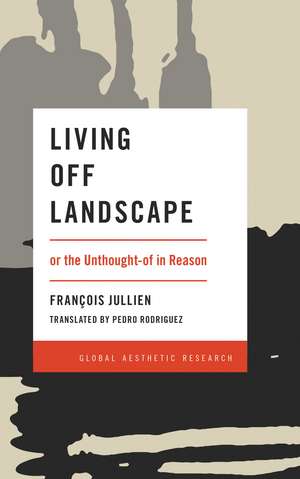
Living Off Landscape: or the Unthought-of in Reason: Global Aesthetic Research
Autor Francois Jullien Traducere de Pedro Rodriguezen Limba Engleză Hardback – 17 ian 2018
In this important new book, one of France's most influential living theorists argues that the first civilization to truly consider landscape was China. In giving landscape the name 'mountain(s)-water(s)', the Chinese language provides a powerful alternative to Western biases. The Chinese conception speaks of a correlation between high and low, between the still and the motile, between what has form and what is formless, between what we see and what we hear. No longer a matter of 'vision', landscape becomes a matter of living. Francois Jullien invites the reader to explore reason's unthought choices, and to take a fresh look at our more basic involvement in the world.
| Toate formatele și edițiile | Preț | Express |
|---|---|---|
| Paperback (1) | 207.87 lei 6-8 săpt. | |
| Bloomsbury Publishing – 9 ian 2018 | 207.87 lei 6-8 săpt. | |
| Hardback (1) | 553.37 lei 6-8 săpt. | |
| Bloomsbury Publishing – 17 ian 2018 | 553.37 lei 6-8 săpt. |





Preț: 553.37 lei
Preț vechi: 835.90 lei
-34%
Puncte Express: 830
Preț estimativ în valută:
97.86€ • 115.81$ • 85.33£
97.86€ • 115.81$ • 85.33£
Carte tipărită la comandă
Livrare economică 03-17 aprilie
Specificații
ISBN-13: 9781786603371
ISBN-10: 1786603373
Pagini: 160
Dimensiuni: 158 x 240 x 17 mm
Greutate: 0.39 kg
Editura: Bloomsbury Publishing
Colecția Rowman & Littlefield
Seria Global Aesthetic Research
Locul publicării:New York, United States
ISBN-10: 1786603373
Pagini: 160
Dimensiuni: 158 x 240 x 17 mm
Greutate: 0.39 kg
Editura: Bloomsbury Publishing
Colecția Rowman & Littlefield
Seria Global Aesthetic Research
Locul publicării:New York, United States
Cuprins
Prologue / 1. Land - Landscape: Expanse, View, Cut-Off / 2. "Mountain(s)-Water(s)" / 3. From a Landscape to Living / 4. When the Perceptual Turns Out to Be Affectual / 5. When "Spirit" Emanates from the Physical / 6. Tension-Setting / 7. Singularization, Variation, Remove / 8. Connivance / Epilogue / Index
Recenzii
Francois Jullien's rich exploration of what he calls "landscape thought" raises awareness of the cultural conditioning that obscures understanding and renders new thought impossible. Through his focus on environmental aesthetics in China and Europe he provides us with a philosophical method for productive possibilities of global engagement at all levels. This is a comparatist scholarship for a globally articulated time.?
Although the appearance of any book by Jullien merits celebration, this work is especially precious. Retrieving the Chinese tradition of shan shui (??) or mountain(s) and river(s) "landscape" painting, which deploys the polar vitality of emptiness and form, he challenges the European landscape tradition and exposes "connivance" as another way of living with the " spirit" of the singular "milieu" of a place. What could be more important in our age of ecological crisis and "impending uniformity"?
While the author is highly critical of traditional European approaches, the insights offered by this enchanting work will help readers rediscover the meaning and value of landscape and break away from customary perception by allowing them to wander through nature as depicted by classical Chinese poets and painters, while at the same time inspiring them to find new approaches to solving issues in contemporary urban design, and sustainable environmental development.
With immense intelligence and reflexivity, François Jullien does the seemingly impossible: peeling off layer by layer the opaque cultural sediments that pre-condition our landscape-thought even when we struggle to escape from them. Living Off Landscape is a thought thriller; it demonstrates yet again that no one comes close to Jullien in terms of insights and relevance of cross-cultural thinking. Jullien shows us the form of the twenty-first century mind.
Jullien's main merit with this book ... lies not (only) in the explanation of the differences of the cultural tradition and their landscape-interpretation, and not even merely in the fact of presenting his method of investigating the concepts through the divide, but that through his observation of the tradition he manages to propose novel ways of being engaged with the landscape that have multiple further consequences not only in interpreting past art products and cultural phenomena but also in offering new answers to contemporary environmental and ecological issues.
Although the appearance of any book by Jullien merits celebration, this work is especially precious. Retrieving the Chinese tradition of shan shui (??) or mountain(s) and river(s) "landscape" painting, which deploys the polar vitality of emptiness and form, he challenges the European landscape tradition and exposes "connivance" as another way of living with the " spirit" of the singular "milieu" of a place. What could be more important in our age of ecological crisis and "impending uniformity"?
While the author is highly critical of traditional European approaches, the insights offered by this enchanting work will help readers rediscover the meaning and value of landscape and break away from customary perception by allowing them to wander through nature as depicted by classical Chinese poets and painters, while at the same time inspiring them to find new approaches to solving issues in contemporary urban design, and sustainable environmental development.
With immense intelligence and reflexivity, François Jullien does the seemingly impossible: peeling off layer by layer the opaque cultural sediments that pre-condition our landscape-thought even when we struggle to escape from them. Living Off Landscape is a thought thriller; it demonstrates yet again that no one comes close to Jullien in terms of insights and relevance of cross-cultural thinking. Jullien shows us the form of the twenty-first century mind.
Jullien's main merit with this book ... lies not (only) in the explanation of the differences of the cultural tradition and their landscape-interpretation, and not even merely in the fact of presenting his method of investigating the concepts through the divide, but that through his observation of the tradition he manages to propose novel ways of being engaged with the landscape that have multiple further consequences not only in interpreting past art products and cultural phenomena but also in offering new answers to contemporary environmental and ecological issues.