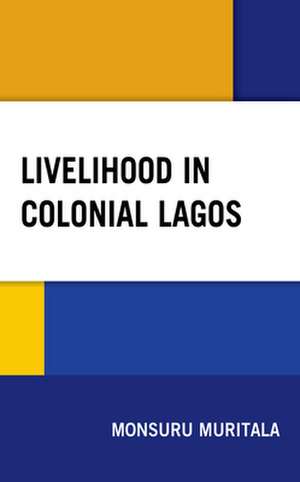
Livelihood in Colonial Lagos
Autor Monsuru Muritalaen Limba Engleză Hardback – 16 oct 2019
Preț: 550.09 lei
Preț vechi: 815.71 lei
-33%
Puncte Express: 825
Carte tipărită la comandă
Livrare economică 21 noiembrie-05 decembrie
Livrare prin curier în România Termenul estimat este afișat lângă disponibilitate.
Transport gratuit pentru acest produs Plată online sau ramburs, în funcție de opțiunile comenzii.
Retur gratuit în 14 zile Comandă securizată și suport în română.
Specificații
ISBN-13: 9781498582148
ISBN-10: 1498582141
Pagini: 182
Ilustrații: 4 Tables
Dimensiuni: 157 x 235 x 15 mm
Greutate: 0.44 kg
Editura: Lexington Books
Locul publicării:New York, United States
ISBN-10: 1498582141
Pagini: 182
Ilustrații: 4 Tables
Dimensiuni: 157 x 235 x 15 mm
Greutate: 0.44 kg
Editura: Lexington Books
Locul publicării:New York, United States
V-ar putea interesa
-
 -36%Preț: 523.50 lei814.90 lei
 -
 -30%Preț: 535.50 lei767.72 lei
 -
 Borders and ImmigrationLaurence Armand French-15%Preț: 653.30 lei768.59 lei
 -
 -34%Preț: 507.73 lei766.77 lei
 -
 Black Girls Experiencing Their Intersectional Identities in SchoolCrystal L Edwards-15%Preț: 647.59 lei761.86 lei
 -
 -15%Preț: 649.23 lei763.79 lei
 -
 Companion to Ricoeur's Fallible ManScott Davidson-32%Preț: 583.24 lei864.02 lei
 -
 -32%Preț: 584.03 lei864.49 lei
 -
 Balanced WonderJan B W Pedersen-15%Preț: 686.93 lei808.16 lei
 -
 Dark Forces at WorkCynthia J Miller-18%Preț: 802.81 lei979.03 lei
 -
 Amplified AdvantageAllison L Hurst-15%Preț: 688.46 lei809.94 lei
 -
 The Carthaginian Empire: 550–202 BCENathan Pilkington-33%Preț: 580.87 lei862.58 lei
 -
 Britain, the Bible, and Balfour: Mandate for a Jewish State, 1530–1917Jonathan Immanuel-37%Preț: 727.72 lei1151.49 lei
 -
 African American Tea Party SupportersKirk A. Johnson-33%Preț: 582.62 lei863.65 lei
 -
 Plato's Tough Guys and Their Attachment to JusticePeter J Hansen-19%Preț: 653.58 lei806.89 lei
 -
 -33%Preț: 550.36 lei815.86 lei
 -
 -33%Preț: 549.46 lei815.32 lei
 -
 Bringing Stalin Back InTodd H Nelson-15%Preț: 666.29 lei783.87 lei
 -
 Society, Space, and Social Justice: Geographies of IntersectionalityJennifer Y. Pomeroy-32%Preț: 551.24 lei816.38 lei
 -
 Michelle Obama and the FLOTUS EffectHeather E Harris-18%Preț: 697.56 lei850.68 lei
 -
 Patriarchy and the Politics of BeautyAllan D Cooper-15%Preț: 648.60 lei763.06 lei
 -
 Religion in Uniform: A Critique of US Military ChaplaincyEdward Waggoner-32%Preț: 550.96 lei816.23 lei
 -
 Global Justice and Our Epochal MindXunwu Chen-32%Preț: 625.55 lei926.56 lei
 -
 -32%Preț: 583.43 lei864.14 lei
 -
 -19%Preț: 648.37 lei800.47 lei
 -
 Politics of Children in Latin American CinemaMaría Soledad Paz-MacKay-32%Preț: 584.30 lei864.66 lei
 -
 -32%Preț: 584.03 lei864.49 lei
 -
 -32%Preț: 583.67 lei864.29 lei
 -
 John Rawls and American PragmatismDaniele Botti-32%Preț: 615.96 lei912.08 lei
 -
 Possibility’s Parents: Stories at the End of LiberalismMargaret Seyford Hrezo-33%Preț: 549.74 lei815.48 lei
Cuprins
List of Abbreviations
Introduction
Chapter One - An Overview of the Pre-Colonial Economy and Society of Lagos
Chapter Two - Colonial Infrastructure and the Modern Economy, 1861-1960
Chapter Three - Waged Employment, the Extended Family and Urban Culture, 1900-1960
Chapter Four - Women and Urban Experience, 1900-1960
Chapter Five - Neighborhood Cultures and the Redefinition of Social Values, 1861-1960
Conclusion
Introduction
Chapter One - An Overview of the Pre-Colonial Economy and Society of Lagos
Chapter Two - Colonial Infrastructure and the Modern Economy, 1861-1960
Chapter Three - Waged Employment, the Extended Family and Urban Culture, 1900-1960
Chapter Four - Women and Urban Experience, 1900-1960
Chapter Five - Neighborhood Cultures and the Redefinition of Social Values, 1861-1960
Conclusion
Recenzii
This book is an interpretive and impressive coverage of issues pertaining to the story of urbanization and livelihood in Lagos from the dawn of British colonialism in 1861 to the end of colonial rule in 1960. In a clear, accessible and scholarly manner, the author has explored the nexus between modern urbanization processes and socio-economic change in a dynamic African city. Monsuru Muritala, in his study of Livelihood in Colonial Lagos has, therefore, provided a coherent and intellectually stimulating analysis and interpretation of the human dimensions of history in an African setting confronted with fundamental change. The work is an impressive result of the best of historical scholarship in the 21st century. It is an essential and indispensable book for African and Africanist scholars worldwide.
This is an in-depth study of one century of Lagos social history. It explains the paradox of the city, the character of its people and the connection between colonialism and urbanization. It gives insight into the background of the contemporary problems of Lagos namely unemployment, insecurity, housing deficit, gender inequality and social stratification. The methodology is a model for historians in the fields of urban and social history.
In telling the story of the transformation of Lagos from a small fishing and farming village into an uncontrollably large and urbanized seaside metropolis, this book subverts the existing top-down narrative on African urbanization. In place of the usual focus on kings, colonial officials, international merchants, African leadership elite and politicians in city formation and transformation, Livelihood in Colonial Lagos builds a complex narrative around urban livelihood in one of Africa's most energetic cities at its most defining moments. The central question in this book is, in the hundred years following its annexation by the British, how did Lagos transform from a rural fishing and farming village to a modern and complex metropolis? What impact did that transformation have on the livelihoods of the rich and powerful as well as the poor and powerless? It explores several socio-economic themes from below, including markets, women and the extended family, migration, settlement patterns and neighborhood cultures, and the intractable problems of slums and slum clearance. A study anchored in economic history, this book brings fresh interpretations to familiar themes, makes an invaluable contribution to the study of Lagos, and takes urban studies on a new trajectory by introducing new information from colonial and private archives.
Livelihood in Colonial Lagos uses of a wide range of sources (including archival materials, newspapers, and oral evidence) to shed light of how Lagosians of the 1920s through the 1950s negotiated social and economic barriers as they sought to maximize the gains of colonial urbanization. The author draws conclusion from verifiable sources and presents complex ideas in an engaging manner. Throughout the book, he embeds his narrative in relevant theoretical and conceptual frameworks without compromising empiricism. The beautiful craft of history writing comes to light in the way he allows social history to speak to economic, political, and imperial issues in one of Britain's most important urban locations.
This is an in-depth study of one century of Lagos social history. It explains the paradox of the city, the character of its people and the connection between colonialism and urbanization. It gives insight into the background of the contemporary problems of Lagos namely unemployment, insecurity, housing deficit, gender inequality and social stratification. The methodology is a model for historians in the fields of urban and social history.
In telling the story of the transformation of Lagos from a small fishing and farming village into an uncontrollably large and urbanized seaside metropolis, this book subverts the existing top-down narrative on African urbanization. In place of the usual focus on kings, colonial officials, international merchants, African leadership elite and politicians in city formation and transformation, Livelihood in Colonial Lagos builds a complex narrative around urban livelihood in one of Africa's most energetic cities at its most defining moments. The central question in this book is, in the hundred years following its annexation by the British, how did Lagos transform from a rural fishing and farming village to a modern and complex metropolis? What impact did that transformation have on the livelihoods of the rich and powerful as well as the poor and powerless? It explores several socio-economic themes from below, including markets, women and the extended family, migration, settlement patterns and neighborhood cultures, and the intractable problems of slums and slum clearance. A study anchored in economic history, this book brings fresh interpretations to familiar themes, makes an invaluable contribution to the study of Lagos, and takes urban studies on a new trajectory by introducing new information from colonial and private archives.
Livelihood in Colonial Lagos uses of a wide range of sources (including archival materials, newspapers, and oral evidence) to shed light of how Lagosians of the 1920s through the 1950s negotiated social and economic barriers as they sought to maximize the gains of colonial urbanization. The author draws conclusion from verifiable sources and presents complex ideas in an engaging manner. Throughout the book, he embeds his narrative in relevant theoretical and conceptual frameworks without compromising empiricism. The beautiful craft of history writing comes to light in the way he allows social history to speak to economic, political, and imperial issues in one of Britain's most important urban locations.