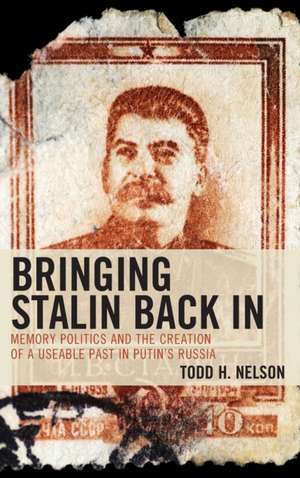
Bringing Stalin Back In
Autor Todd H Nelsonen Limba Engleză Hardback – 16 oct 2019
Preț: 666.29 lei
Preț vechi: 783.87 lei
-15%
Puncte Express: 999
Carte tipărită la comandă
Livrare economică 21 noiembrie-05 decembrie
Livrare prin curier în România Termenul estimat este afișat lângă disponibilitate.
Transport gratuit pentru acest produs Plată online sau ramburs, în funcție de opțiunile comenzii.
Retur gratuit în 14 zile Comandă securizată și suport în română.
Specificații
ISBN-13: 9781498591522
ISBN-10: 1498591523
Pagini: 182
Dimensiuni: 157 x 235 x 15 mm
Greutate: 0.42 kg
Editura: Bloomsbury Publishing
Locul publicării:New York, United States
ISBN-10: 1498591523
Pagini: 182
Dimensiuni: 157 x 235 x 15 mm
Greutate: 0.42 kg
Editura: Bloomsbury Publishing
Locul publicării:New York, United States
Cuprins
Chapter 1: Introduction: The Long Shadow of Stalin
Chapter 2: Russian 'Soft Memory' Part I: Crafting the Stalinist Narrative in Russian Society-at-Large
Chapter 3: Russian 'Soft Memory' Part II: The Education Sphere and the Presentation of Stalinism
Chapter 4: 'Hard' Memory: Comparing Memorialization of the Great Patriotic War and the Stalinist Repressions
Chapter 5: Bringing It All Together: Complex Co-Optation, Civil Society, and Access to Discourse on the Soviet Period
Chapter 6: Conclusion: Ghosts of the Past in the Russian Present
Chapter 2: Russian 'Soft Memory' Part I: Crafting the Stalinist Narrative in Russian Society-at-Large
Chapter 3: Russian 'Soft Memory' Part II: The Education Sphere and the Presentation of Stalinism
Chapter 4: 'Hard' Memory: Comparing Memorialization of the Great Patriotic War and the Stalinist Repressions
Chapter 5: Bringing It All Together: Complex Co-Optation, Civil Society, and Access to Discourse on the Soviet Period
Chapter 6: Conclusion: Ghosts of the Past in the Russian Present
Recenzii
Nelson has produced a well written and documented account of Stalin's rehabilitation in post-Soviet Russia. This work has an extensive bibliography. It would be of interest to scholars interested in the construction of historical memory in Russia and also, more broadly, to readers with a general interest in post-Soviet Russian affairs.
Bringing Stalin Back In will be most useful to students because of its well-written syntheses of English-language scholarship on memory politics in Russia. Nelson's prose is accessible, and he mixes in personal encounters and writes in detail of his visits to a range of far-flung memorial sites.
In coming to this conclusion, the book effectively overturns its initial premise of a gap between words and deeds, having demonstrated that what Russians (and Russian leaders) say matters in a very important way. Readers interested in learning how Russian public discourse shapes Russian collective memory and Russian public life will find this study a useful primer.
"Under the Soviet regime, Russians liked to joke that theirs was the only country with an unpredictable past. In this insightful, well-researched work, Todd Nelson shows how Vladimir Putin has modernized Soviet techniques to tighten his grip on the politics of memory in today's Russia. "
"In Russia, Stalin is the focal point of the memory; and memory is the central issue of contemporary politics. Moreover, conversations about Stalin in Russia are at the same time discussions about Russia's present and future. In this book Todd H. Nelson provides the reader with a deep analysis of that main controversy, demonstrates the difficult crossings of the memories of war victory and memories of terror, and suggests a framework for the future study of Russia's dealing with its past."
"Joseph Stalin's long reign as the leader of the Soviet Union was marked by violent terror and repression that caused the deaths of millions, and though he has been dead for nearly 70 years, his malevolent shadow still looms large over Russia. Far too often, Russian President Vladimir Putin has associated Stalin with images of Russian glory, while glossing over the Stalinist terror. In this important book, Todd Nelson makes excellent use of discourse analysis to examine how various types of official texts in Russia have shaped official and public memories of Stalin through a process of complex co-optation. Bringing Stalin Back In is crucial for those who want to understand why millions of Russians nowadays, including many whose relatives were murdered by Stalin's security apparatus, tell public opinion pollsters that Stalin was one of the 'greatest leaders' in Russia's history."
"Taking readers on a gripping journey from GULAG memorial sites through contemporary history textbooks, Todd Nelson lays bare the myriad ways in which the Russian government under Putin has whitewashed the Stalin era in an effort to legitimize its own increasingly authoritarian rule."
Bringing Stalin Back In will be most useful to students because of its well-written syntheses of English-language scholarship on memory politics in Russia. Nelson's prose is accessible, and he mixes in personal encounters and writes in detail of his visits to a range of far-flung memorial sites.
In coming to this conclusion, the book effectively overturns its initial premise of a gap between words and deeds, having demonstrated that what Russians (and Russian leaders) say matters in a very important way. Readers interested in learning how Russian public discourse shapes Russian collective memory and Russian public life will find this study a useful primer.
"Under the Soviet regime, Russians liked to joke that theirs was the only country with an unpredictable past. In this insightful, well-researched work, Todd Nelson shows how Vladimir Putin has modernized Soviet techniques to tighten his grip on the politics of memory in today's Russia. "
"In Russia, Stalin is the focal point of the memory; and memory is the central issue of contemporary politics. Moreover, conversations about Stalin in Russia are at the same time discussions about Russia's present and future. In this book Todd H. Nelson provides the reader with a deep analysis of that main controversy, demonstrates the difficult crossings of the memories of war victory and memories of terror, and suggests a framework for the future study of Russia's dealing with its past."
"Joseph Stalin's long reign as the leader of the Soviet Union was marked by violent terror and repression that caused the deaths of millions, and though he has been dead for nearly 70 years, his malevolent shadow still looms large over Russia. Far too often, Russian President Vladimir Putin has associated Stalin with images of Russian glory, while glossing over the Stalinist terror. In this important book, Todd Nelson makes excellent use of discourse analysis to examine how various types of official texts in Russia have shaped official and public memories of Stalin through a process of complex co-optation. Bringing Stalin Back In is crucial for those who want to understand why millions of Russians nowadays, including many whose relatives were murdered by Stalin's security apparatus, tell public opinion pollsters that Stalin was one of the 'greatest leaders' in Russia's history."
"Taking readers on a gripping journey from GULAG memorial sites through contemporary history textbooks, Todd Nelson lays bare the myriad ways in which the Russian government under Putin has whitewashed the Stalin era in an effort to legitimize its own increasingly authoritarian rule."