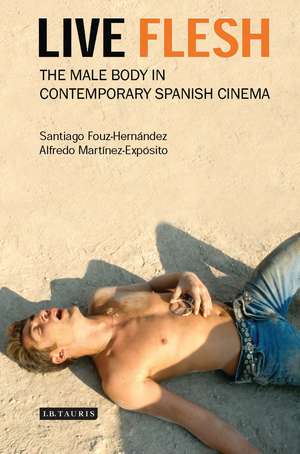
Live Flesh: The Male Body in Contemporary Spanish Cinema
Autor Santiago Fouz-Hernández, Alfredo Martinez-Expositoen Limba Engleză Hardback – 26 iun 2007
Preț: 856.51 lei
Preț vechi: 1071.49 lei
-20%
Puncte Express: 1285
Carte disponibilă
Livrare economică 10-24 noiembrie
Livrare prin curier în România Termenul estimat este afișat lângă disponibilitate.
Transport gratuit pentru acest produs Plată online sau ramburs, în funcție de opțiunile comenzii.
Retur gratuit în 14 zile Comandă securizată și suport în română.
Specificații
ISBN-13: 9781845114497
ISBN-10: 1845114493
Pagini: 288
Ilustrații: 16 integrated halftones
Dimensiuni: 156 x 234 x 27 mm
Greutate: 0.56 kg
Editura: Bloomsbury Publishing
Colecția I.B.Tauris
Locul publicării:London, United Kingdom
ISBN-10: 1845114493
Pagini: 288
Ilustrații: 16 integrated halftones
Dimensiuni: 156 x 234 x 27 mm
Greutate: 0.56 kg
Editura: Bloomsbury Publishing
Colecția I.B.Tauris
Locul publicării:London, United Kingdom
V-ar putea interesa
-
 What the Hell is He Thinking?Zoe StrimpelPreț: 115.57 lei
 -
 Men and Masculinities Around the WorldE. RuspiniPreț: 405.27 lei
 -
 Masculinities, Care and EqualityN. HanlonPreț: 383.94 lei
 -
 Representing MasculinityS. DudinkPreț: 400.69 lei
 -
 -18%Preț: 1365.08 lei1664.73 lei
 -
 The Male BrainLouann Brizendine-19%Preț: 64.20 lei79.02 lei
 -
 Why Men Hate Going to ChurchDavid MurrowPreț: 109.69 lei
 -
 What is Masculinity?J. Arnold-18%Preț: 702.66 lei856.91 lei
 -
 Masculinities in Polish, Czech and Slovak CinemaEwa MazierskaPreț: 161.86 lei
 -
 Maskulinitas: Culture, Gender & Politics in IndonesiaMarshall Clark-18%Preț: 133.80 lei162.42 lei
Notă biografică
The Authors Santiago Fouz-Hernandez teaches Spanish and Film Studies at the University of Durham. His publications include, as co-editor with Freya Jarman, Madonna's Drowned Worlds. Alfredo Martinez-Exposito is Reader in Spanish, University of Queensland. His books include, as editor, Gay and Lesbian Writing in the Hispanic World.
Cuprins
?CONTENTS IntroductionCHAPTER 1: Stereotypical BodiesCHAPTER 2: Young Bodies CHAPTER 3: Muscular Bodies CHAPTER 4: (Dis)abled bodies CHAPTER 5: Homosexual bodiesCHAPTER 6: Transformed BodiesCHAPTER 7: Foreign BodiesCHAPTER 8: The Genitals FilmographyBibliographyIndex
Descriere
Descriere de la o altă ediție sau format:
In post-Franco Spain, a re-shaping of notions of the masculine has been under way for some time. The authors of "Live Flesh" demonstrate how contemporary Spanish films, during this modern period, have contributed to this process. They do so by visualizing the ways in which Spanish men have been abandoning old self images and adopting new ones, and they explain and explore the complexity and diversity of these fresh cinematic creations of masculine identities. The book's point of focus is Spanish films of the democratic period, both popular and auteur, made by directors of national and international prominence, such as Pedro Almodovar, Alejandro Amenabar, Bigas Luna or Julio Medem, as well as films featuring acclaimed actors who have contributed to the construction of contemporary ideas of the masculine in their country, including Antonio Banderas and Javier Bardem.
Using a fresh theoretical framework, embracing queer and feminist theory and concepts of nation, race and class, each chapter examines key films that represent the male body, highlighting notable elements - young, muscular, homosexual, (dis)abled, foreign and so on - and goes on to focus on recent case studies from the early 1990s to the present. An increasingly transnational Spanish cinema is a most promising field in which to explore questions of how male bodies are represented - and mediated - in film. "Live Flesh" more than fulfils this promise and goes further, to reveal how these representations have intervened in the Spanish cultural imagination.
In post-Franco Spain, a re-shaping of notions of the masculine has been under way for some time. The authors of "Live Flesh" demonstrate how contemporary Spanish films, during this modern period, have contributed to this process. They do so by visualizing the ways in which Spanish men have been abandoning old self images and adopting new ones, and they explain and explore the complexity and diversity of these fresh cinematic creations of masculine identities. The book's point of focus is Spanish films of the democratic period, both popular and auteur, made by directors of national and international prominence, such as Pedro Almodovar, Alejandro Amenabar, Bigas Luna or Julio Medem, as well as films featuring acclaimed actors who have contributed to the construction of contemporary ideas of the masculine in their country, including Antonio Banderas and Javier Bardem.
Using a fresh theoretical framework, embracing queer and feminist theory and concepts of nation, race and class, each chapter examines key films that represent the male body, highlighting notable elements - young, muscular, homosexual, (dis)abled, foreign and so on - and goes on to focus on recent case studies from the early 1990s to the present. An increasingly transnational Spanish cinema is a most promising field in which to explore questions of how male bodies are represented - and mediated - in film. "Live Flesh" more than fulfils this promise and goes further, to reveal how these representations have intervened in the Spanish cultural imagination.