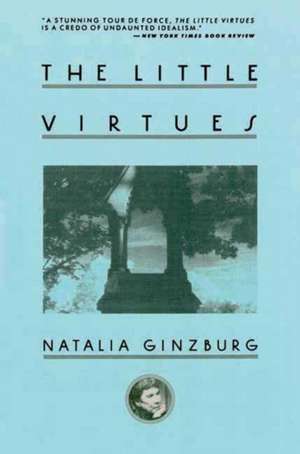
Little Virtues
Autor Natalia Ginzburg Traducere de Dick Davisen Limba Engleză Paperback – aug 2013
Motivația Nataliei Ginzburg pentru a scrie aceste eseuri rezidă în dorința de a distila sensul dintr-o existență marcată de traumele istoriei și de rigorile exilului. Găsim în această carte o încercare profund personală de a redefini valorile pe care le transmitem generațiilor viitoare. Reținem pledoaria ei neașteptată: copiii nu trebuie învățați prudența, ci curajul; nu tactul, ci dragostea de adevăr. Este o perspectivă care transformă rolul de părinte și de cetățean într-o formă de rezistență morală. Ca și A Place To Live de Natalia Ginzburg, această colecție transformă documentele memoriei și fragmentele de viață cotidiană într-o narațiune coerentă despre identitate. Dacă în alte lucrări precum The Road to the City, Ginzburg explora dorința de evadare din mediul rural prin ochii unei tinere, în „The Little Virtues” ea revine asupra perioadei petrecute în Abruzzi cu maturitatea celui care a înțeles că adevărata libertate este interioară. Tonul este intim, aproape șoptit, dar de o claritate tăioasă. Stilul său, descris adesea ca fiind „cioplit în piatră”, reușește să confere unei perechi de pantofi vechi sau unei reflecții despre tăcere greutatea unei revelații filozofice. Comparativ cu Values, Virtues, and Vices, Italian Style de Raymond Angelo Belliotti, care analizează virtuțile italiene printr-o lentilă istorică largă, opera lui Ginzburg rămâne ancorată în domestic și în experiența imediată. Ea nu teoretizează etica, ci o trăiește printre amintirile despre Cesare Pavese sau despre dificultățile de după război. Merită menționat că această lucrare reprezintă chintesența filozofiei sale de viață, legând temele recurente din The City and the House — familia, izolarea și comunicarea — de o structură eseistică de o rară forță poetică.
Preț: 72.96 lei
Carte disponibilă
Livrare economică 02-16 noiembrie
Specificații
ISBN-10: 1611457971
Pagini: 110
Dimensiuni: 136 x 208 x 10 mm
Greutate: 0.14 kg
Editura: Arcade Publishing
V-ar putea interesa
-
 The Road to CharacterDavid Brooks-31%Preț: 64.81 lei93.30 lei
 -
 Great Italian StoriesJhumpa Lahiri-21%Preț: 61.28 lei77.10 lei
 -
 Enigma of ReasonDan Sperber-30%Preț: 65.76 lei94.01 lei
 -
 The Sneetches and Other StoriesDr. SeussPreț: 114.35 lei
 -
 MeditationsMarcus AureliusPreț: 33.99 lei
 -
 The Solitude of Prime NumbersPaolo Giordano-19%Preț: 64.05 lei78.95 lei
 -
 Mystery and MannersFlannery O'ConnorPreț: 92.84 lei
 -
 Dear Mr. YouMary -Louise ParkerPreț: 90.61 lei
 -
 The Montessori MethodMaria MontessoriPreț: 68.36 lei
 -
 The ProphetKahlil GibranPreț: 27.21 lei
 -
 A Place To Live: And Other Selected EssaysNatalia Ginzburg-20%Preț: 79.84 lei99.25 lei
 -
 Preț: 166.08 lei
 -
 Anarchy Explained to ChildrenJose Antonio Emmanuel-21%Preț: 72.84 lei91.81 lei
 -
 Family and BorghesiaNatalia Ginzburg-21%Preț: 87.89 lei111.19 lei
 -
 In the MarginsElena FerrantePreț: 98.61 lei
 -
 Family LexiconNatalia-GinzburgPreț: 86.48 lei
 -
 Happiness, As SuchNatalia GinzburgPreț: 71.68 lei
 -
 The Road to the CityNatalia GinzburgPreț: 63.11 lei
 -
 All Our YesterdaysNatalia GinzburgPreț: 94.76 lei
 -
 Family and BorghesiNatalia GinzburgPreț: 71.77 lei
 -
 Preț: 194.43 lei
De ce să citești această carte
Recomandăm această carte cititorilor care caută o voce onestă și lucidă asupra condiției umane. Veți câștiga o nouă perspectivă asupra educației și a valorilor care contează cu adevărat în momente de criză. Este o lectură esențială pentru cei care apreciază literatura italiană de după război și vor să descopere cum simplitatea stilistică poate ascunde o profunzime emoțională copleșitoare.
Despre autor
Natalia Ginzburg (1916–1991) a fost o figură centrală a literaturii italiene din secolul XX, recunoscută pentru modul în care a împletit viața de familie cu analiza politică a anilor fasciști. Activistă și ulterior membră a Parlamentului italian, Ginzburg a scris romane, piese de teatru și eseuri care i-au adus prestigioasele premii Strega și Bagutta. Opera sa, marcată de pierderea primului soț în închisorile fasciste, reflectă o luptă constantă pentru adevăr și claritate morală, fiind tradusă și apreciată la nivel internațional pentru onestitatea sa radicală.
Descriere scurtă
“A glowing light of modern Italian literature . . . Ginzburg’s magic is the utter simplicity of her prose, suddenly illuminated by one word that makes a lightning streak of a plain phrase. . . . As direct and clean as if it were carved in stone, it yet speaks thoughts of the heart.” —The New York Times Book Review