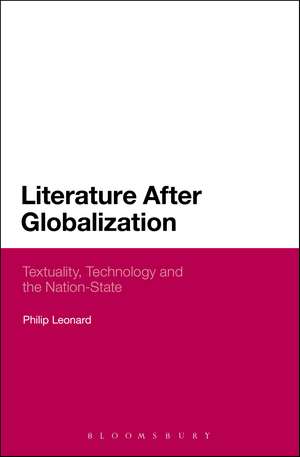
Literature After Globalization: Textuality, Technology and the Nation-State
Autor Dr Philip Leonarden Limba Engleză Hardback – 17 ian 2013
Literature after Globalization offers a detailed study of recent literary and theoretical responses to technology, globalization, and national identity. Focusing on texts of the the 1990s and 2000s, particularly novels and other writing by Mark Danielewski, Hari Kunzru, Indra Sinha, and Neal Stephenson, it charts a departure from narratives of globalization which declare the collapse of national cultures, and it considers how national sovereignty has been reinvented and reasserted in the face of technology's transnational effects. Drawing upon recent theoretical responses to technology and culture (including work by Yochai Benkler, Manuel Castells, Gilles Deleuze, Jacques Derrida, N. Katherine Hayles, Paul Virilio, and McKenzie Wark) this book will explore how, in these novels, the notion of an inclusive globalization has been replaced by a sense of national globalism.
Preț: 835.40 lei
Preț vechi: 1337.25 lei
-38%
Puncte Express: 1253
Carte tipărită la comandă
Livrare economică 04-18 decembrie
Livrare prin curier în România Termenul estimat este afișat lângă disponibilitate.
Transport gratuit pentru acest produs Plată online sau ramburs, în funcție de opțiunile comenzii.
Retur gratuit în 14 zile Comandă securizată și suport în română.
Specificații
ISBN-13: 9781441190710
ISBN-10: 1441190716
Pagini: 208
Dimensiuni: 154 x 236 x 18 mm
Greutate: 0.5 kg
Ediția:New.
Editura: Bloomsbury Publishing
Colecția Bloomsbury Academic
Locul publicării:London, United Kingdom
ISBN-10: 1441190716
Pagini: 208
Dimensiuni: 154 x 236 x 18 mm
Greutate: 0.5 kg
Ediția:New.
Editura: Bloomsbury Publishing
Colecția Bloomsbury Academic
Locul publicării:London, United Kingdom
V-ar putea interesa
-
 Hotel BemelmansLudwig Bemelmans-42%Preț: 81.46 lei141.64 lei
 -
 The Real Life of Anthony BurgessAndrew Biswell-23%Preț: 101.31 lei131.27 lei
 -
 F. Scott FitzgeraldA. HookPreț: 396.50 lei
 -
 Ted HughesTed HughesPreț: 69.59 lei
 -
 Twentieth-Century Scottish PoetryDouglas DunnPreț: 159.36 lei
 -
 Diaries, 1942-1954James Lees-Milne-25%Preț: 82.94 lei109.86 lei
 -
 Contemporary British FictionNick Bentley-11%Preț: 162.99 lei183.62 lei
 -
 Literature of the 1980s: After the WatershedJoseph Brooker-16%Preț: 179.43 lei212.61 lei
 -
 Harbors and High SeasDean KingPreț: 157.88 lei
 -
 Gay Rebel of the Harlem RenaissanceRichard Bruce NugentPreț: 164.16 lei
 -
 The Aesthetics of Resistance, Volume IPeter WeissPreț: 168.07 lei
 -
 -34%Preț: 86.31 lei131.14 lei
 -
 -25%Preț: 276.77 lei368.86 lei
 -
 -16%Preț: 276.49 lei328.74 lei
 -
 Preț: 130.91 lei
Cuprins
Acknowledgments \ 1 The ends of man: electronic frontiers in an age of global community \ 2 A space without geography, a nation without borders: The Cybergypsies and the literature of being-in-common \ 3 Teach phenomenology the bomb: Starship Troopers, the technologized body, and humanitarian warfare \ 4 'Secure, anonymous, unregulated': Cryptonomicon and the transnational data haven \ 5 'A revolution in
code'? Transmission and the Cultural Politics of Hacking \ 6 'Without return. Without place': rewriting the book and the nation in Only Revolutions \ Bibliography
code'? Transmission and the Cultural Politics of Hacking \ 6 'Without return. Without place': rewriting the book and the nation in Only Revolutions \ Bibliography
Recenzii
Elegant, challenging and ambitious, Leonard's Literature after Globalization reads contemporary fiction in terms that ask broad questions about citizenship and national identity in the context of the messy fluidity and flux of our networked world. In the process, he generate a range of important insights into the nature of readership, identity and statehood at the start of the 21st century.
Literature After Globalization is no doubt a thought-provoking study.
Lenoard (Nottingham Trent Univ., UK) offers six chapters on five novels of globalization. He writes on Anglo-Indian Indra Sinha's The Cyber Gypsies (1999), a barely fictional memoir of the emergence of early multi-participant online communities. He explores Cryptonimicon (1999), one of the best works of the talented Neal Stephenson, in which the encryption of vast amounts of data is an active theme. Leonard offers perspicacious readings of the Anglo-India Hari Kunzru's compelling Transimssion (2004), which has a hacker as its protagonist, and of Mark Danielewski's Only Revolutions (2006), arguably not a novel but rather a multi-stranded 360-page meditation on open-ended contrsuctions of self from fragments of existing culture. A suggestive reading of the film Starship Troopers (1997), based on Robert Heinlein's 1959 book of the same title, is also offered. Leonard's cumulative representation of interfaces between contemporary literature and the digital doain is even more valuable than these find readings, as are his rapid yet learned and subtle comments on the work of major theorists. This is a rare achievement in the field of literature and globalization, a definite advance on even such competent works as James Annesley's Fictions of Globalization (2006) and Suman Gupta's Globalization and Literature (CH, Oct'09, 47-0689). Summing Up: Essential. Lower-division undergraduates through faculty.
Literature After Globalization is no doubt a thought-provoking study.
Lenoard (Nottingham Trent Univ., UK) offers six chapters on five novels of globalization. He writes on Anglo-Indian Indra Sinha's The Cyber Gypsies (1999), a barely fictional memoir of the emergence of early multi-participant online communities. He explores Cryptonimicon (1999), one of the best works of the talented Neal Stephenson, in which the encryption of vast amounts of data is an active theme. Leonard offers perspicacious readings of the Anglo-India Hari Kunzru's compelling Transimssion (2004), which has a hacker as its protagonist, and of Mark Danielewski's Only Revolutions (2006), arguably not a novel but rather a multi-stranded 360-page meditation on open-ended contrsuctions of self from fragments of existing culture. A suggestive reading of the film Starship Troopers (1997), based on Robert Heinlein's 1959 book of the same title, is also offered. Leonard's cumulative representation of interfaces between contemporary literature and the digital doain is even more valuable than these find readings, as are his rapid yet learned and subtle comments on the work of major theorists. This is a rare achievement in the field of literature and globalization, a definite advance on even such competent works as James Annesley's Fictions of Globalization (2006) and Suman Gupta's Globalization and Literature (CH, Oct'09, 47-0689). Summing Up: Essential. Lower-division undergraduates through faculty.