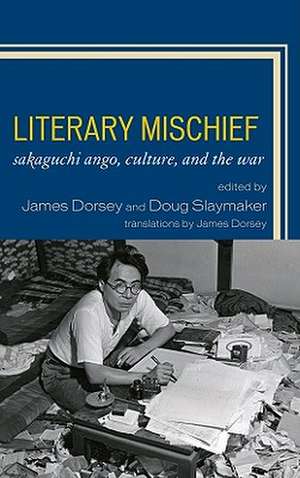
Literary Mischief: Sakaguchi Ango, Culture, and the War: New Studies in Modern Japan
Autor James Dorsey, Douglas Slaymaker Contribuţii de Ogino Anna, Karatani Kojin, Doug Slaymaker, Robert Steenen Limba Engleză Hardback – 30 apr 2010
Din seria New Studies in Modern Japan
- 23%
 Preț: 296.31 lei
 - 18%
 Preț: 343.22 lei
 - 22%
 Preț: 309.02 lei
 - 22%
 Preț: 308.25 lei
 - 22%
 Preț: 327.86 lei
 - 34%
 Preț: 565.37 lei
 - 34%
 Preț: 626.66 lei
 - 22%
 Preț: 344.70 lei
 - 34%
 Preț: 645.58 lei
 - 27%
 Preț: 248.28 lei
 -
 Preț: 341.77 lei
 - 22%
 Preț: 363.77 lei
 - 26%
 Preț: 256.34 lei
 - 34%
 Preț: 554.20 lei
 - 26%
 Preț: 247.84 lei
 - 25%
 Preț: 210.56 lei
 - 27%
 Preț: 242.27 lei
 - 25%
 Preț: 211.24 lei
 - 22%
 Preț: 308.16 lei
 - 34%
 Preț: 523.56 lei
 - 26%
 Preț: 258.24 lei
 - 26%
 Preț: 271.66 lei
 - 34%
 Preț: 501.08 lei
 - 22%
 Preț: 346.04 lei
 - 25%
 Preț: 209.55 lei
 - 24%
 Preț: 211.52 lei
Preț: 565.37 lei
Preț vechi: 854.71 lei
-34%
Puncte Express: 848
Preț estimativ în valută:
100.09€ • 116.55$ • 86.95£
100.09€ • 116.55$ • 86.95£
Carte tipărită la comandă
Livrare economică 23 februarie-09 martie
Preluare comenzi: 021 569.72.76
Specificații
ISBN-13: 9780739138663
ISBN-10: 0739138669
Pagini: 201
Dimensiuni: 166 x 239 x 19 mm
Greutate: 0.48 kg
Editura: Bloomsbury Publishing
Colecția Lexington Books
Seria New Studies in Modern Japan
Locul publicării:New York, United States
ISBN-10: 0739138669
Pagini: 201
Dimensiuni: 166 x 239 x 19 mm
Greutate: 0.48 kg
Editura: Bloomsbury Publishing
Colecția Lexington Books
Seria New Studies in Modern Japan
Locul publicării:New York, United States
V-ar putea interesa
-
 Ways Of EscapeGraham Greene-32%Preț: 59.83 lei88.59 lei
 -
 Bruce ChatwinNicholas ShakespearePreț: 84.68 lei
 -
 Preț: 107.39 lei
 -
 Gathering EvidenceThomas Bernhard-32%Preț: 61.03 lei89.31 lei
 -
 Rory & ItaRoddy DoylePreț: 115.28 lei
 -
 Kafka: A Very Short IntroductionRitchie Robertson-22%Preț: 52.64 lei67.44 lei
 -
 -12%Preț: 326.66 lei369.53 lei
 -
 SlipstreamElizabeth Jane Howard-34%Preț: 60.31 lei90.71 lei
 -
 Preț: 55.17 lei
 -
 This Boy's LifeTobias Wolff-29%Preț: 71.60 lei101.30 lei
 -
 Preț: 117.22 lei
 -
 Ramsey Campbell: Critical Essays on the Modern Master of HorrorGary William Crawford-34%Preț: 642.58 lei973.46 lei
Cuprins
Part 1 Essays
Chapter 2 1 Introduction: The Scribbler and the Sage
Chapter 3 2 The Irrational Will to Reason: The Praxis of Sakaguchi Ango
Chapter 4 3 Paradox at Play: Ango as Japanese Humanist
Chapter 5 4 Kataru koto nashi: A Brief Tour of Ango's Native Place
Chapter 6 5 Sakaguchi Ango's Individual Cult(ure)
Chapter 7 6 The Art of War: Sakaguchi Ango's "Pearls" and the Nature of Literary Resistance
Part 8 Translations
9 7 A Personal View of Japanese Culture (Nihon bunka shikan, 1942)
10 8 Pearls (Shinju, 1942)
11 9 Discourse on Decadence (Darakuron, 1946)
12 10 Discourse on Decadence, Part II (Zoku darakuron, 1946)
Chapter 2 1 Introduction: The Scribbler and the Sage
Chapter 3 2 The Irrational Will to Reason: The Praxis of Sakaguchi Ango
Chapter 4 3 Paradox at Play: Ango as Japanese Humanist
Chapter 5 4 Kataru koto nashi: A Brief Tour of Ango's Native Place
Chapter 6 5 Sakaguchi Ango's Individual Cult(ure)
Chapter 7 6 The Art of War: Sakaguchi Ango's "Pearls" and the Nature of Literary Resistance
Part 8 Translations
9 7 A Personal View of Japanese Culture (Nihon bunka shikan, 1942)
10 8 Pearls (Shinju, 1942)
11 9 Discourse on Decadence (Darakuron, 1946)
12 10 Discourse on Decadence, Part II (Zoku darakuron, 1946)
Recenzii
With its critical insights and deft translations, Literary Mischief provides a much-needed introduction to the works of Sakaguchi Ango, the most important anti-canonical author of canonical importance whose literary endeavors helped to shift the trajectory of postwar Japanese thought.
Sakaguchi Ango's insights on humanity, war, and culture have the power to move us as never before. Rising phoenix-like and irascible from the ashes of postwar Japan, Sakaguchi peeled back the shiny layers of pre-war ideology, revealing an enduring vision of the folk. With fine translations by James Dorsey and a selection of illuminating essays, Sakaguchi is riveting.
This volume explores the historical moment and literary genius of a member of the Japanese literati who is little known in the West. Part 1 comprises five judicious essays and an introduction, in which Dorsey explicates the several representative writings by Ango (1906-55) presented in translation in part 2. Ango's penchant for iconoclasm and irreverence for things "traditional" is revealed in his "Discourse on Decadence" (1946), which earned him his literary reputation in postwar Japan. An unflinchingly honest cultural critic, Ango remained independent of political ideology throughout a historical period noted for its severe upheavals. A joyous iconoclast with an insatiable appetite for life and a fondness for farcical extremes, Ango sometimes blurred the boundaries of genre with his writing, which defies categorization in any Japanese literary school. He was considered a buraiha, "libertine," by default, and his life and works are distinguished by rebellion (against form and convention) and passion; he believed literature represented the entire human experience. This excellent book is a welcome addition to Japanese literary criticism. Highly recommended.
Easily one of the more fascinating writers of the twentieth century, Sakaguchi Ango refuses easy categorization. Unconventional, rebellious, and transgressive, he challenges tacit assumptions about 'Japanese-ness,' genre, and aesthetics. In Literary Mischief: Sakaguchi Ango, Culture, and the War Slaymaker and Dorsey give us an Ango dokuhon or 'reader' that aptly captures the author's complexities and brilliance. With essays from Karatani Kôjin, Ogino Anna, and others, and finely-honed translations from Ango's eclectic oeuvre, Literary Mischief explores the often poignant interactions between a luminous literary mind and the broader discourses that informed this pivotal point in Japanese history.
Homing in on the author's deliberate juxtaposition of individual and cultural identity formation
Because they successfully made the case for reconsideration of Ango's oeuvre, one hopes the editors will continue with this endeavor in their ongoing research
Ango's predilection for inverting or dismantling a series of binary oppositions hitherto viewed as inviolable that leaps off the pages
In a carefully constructed thesis, James Dorsey goes to the heart of the debate on literary complicity
Dorsey's close reading of "Shinju," read as it is through the prism of Ango's hallmark "Daraku-ron," is indeed refreshing-as is his conclusion that, for all the conflicting interpretations of the work, "all is not lost."
What we have here, in short, is a long-awaited "Ango reader," a collection that will be of interest to a wide range of Japan hands and one that provides plenty of scope and ideas for further investigation
Sakaguchi Ango's insights on humanity, war, and culture have the power to move us as never before. Rising phoenix-like and irascible from the ashes of postwar Japan, Sakaguchi peeled back the shiny layers of pre-war ideology, revealing an enduring vision of the folk. With fine translations by James Dorsey and a selection of illuminating essays, Sakaguchi is riveting.
This volume explores the historical moment and literary genius of a member of the Japanese literati who is little known in the West. Part 1 comprises five judicious essays and an introduction, in which Dorsey explicates the several representative writings by Ango (1906-55) presented in translation in part 2. Ango's penchant for iconoclasm and irreverence for things "traditional" is revealed in his "Discourse on Decadence" (1946), which earned him his literary reputation in postwar Japan. An unflinchingly honest cultural critic, Ango remained independent of political ideology throughout a historical period noted for its severe upheavals. A joyous iconoclast with an insatiable appetite for life and a fondness for farcical extremes, Ango sometimes blurred the boundaries of genre with his writing, which defies categorization in any Japanese literary school. He was considered a buraiha, "libertine," by default, and his life and works are distinguished by rebellion (against form and convention) and passion; he believed literature represented the entire human experience. This excellent book is a welcome addition to Japanese literary criticism. Highly recommended.
Easily one of the more fascinating writers of the twentieth century, Sakaguchi Ango refuses easy categorization. Unconventional, rebellious, and transgressive, he challenges tacit assumptions about 'Japanese-ness,' genre, and aesthetics. In Literary Mischief: Sakaguchi Ango, Culture, and the War Slaymaker and Dorsey give us an Ango dokuhon or 'reader' that aptly captures the author's complexities and brilliance. With essays from Karatani Kôjin, Ogino Anna, and others, and finely-honed translations from Ango's eclectic oeuvre, Literary Mischief explores the often poignant interactions between a luminous literary mind and the broader discourses that informed this pivotal point in Japanese history.
Homing in on the author's deliberate juxtaposition of individual and cultural identity formation
Because they successfully made the case for reconsideration of Ango's oeuvre, one hopes the editors will continue with this endeavor in their ongoing research
Ango's predilection for inverting or dismantling a series of binary oppositions hitherto viewed as inviolable that leaps off the pages
In a carefully constructed thesis, James Dorsey goes to the heart of the debate on literary complicity
Dorsey's close reading of "Shinju," read as it is through the prism of Ango's hallmark "Daraku-ron," is indeed refreshing-as is his conclusion that, for all the conflicting interpretations of the work, "all is not lost."
What we have here, in short, is a long-awaited "Ango reader," a collection that will be of interest to a wide range of Japan hands and one that provides plenty of scope and ideas for further investigation