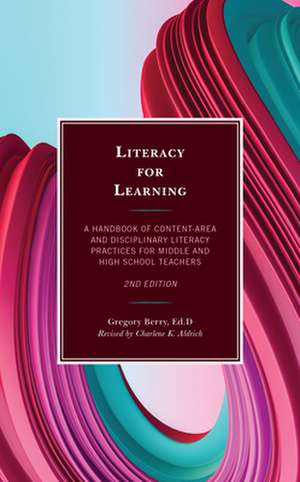
Literacy for Learning: A Handbook of Content-Area and Disciplinary Literacy Practices for Middle and High School Teachers
Autor Gregory Berry, Ed.D Charlene K. Aldrichen Limba Engleză Paperback – 8 dec 2021
Literacy for Learning: A Handbook of Content-Area and Disciplinary Literacy Practices for Middle and High School Teachers, 2nd edition, enables readers to discover how content area teachers are now using a literacy model of instruction to maximize learning in every discipline and meet the Reading Informational Text Standards of the Common Core. As a handbook, this book motivates middle and high school teachers to include daily, independent reading and writing as literacy instructional practices for teaching disciplinary content through a rigorous curriculum and with complex texts. The updates to this 2nd edition include more recent scholarship, as well as a new digital component featuring resources and strategies.
Preț: 325.61 lei
Preț vechi: 404.91 lei
-20%
Puncte Express: 488
Carte tipărită la comandă
Livrare economică 02-16 decembrie
Livrare prin curier în România Termenul estimat este afișat lângă disponibilitate.
Transport gratuit de la 400.00 lei Plată online sau ramburs, în funcție de opțiunile comenzii.
Retur gratuit în 14 zile Comandă securizată și suport în română.
Specificații
ISBN-13: 9781475861594
ISBN-10: 1475861591
Pagini: 122
Ilustrații: 11 b/w illustrations; 1 table; 57 textboxes
Dimensiuni: 148 x 226 x 10 mm
Greutate: 0.19 kg
Ediția:2nd Edition
Editura: Bloomsbury Publishing
Colecția Rowman & Littlefield
Locul publicării:New York, United States
ISBN-10: 1475861591
Pagini: 122
Ilustrații: 11 b/w illustrations; 1 table; 57 textboxes
Dimensiuni: 148 x 226 x 10 mm
Greutate: 0.19 kg
Ediția:2nd Edition
Editura: Bloomsbury Publishing
Colecția Rowman & Littlefield
Locul publicării:New York, United States
Cuprins
Preface
Acknowledgments
Introduction
Part I: Overview of Literacy Expectations in Middle and High School
Chapter 1. Nothing Happens in a Vacuum
Improved Academic Performance?
What Happened?
What is the Literacy Expectation in Middle and High School?
How Do Teachers Meet These Expectations?
Part II: Becoming College and Career Ready
Who Are These Freshmen?
Key Shifts Called for by the Common Core
Chapter 2. Strategic Reading and Writing
What Is Strategic Reading and Writing?
What Does Strategic Reading and Writing Look Like in a Classroom?
Strategic Readers and Writers Are Effective Readers and Writers
Chapter 3. Content-Area Literacy
The Next Step
Developing Content-Area Literacy
Instructor Response
Beyond Deep Learning
Chapter 4. Disciplinary Literacy
Creating Discourse Communities
Intentional Disciplinary Literacy
So, What Does Disciplinary Literacy Look Like?
Part III: A Literacy Model of Instruction Using Informational Texts
Chapter 5. Reading Across the Disciplines
Informational Texts
Recursive Reading and Writing to Learn
A Process for Reading Informational Texts
Before Reading: Preparing to Read and Write
During Reading: Responding in Writing While Reading
After Reading: Reinforcing, Expanding, and Writing
Adapting and Customizing
From Content-Area Literacy to Disciplinary Literacy
More Than a Process for Reading
Chapter 6. Academic Language Across the Disciplines
The Significance of Vocabulary
Brain Development and Vocabulary
Effective Vocabulary Instruction
Chapter 7. Writing Across the Disciplines
What is Content-Area Writing?
The Reading-Writing Connection
Informal Writing versus Formal Writing
Empowered Teachers Empower Students
Improving Writing through Mentor Texts
Part IV: Using Technology to Support Content-Area and Disciplinary Literacy
Chapter 8. Standards, Tenets, and Best Practices
Technology Standards
Basic Tenets of Technology in Education
Reading, Thinking, and Composing Digitally
Chapter 9. Instructional Resources
Libraries/Media Centers/Computer Labs
Open-Access Resources
Dependable, Credible Resources
References
About the Author
Acknowledgments
Introduction
Part I: Overview of Literacy Expectations in Middle and High School
Chapter 1. Nothing Happens in a Vacuum
Improved Academic Performance?
What Happened?
What is the Literacy Expectation in Middle and High School?
How Do Teachers Meet These Expectations?
Part II: Becoming College and Career Ready
Who Are These Freshmen?
Key Shifts Called for by the Common Core
Chapter 2. Strategic Reading and Writing
What Is Strategic Reading and Writing?
What Does Strategic Reading and Writing Look Like in a Classroom?
Strategic Readers and Writers Are Effective Readers and Writers
Chapter 3. Content-Area Literacy
The Next Step
Developing Content-Area Literacy
Instructor Response
Beyond Deep Learning
Chapter 4. Disciplinary Literacy
Creating Discourse Communities
Intentional Disciplinary Literacy
So, What Does Disciplinary Literacy Look Like?
Part III: A Literacy Model of Instruction Using Informational Texts
Chapter 5. Reading Across the Disciplines
Informational Texts
Recursive Reading and Writing to Learn
A Process for Reading Informational Texts
Before Reading: Preparing to Read and Write
During Reading: Responding in Writing While Reading
After Reading: Reinforcing, Expanding, and Writing
Adapting and Customizing
From Content-Area Literacy to Disciplinary Literacy
More Than a Process for Reading
Chapter 6. Academic Language Across the Disciplines
The Significance of Vocabulary
Brain Development and Vocabulary
Effective Vocabulary Instruction
Chapter 7. Writing Across the Disciplines
What is Content-Area Writing?
The Reading-Writing Connection
Informal Writing versus Formal Writing
Empowered Teachers Empower Students
Improving Writing through Mentor Texts
Part IV: Using Technology to Support Content-Area and Disciplinary Literacy
Chapter 8. Standards, Tenets, and Best Practices
Technology Standards
Basic Tenets of Technology in Education
Reading, Thinking, and Composing Digitally
Chapter 9. Instructional Resources
Libraries/Media Centers/Computer Labs
Open-Access Resources
Dependable, Credible Resources
References
About the Author
Recenzii
It is with great enthusiasm and excitement that I welcome the revised edition of my 2013 book Literacy for Learning: A Handbook of Content-Area Strategies for Middle and High School Teachers. Charlene K. Aldrich's masterful and thoughtfully organized revision provides necessary, timely, and research-driven updates, including an approach that bridges content area and disciplinary literacy, adds more recent scholarship, and provides convenient new digital accessibility for the resources and strategies. This revised edition will enable today's teachers to carry out the original mission of the book: to empower teachers to "help adolescent learners with the complex cognitive processes of reading, writing and learning in all subject areas," and, as the new edition states, "to empower students as agents of their own learning." This new edition will be an invaluable resource for teachers in all disciplines for many years to come.
As a 32-year career educator in Early Childhood and literacy specialist, and knowing Charlene Aldrich for many years, I have read her book Literacy for Learning: A Handbook of Content-Area and Disciplinary Literacy Practices for Middle and High School Teachers, 2nd Edition, and fully endorse and support her commitment to growing literacy in the next generation of teachers and students. Her efforts to develop literacy-infused lesson plans combining informational text with literary text will truly enhance content-area learning.
Charlene Aldrich has been teaching content-area reading and writing courses to pre-service and in-service teachers for years. Based on her expertise, she saw a need to expand the initial nature of this book to more accurately explore content-area reading and writing practices and the interconnectedness and relationship with disciplinary literacy. As an educator, she believes in continued learning and growth, and strives to model this practice for her students and colleagues by constantly reading and researching to strengthen her knowledge and that of others, as well as publishing with literacy colleagues. She is truly passionate about collaborating with all teachers to know how to best support all learners.
Charlene Aldrich is an accomplished teacher of teachers, using practical strategies to help educators in all content areas become more fluent in incorporating literacy elements in their daily classroom practices. This text will be invaluable to teachers who want or need to infuse their instruction with proven literacy strategies.
As a 32-year career educator in Early Childhood and literacy specialist, and knowing Charlene Aldrich for many years, I have read her book Literacy for Learning: A Handbook of Content-Area and Disciplinary Literacy Practices for Middle and High School Teachers, 2nd Edition, and fully endorse and support her commitment to growing literacy in the next generation of teachers and students. Her efforts to develop literacy-infused lesson plans combining informational text with literary text will truly enhance content-area learning.
Charlene Aldrich has been teaching content-area reading and writing courses to pre-service and in-service teachers for years. Based on her expertise, she saw a need to expand the initial nature of this book to more accurately explore content-area reading and writing practices and the interconnectedness and relationship with disciplinary literacy. As an educator, she believes in continued learning and growth, and strives to model this practice for her students and colleagues by constantly reading and researching to strengthen her knowledge and that of others, as well as publishing with literacy colleagues. She is truly passionate about collaborating with all teachers to know how to best support all learners.
Charlene Aldrich is an accomplished teacher of teachers, using practical strategies to help educators in all content areas become more fluent in incorporating literacy elements in their daily classroom practices. This text will be invaluable to teachers who want or need to infuse their instruction with proven literacy strategies.