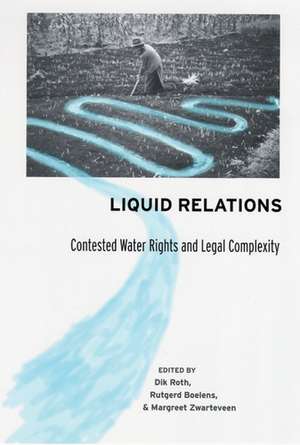
Liquid Relations: Contested Water Rights and Legal Complexity
Autor Dik Roth, Rutgerd Boelens, Margreet Zwarteveenen Limba Engleză Paperback – 21 noi 2005
Water management plays an increasingly critical role in national and international policy agendas. Growing scarcity, overuse, and pollution, combined with burgeoning demand, have made socio-political and economic conflicts almost unavoidable. Proposals to address water shortages are usually based on two key assumptions: (1) water is a commodity that can be bought and sold and (2) “states,” or other centralized entities, should control access to water.
Liquid Relations criticizes these assumptions from a socio-legal perspective. Eleven case studies examine laws, distribution, and irrigation in regions around the world, including the United States, Nepal, Indonesia, Chile, Ecuador, India, and South Africa. In each case, problems are shown to be both ecological and human-made. The essays also consider the ways that gender, ethnicity, and class differences influence water rights and control.
In the concluding chapter, the editors draw on the essays’ findings to offer an alternative approach to water rights and water governance issues. By showing how issues like water scarcity and competition are embedded in specific resource use and management histories, this volume highlights the need for analyses and solutions that are context-specific rather than universal.
Liquid Relations criticizes these assumptions from a socio-legal perspective. Eleven case studies examine laws, distribution, and irrigation in regions around the world, including the United States, Nepal, Indonesia, Chile, Ecuador, India, and South Africa. In each case, problems are shown to be both ecological and human-made. The essays also consider the ways that gender, ethnicity, and class differences influence water rights and control.
In the concluding chapter, the editors draw on the essays’ findings to offer an alternative approach to water rights and water governance issues. By showing how issues like water scarcity and competition are embedded in specific resource use and management histories, this volume highlights the need for analyses and solutions that are context-specific rather than universal.
Preț: 362.75 lei
Nou
Puncte Express: 544
Preț estimativ în valută:
64.19€ • 75.27$ • 56.37£
64.19€ • 75.27$ • 56.37£
Carte tipărită la comandă
Livrare economică 11-25 februarie 26
Preluare comenzi: 021 569.72.76
Specificații
ISBN-13: 9780813536750
ISBN-10: 0813536758
Pagini: 328
Dimensiuni: 152 x 229 x 18 mm
Greutate: 0.51 kg
Ediția:None
Editura: Rutgers University Press
Colecția Rutgers University Press
ISBN-10: 0813536758
Pagini: 328
Dimensiuni: 152 x 229 x 18 mm
Greutate: 0.51 kg
Ediția:None
Editura: Rutgers University Press
Colecția Rutgers University Press
V-ar putea interesa
-
 Governing Knowledge CommonsBrett M. Frischmann-24%Preț: 391.54 lei513.12 lei
 -
 Environmental Law: A Very Short IntroductionElizabeth Fisher-22%Preț: 52.79 lei67.49 lei
 -
 EU Environmental Law and the Internal MarketNicolas de Sadeleer-33%Preț: 823.79 lei1234.95 lei
 -
 European Environmental LawSuzanne KingstonPreț: 435.74 lei
 -
 Environmental Law and Governance for the AnthropoceneProfessor Louis Kotzé-33%Preț: 620.16 lei931.68 lei
 -
 Better AirJessica Lincoln-Oswalt-31%Preț: 1441.43 lei2077.76 lei
 -
 Emissions Control in Electricity GenerationJackson L. Walker-31%Preț: 811.00 lei1168.37 lei
 -
 Climate ChangeBailey Summers-30%Preț: 362.02 lei514.01 lei
 -
 Wildfire Suppression: Federal Funding & SpendingNeal Jenkins-26%Preț: 997.01 lei1347.16 lei
 -
 Out of the Mainstream: Water Rights, Politics and IdentityRutgerd Boelens-18%Preț: 1022.85 lei1247.38 lei
 -
 Out of the Mainstream: Water Rights, Politics and IdentityRutgerd Boelens-15%Preț: 419.26 lei493.25 lei
 -
 -18%Preț: 1364.38 lei1663.88 lei
 -
 Culture, International Transactions and the AnthropoceneLourdes Arizpe SchlosserPreț: 376.55 lei
 -
 -13%Preț: 635.15 lei730.06 lei
Notă biografică
Dik Roth is a researcher and lecturer on legal anthropology, natural resources management, and development in the law and governance group of the department of social sciences at Wageningen University in the Netherlands. Rutgerd Boelens and Margreet Zwarteveen are researchers and lecturers on water rights, water management, and development policies in the department of environmental sciences, also at Wageningen University.
Recenzii
This book makes a significant contribution to our understanding of the global problem of increasing competition for fresh water by applying the insights of legal pluralism to the understudied issue of water rights.
Descriere
Water management plays an increasingly critical role in national and international policy agendas. Growing scarcity, overuse, and pollution, combined with burgeoning demand, have made socio-political and economic conflicts almost unavoidable. Proposals to address water shortages are usually based on two key assumptions: (1) water is a commodity that can be bought and sold and (2) “states,” or other centralized entities, should control access to water.
Liquid Relations criticizes these assumptions from a socio-legal perspective.
Liquid Relations criticizes these assumptions from a socio-legal perspective.