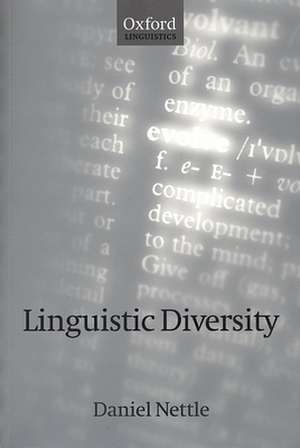
Linguistic Diversity
Autor Daniel Nettleen Limba Engleză Hardback – 6 mai 1999
Preț: 444.53 lei
Preț vechi: 635.43 lei
-30%
Puncte Express: 667
Carte tipărită la comandă
Livrare economică 27 noiembrie-08 decembrie
Livrare prin curier în România Termenul estimat este afișat lângă disponibilitate.
Transport gratuit pentru acest produs Plată online sau ramburs, în funcție de opțiunile comenzii.
Retur gratuit în 14 zile Comandă securizată și suport în română.
Specificații
ISBN-13: 9780198238584
ISBN-10: 0198238584
Pagini: 180
Ilustrații: numerous graphs
Dimensiuni: 161 x 242 x 15 mm
Greutate: 0.41 kg
Editura: OUP OXFORD
Colecția OUP Oxford
Locul publicării:Oxford, United Kingdom
ISBN-10: 0198238584
Pagini: 180
Ilustrații: numerous graphs
Dimensiuni: 161 x 242 x 15 mm
Greutate: 0.41 kg
Editura: OUP OXFORD
Colecția OUP Oxford
Locul publicării:Oxford, United Kingdom
V-ar putea interesa
-
 ProtoLaura SpinneyPreț: 123.57 lei
 -
 The Power of BabelJohn McWhorterPreț: 105.83 lei
 -
 Empires of the WordNicholas OstlerPreț: 136.63 lei
 -
 -16%Preț: 81.72 lei96.86 lei
 -
 The Unfolding of LanguageGuy Deutscher-18%Preț: 65.26 lei79.63 lei
 -
 Through the Language GlassGuy Deutscher-18%Preț: 66.07 lei80.15 lei
 -
 The Stories of EnglishDavid Crystal-27%Preț: 90.22 lei123.25 lei
 -
 -18%Preț: 94.55 lei115.81 lei
 -
 Multilingualism: A Very Short IntroductionJohn C. Maher-20%Preț: 57.15 lei71.12 lei
 -
 Languages: A Very Short IntroductionStephen Anderson-20%Preț: 56.62 lei70.82 lei
 -
 -15%Preț: 63.07 lei74.21 lei
 -
 A Little Book of LanguageDavid CrystalPreț: 85.95 lei
 -
 Words of WonderNicholas EvansPreț: 339.43 lei
 -
 The Origin of Language: How We Learned to Speak and WhyMadeleine Beekman-13%Preț: 105.91 lei122.43 leiRecomandat
 -
 Lingo: A Language Spotter's Guide to EuropeGaston Dorren-19%Preț: 69.69 lei86.03 lei
 -
 Babel: Around the World in Twenty LanguagesGaston Dorren-18%Preț: 71.72 lei87.22 lei
 -
 Languages Are Good for UsSophie Hardach-26%Preț: 53.11 lei71.43 lei
 -
 -17%Preț: 79.90 lei95.77 lei
 -
 The Last Lingua FrancaNicholas Ostler-19%Preț: 63.74 lei78.29 lei
 -
 Amorous or Loving?Rupert GavinPreț: 195.85 lei
Recenzii
This volume represents the synthesis of a bewildering amount of information and theory in numerous disciplines.
Nettle has produced a careful, thoughtful, and valuable study. He is to be commended for being unafraid to challenge the shibboleth that biological and linguistic diversity are wholly unrelated. He substantially adds to our knowledge of why languages have come to be distributed the way they are.
Nettle makes an important contribution to our understanding of reasons for the variation in the number of languages by correlating economic factors of subsistence with linguistic diversity.
A panopoly of possible microprocesses of language variation are explored painstakingly and with great ingenuity by the author ... This book is a mine of geolinguistic and sociolinguistic data, presented in a plain and captivating style.
His conclusions ... are eminently reasonable and manage to tie together a number of strands of thought in an original and creative way ... a valuable contribution to our understanding of how and why languages have changed over time.
Nettle has produced a careful, thoughtful, and valuable study. He is to be commended for being unafraid to challenge the shibboleth that biological and linguistic diversity are wholly unrelated. He substantially adds to our knowledge of why languages have come to be distributed the way they are.
Nettle makes an important contribution to our understanding of reasons for the variation in the number of languages by correlating economic factors of subsistence with linguistic diversity.
A panopoly of possible microprocesses of language variation are explored painstakingly and with great ingenuity by the author ... This book is a mine of geolinguistic and sociolinguistic data, presented in a plain and captivating style.
His conclusions ... are eminently reasonable and manage to tie together a number of strands of thought in an original and creative way ... a valuable contribution to our understanding of how and why languages have changed over time.