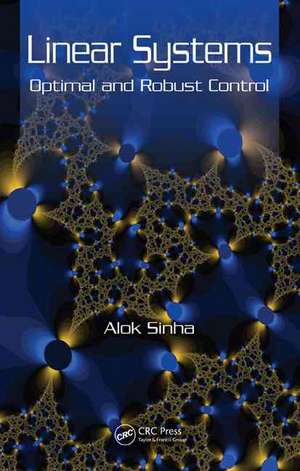
Linear Systems: Optimal and Robust Control
Autor Alok Sinhaen Limba Engleză Hardback – 31 ian 2007
By learning the theories and algorithms as well as exploring the examples in Linear Systems: Optimal and Robust Control, students will be able to better understand and ultimately better manage engineering processes and systems.
Preț: 1125.14 lei
Preț vechi: 1372.13 lei
-18%
Puncte Express: 1688
Carte tipărită la comandă
Livrare economică 08-22 decembrie
Livrare prin curier în România Termenul estimat este afișat lângă disponibilitate.
Transport gratuit pentru acest produs Plată online sau ramburs, în funcție de opțiunile comenzii.
Retur gratuit în 14 zile Comandă securizată și suport în română.
Specificații
ISBN-13: 9780849392177
ISBN-10: 0849392179
Pagini: 488
Ilustrații: 134 Illustrations, black and white
Dimensiuni: 156 x 234 x 31 mm
Greutate: 0.82 kg
Ediția:1
Editura: CRC Press
Colecția CRC Press
ISBN-10: 0849392179
Pagini: 488
Ilustrații: 134 Illustrations, black and white
Dimensiuni: 156 x 234 x 31 mm
Greutate: 0.82 kg
Ediția:1
Editura: CRC Press
Colecția CRC Press
V-ar putea interesa
-
 Signals and Systems Using MATLAB®Aydin Akan-31%Preț: 676.23 lei981.55 lei
 -
 Optimal Control TheoryDonald E. KirkPreț: 210.78 lei
 -
 -23%Preț: 175.25 lei227.99 lei
 -
 Linear System Theory: The State Space ApproachLofti A. ZadehPreț: 207.90 lei
 -
 Optimal Control and EstimationRobert F. Stengel-19%Preț: 214.50 lei264.50 lei
 -
 Understanding Process Dynamics and ControlCostas Kravaris-9%Preț: 835.70 lei918.35 lei
 -
 Linear Multivariable Control SystemsShankar P Bhattacharyya-11%Preț: 667.91 lei750.46 lei
 -
 -11%Preț: 676.58 lei760.19 lei
 -
 -11%Preț: 674.61 lei758.00 lei
 -
 Linear Parameter-Varying ControlOlivier Sename-23%Preț: 718.87 lei933.60 lei
 -
 Automatic Control with Interactive ToolsJosé Luis Guzmán-19%Preț: 546.26 lei674.40 lei
 -
 An Introduction to Optimal Control TheoryOnésimo Hernández-LermaPreț: 479.91 lei
 -
 Sliding-Mode Control and Variable-Structure SystemsTiago Roux Oliveira-18%Preț: 1457.64 lei1777.61 lei
 -
 Robust and Adaptive ControlEugene LavretskyPreț: 542.07 lei
 -
 Signals and Systems with MATLAB® and Simulink®Farzin AsadiPreț: 431.01 lei
 -
 Stabilizing and Optimizing Control for Time-Delay SystemsWook Hyun Kwon-15%Preț: 680.73 lei800.85 lei
Public țintă
UndergraduateCuprins
Introduction. State Space Description of a Linear System. State Feedback Control and Optimization. Control with Estimated States. Robust Control: Fundamental Concepts and, and Techniques. Robust Control: Sliding Mode Methods. Appendix A: Linear Algebraic Equations, Eigenvalues/Eigenvectors and Matrix Inversion Lemma. Appendix B: Quadratic Functions, Important Derivatives, Fourier Integrals and Parseval’s Relation. Appendix C: Norms, Singular Values, Supremum and Infinimum. Appendix D: Stochastic Processes. Appendix E: Optimization of a scalar function with constraints in the form of a symmetric real matrix equal to zero. Appendix F: Flexible Tetrahedral Truss Structure. Appendix G: Space Shuttle Dynamics during Reentry.
Descriere
Designed for graduate-level courses, this text explains the concepts behind linear systems, optimal control, and robust control and illustrates these concepts with concrete examples and problems. It includes H∞ and sliding mode methods together for the first time in book form. The author develops mathematical analyses, including the derivation of H∞, and highlights the use of MATLAB® software to solve practical problems via computer. The text contains end-of-chapter exercises so that readers can test their assimilation of the material.
A solutions manual is available with qualifying course adoption.
A solutions manual is available with qualifying course adoption.