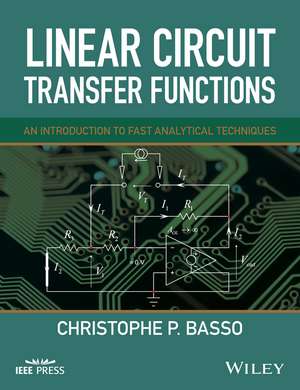
Linear Circuit Transfer Functions
Autor Christophe P. Bassoen Limba Engleză Hardback – 13 mai 2016
Recomandăm Linear Circuit Transfer Functions inginerilor practicieni și studenților avansați care doresc să depășească limitările analizei clasice de noduri și bucle. Autorul Christophe P. Basso propune o schimbare de paradigmă prin utilizarea tehnicii FACTs (Fast Analytical Circuits Techniques), o metodă care permite determinarea răspunsului în frecvență al circuitelor pasive și active fără a recurge la calcule algebrice laborioase. Suntem de părere că valoarea acestui volum rezidă în capacitatea de a transforma o sarcină matematică complexă într-un proces intuitiv, bazat pe observarea constantelor de timp în diferite configurații ale circuitului. Structura lucrării, publicată sub egida IEEE Press la editura John Wiley & Sons, Inc., ghidează cititorul de la exemple simple către circuite cu grad ridicat de complexitate. Dacă Fast Analytical Techniques for Electrical and Electronic Circuits de Vatché Vorpérian v-a oferit cadrul teoretic fundamental pentru aceste tehnici, lucrarea lui Basso vine să rafineze procesul, oferind instrumente practice pentru obținerea unor funcții de transfer cu „entropie scăzută” — expresii matematice compacte, gata de a fi interpretate fizic. În timp ce manuale precum Fundamentals of Modern Electric Circuit Analysis and Filter Synthesis se concentrează pe sinteza filtrelor prin metode tradiționale, acest volum pune accentul pe eficiența analizei prin inspecție. Un aspect tehnic esențial este includerea fișierelor Mathcad®, care permit verificarea imediată a modelelor teoretice. Stilul de scriere este unul pragmatic, orientat spre designul real, făcând din această carte un instrument indispensabil pentru cei care lucrează în electronică de putere sau procesarea semnalelor.
Preț: 641.89 lei
Preț vechi: 833.62 lei
-23%
Carte disponibilă
Livrare economică 11-25 noiembrie
Livrare express 27-31 octombrie pentru 46.60 lei
Specificații
ISBN-10: 1119236371
Pagini: 464
Dimensiuni: 177 x 251 x 30 mm
Greutate: 0.84 kg
Ediția:1
Editura: Wiley
Locul publicării:Chichester, United Kingdom
V-ar putea interesa
-
 Programmable Microcontrollers with ApplicationsCem Unsalan-15%Preț: 540.46 lei635.83 lei
 -
 -9%Preț: 948.08 lei1041.85 lei
 -
 MathCAD for Electrical Engineers and TechnologistsStephen Philip TubbsPreț: 272.94 lei
 -
 -9%Preț: 799.52 lei878.60 lei
 -
 -9%Preț: 775.50 lei852.20 lei
 -
 Foundations of Fuzzy ControlJan Jantzen-9%Preț: 726.84 lei798.72 lei
 -
 Fundamentals of Electric PowerCeraolo-9%Preț: 863.47 lei948.87 lei
 -
 Enhanced Phase-Locked Loop Structures for Power and Energy ApplicationsMasoud Karimi-Ghartemani-9%Preț: 772.02 lei848.37 lei
 -
 Color Appearance Models 3eMark D Fairchild-9%Preț: 868.28 lei954.14 lei
 -
 Digital Electronics: A Practical Approach with VHDLWilliam Kleitz-13%Preț: 581.68 lei668.61 lei
 -
 Signals and Systems Using MathCADMR Volvick DeRosePreț: 276.35 lei
 -
 Beyond-CMOS Nanodevices 1Francis Balestra-9%Preț: 1239.34 lei1361.90 lei
 -
 Genetic Algorithms for Low Power Logic Optimization and SynthesisSaurabh Chaudhury-8%Preț: 461.28 lei501.40 lei
 -
 Preț: 196.71 lei
Public țintă
Primary: Practicing engineers. Secondary: BSEE and MSEE students in circuit theory.De ce să citești această carte
Această carte se adresează inginerilor care vor să își accelereze fluxul de proiectare. Cititorul câștigă abilitatea de a deduce funcții de transfer complexe aproape prin simplă inspecție, reducând erorile algebrice. Este un manual practic care transformă teoria circuitelor într-un instrument de diagnoză rapidă, esențial pentru optimizarea răspunsului în frecvență în aplicații reale de inginerie electronică.
Descriere
Notă biografică
Christophe Basso holds a BSEE equivalent from Montpellier University (France) and an MSEE from the Institut National Polytechnique of Toulouse. He has over 20 years of power supply industry experience. His recent research interests focus on developing new offline PWM controller specifications. On top of his 3 published books on Switch mode power supplies, Basso also has 30 patents on power conversion and has authored numerous conference papers and trade magazines.
Cuprins
Acknowledgement xiii
1 Electrical Analysis - Terminology and Theorems 1
1.1 Transfer Functions, an Informal Approach 1
1.1.1 Input and Output Ports 3
1.1.2 Different Types of Transfer Function 6
1.2 The Few Tools and Theorems You Did Not Forget . . . 11
1.2.1 The Voltage Divider 11
1.2.2 The Current Divider 12
1.2.3 Thévenin's Theorem at Work 14
1.2.4 Norton's Theorem at Work 19
1.3 What Should I Retain from this Chapter? 25
1.4 Appendix 1A - Finding Output Impedance/Resistance 26
1.5 Appendix 1B - Problems 37
Answers 39
2 Transfer Functions 41
2.1 Linear Systems 41
2.1.1 A Linear Time-invariant System 43
2.1.2 The Need for Linearization 43
2.2 Time Constants 44
2.2.1 Time Constant Involving an Inductor 47
2.3 Transfer Functions 49
2.3.1 Low-entropy Expressions 54
2.3.2 Higher Order Expressions 59
2.3.3 Second-order Polynomial Forms 60
2.3.4 Low-Q Approximation for a 2nd-order Polynomial 62
2.3.5 Approximation for a 3rd-order Polynomial 68
2.3.6 How to Determine the Order of the System? 69
2.3.7 Zeros in the Network 76
2.4 First Step Towards a Generalized 1st-order Transfer Function 78
2.4.1 Solving 1st-order Circuits with Ease, Three Examples 82
2.4.2 Obtaining the Zero with the Null Double Injection 89
2.4.3 Checking Zeros Obtained in Null Double Injection with SPICE 94
2.4.4 Network Excitation 95
2.5 What Should I Retain from this Chapter? 100
References 101
2.6 Appendix 2A - Problems 102
Answers 105
3 Superposition and the Extra Element Theorem 116
3.1 The Superposition Theorem 116
3.1.1 A Two-input/Two-output System 120
3.2 The Extra Element Theorem 126
3.2.1 The EET at Work on Simple Circuits 130
3.2.2 The EET at Work - Example 2 132
3.2.3 The EET at Work - Example 3 137
3.2.4 The EET at Work - Example 4 138
3.2.5 The EET at Work - Example 5 140
3.2.6 The EET at Work - Example 6 146
3.2.7 Inverted Pole and Zero Notation 150
3.3 A Generalized Transfer Function for 1st-order Systems 153
3.3.1 Generalized Transfer Function - Example 1 156
3.3.2 Generalized Transfer Function - Example 2 159
3.3.3 Generalized Transfer Function - Example 3 163
3.3.4 Generalized Transfer Function - Example 4 170
3.3.5 Generalized Transfer Function - Example 5 174
3.4 Further Reading 180
3.5 What Should I Retain from this Chapter? 180
References 182
3.6 Appendix 3A - Problems 183
Answers 185
References 218
4 Second-order Transfer Functions 219
4.1 Applying the Extra Element Theorem Twice 219
4.1.1 Low-entropy 2nd-order Expressions 227
4.1.2 Determining the Zero Positions 231
4.1.3 Rearranging and Plotting Expressions 233
4.1.4 Example 1 - A Low-Pass Filter 235
4.1.5 Example 2 - A Two-capacitor Filter 241
4.1.6 Example 3 - A Two-capacitor Band-stop Filter 245
4.1.7 Example 4 - An LC Notch Filter 248
4.2 A Generalized Transfer Function for 2nd-Order Systems 255
4.2.1 Inferring the Presence of Zeros in the Circuit 256
4.2.2 Generalized 2nd-order Transfer Function - Example 1 257
4.2.3 Generalized 2nd-order Transfer Function - Example 2 262
4.2.4 Generalized 2nd-order Transfer Function - Example 3 266
4.2.5 Generalized 2nd-order Transfer Function - Example 4 273
4.3 What Should I Retain from this Chapter ? 277
References 279
4.4 Appendix 4A - Problems 279
Answers 282
References 311
5 Nth-order Transfer Functions 312
5.1 From the 2EET to the NEET 312
5.1.1 3rd-order Transfer Function Example 317
5.1.2 Transfer Functions with Zeros 320
5.1.3 A Generalized Nth-order Transfer Function 327
5.2 Five High-order Transfer Functions Examples 335
5.2.1 Example 2: A 3rd-order Active Notch Circuit 341
5.2.2 Example 3: A 4th-order LC Passive Filter 349
5.2.3 Example 4: A 4th-order Band-pass Active Filter 355
5.2.4 Example 5: A 3rd-order Low-pass Active GIC Filter 368
5.3 What Should I Retain from this Chapter ? 383
References 385
5.5 Appendix 5A - Problems 385
Answers 388
References 431
Conclusion 433
Glossary of Terms 435
Index 439