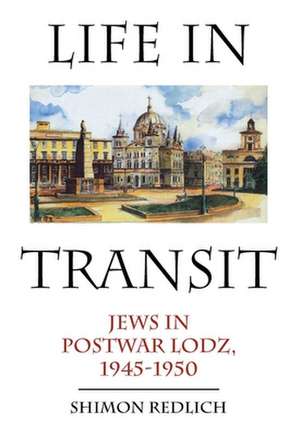
Life in Transit: Jews in Postwar Lodz, 1945-1950
Autor Shimon Redlichen Limba Engleză Hardback – feb 2011
Preț: 709.51 lei
Preț vechi: 875.95 lei
-19%
Puncte Express: 1064
Carte tipărită la comandă
Livrare economică 05-19 decembrie
Livrare prin curier în România Termenul estimat este afișat lângă disponibilitate.
Transport gratuit pentru acest produs Plată online sau ramburs, în funcție de opțiunile comenzii.
Retur gratuit în 14 zile Comandă securizată și suport în română.
Specificații
ISBN-13: 9781936235216
ISBN-10: 1936235218
Pagini: 282
Dimensiuni: 159 x 238 x 20 mm
Greutate: 0.56 kg
Ediția:New.
Editura: Academic Studies Press
Colecția Academic Studies Press
Locul publicării:Boston, MA, United States
ISBN-10: 1936235218
Pagini: 282
Dimensiuni: 159 x 238 x 20 mm
Greutate: 0.56 kg
Ediția:New.
Editura: Academic Studies Press
Colecția Academic Studies Press
Locul publicării:Boston, MA, United States
V-ar putea interesa
-
 -27%Preț: 80.73 lei109.89 lei
 -
 The Definition of Anti-SemitismKenneth L. Marcus-9%Preț: 352.25 lei388.99 lei
 -
 -24%Preț: 192.53 lei253.67 lei
 -
 Preț: 251.66 lei
 -
 Goodbye East EndDavid MerronPreț: 113.41 lei
 -
 Preț: 444.17 lei
 -
 -19%Preț: 454.27 lei560.83 lei
 -
 New DiasporaVictoria AaronsPreț: 315.32 lei
 -
 Will to FreedomEgon BalasPreț: 155.02 lei
 -
 Jews and Genes: The Genetic Future in Contemporary Jewish ThoughtRabbi Elliot N. DorffPreț: 333.42 lei
 -
 War, the Holocaust and StalinismShimon RedlichPreț: 507.95 lei
 -
 The Rag RaceAdam D MendelsohnPreț: 246.55 lei
 -
 Questions Jews AskMordecai M. Kaplan-38%Preț: 418.45 lei674.13 lei
 -
 The Greater Judaism in Making: A Study of Modern Evolution of JudaismMordecai M. Kaplan-24%Preț: 511.47 lei677.29 lei
 -
 -25%Preț: 647.57 lei863.76 lei
 -
 Personal Theology: Essays in Honor of Neil GillmanWilliam Plevan-25%Preț: 556.29 lei740.90 lei
 -
 -25%Preț: 557.69 lei741.81 lei
 -
 -25%Preț: 501.21 lei670.63 lei
 -
 -15%Preț: 644.10 lei757.76 lei
 -
 -26%Preț: 547.92 lei739.26 lei
Recenzii
"Focusing on the city of Lodz, but with a far wider span, this is one of the most impressive books on the Holocaust and its aftermath that I have read."
“This remarkable combination of memoir and history is a continuation of the prize-winning book Together and Apart in Brezany: Poles, Jews and Ukrainians, 1919-1945 (Bloomington, 2002), which described the author’s experiences as a boy before and during the Second World War. Life in Transit depicts his emigration with his family after the war to the largely undamaged town of Lódz, then the principal concentration of Jews in Poland. It provides a moving picture both of this community’s attempt to rebuild the shattered world of Polish Jewry and of the author’s own experiences as he came gradually to see that he has no future in Poland and thus decides to emigrate to Israel.”
“This book is both a moving personal account of childhood in the immediate aftermath of the Holocaust and a highly valuable account of Jewish life in Lodz in the early postwar years. Chronologically following in the footsteps of Redlich's extraordinary study of the town of Brzezany in Eastern Galicia during the German occupation, Life in Transit is filled with important insights into the identity of Jewish survivors, their varying wartime experiences and stories of survival, and, not least, the education of a new generation of child survivors, who in large part went on to build new lives for themselves across the globe. This book is certain to become essential reading for all those interested in life after genocide.”
"Life in Transit is an engaging and well-rounded narrative of interest to anyone who studies modern east European and east European Jewish social history, the Holocaust and its impact, and urban studies. By employing interviews and other personal accounts, Redlich is able to explore successfully the multiple dynamics and evolution of Jewish identity and values after the Holocaust. He pays constant attention to the differences in the prewar and wartime lived experiences and values of the Jews who lived in the city in the early postwar period, offering insight into the diverse and sometimes contradictory perceptions of what the city and life in it meant to them."
Life in Transit is populated by living, breathing people—rendered unfiltered by Redlich—who, in the shadow of the Holocaust, evinced a tremendous will to live. . . . [T]he distinctive contribution of Life in Transit is its emphasis, as shown through the lens of the remarkable Lodz Jewish community, on the vitality of the remaining remnant. Far from being dispirited, demoralized, or helpless, these Jews were protagonists both in their own survival during the Holocaust and in the rebirth of Jewry in its aftermath. In portraying this community—and, in so doing, revising the predominant historiographical reconstruction of postwar Polish Jewry—Redlich has produced a wondrous book.
“This remarkable combination of memoir and history is a continuation of the prize-winning book Together and Apart in Brezany: Poles, Jews and Ukrainians, 1919-1945 (Bloomington, 2002), which described the author’s experiences as a boy before and during the Second World War. Life in Transit depicts his emigration with his family after the war to the largely undamaged town of Lódz, then the principal concentration of Jews in Poland. It provides a moving picture both of this community’s attempt to rebuild the shattered world of Polish Jewry and of the author’s own experiences as he came gradually to see that he has no future in Poland and thus decides to emigrate to Israel.”
“This book is both a moving personal account of childhood in the immediate aftermath of the Holocaust and a highly valuable account of Jewish life in Lodz in the early postwar years. Chronologically following in the footsteps of Redlich's extraordinary study of the town of Brzezany in Eastern Galicia during the German occupation, Life in Transit is filled with important insights into the identity of Jewish survivors, their varying wartime experiences and stories of survival, and, not least, the education of a new generation of child survivors, who in large part went on to build new lives for themselves across the globe. This book is certain to become essential reading for all those interested in life after genocide.”
"Life in Transit is an engaging and well-rounded narrative of interest to anyone who studies modern east European and east European Jewish social history, the Holocaust and its impact, and urban studies. By employing interviews and other personal accounts, Redlich is able to explore successfully the multiple dynamics and evolution of Jewish identity and values after the Holocaust. He pays constant attention to the differences in the prewar and wartime lived experiences and values of the Jews who lived in the city in the early postwar period, offering insight into the diverse and sometimes contradictory perceptions of what the city and life in it meant to them."
Life in Transit is populated by living, breathing people—rendered unfiltered by Redlich—who, in the shadow of the Holocaust, evinced a tremendous will to live. . . . [T]he distinctive contribution of Life in Transit is its emphasis, as shown through the lens of the remarkable Lodz Jewish community, on the vitality of the remaining remnant. Far from being dispirited, demoralized, or helpless, these Jews were protagonists both in their own survival during the Holocaust and in the rebirth of Jewry in its aftermath. In portraying this community—and, in so doing, revising the predominant historiographical reconstruction of postwar Polish Jewry—Redlich has produced a wondrous book.