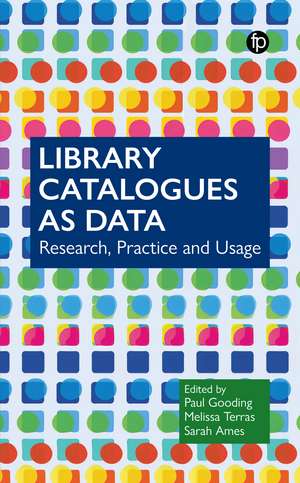
Library Catalogues as Data: Research, Practice and Usage
Editat de Paul Gooding, Melissa Terras, Sarah Amesen Limba Engleză Paperback – 29 iun 2025
Observăm în Library Catalogues as Data o schimbare de paradigmă esențială pentru biblioteconomia modernă: transformarea înregistrărilor de catalog din simple metadate administrative în seturi de date complexe pentru cercetare. Structura volumului este organizată metodologic pentru a ghida cititorul de la concepte teoretice la aplicații practice, fiind împărțită în patru secțiuni ce explorează pregătirea datelor, etica utilizării acestora, interoperabilitatea sistemelor și analiza critică a colecțiilor. Ne-a atras atenția rigoarea cu care este abordată tranziția de la fișierul de bibliotecă la ecosistemul digital, capitolul introductiv stabilind clar coordonatele acestui „ecosistem al datelor de catalog”.
Metodologia propusă de editori integrează tehnici avansate, precum procesarea limbajului natural (NLP) și lingvistica de corpus, pentru a identifica prejudecățile inerente în metadate. Această abordare extinde cadrul propus de Data Science for Librarians de Yunfei Du, aducând date noi din era inteligenței artificiale generative. În timp ce lucrarea lui Du se concentrează pe fundamentele științei datelor, volumul de față aplică aceste principii pe studii de caz concrete, cum ar fi utilizarea ChatGPT pentru bibliometrie sau transformarea cataloagelor din secolul al XIX-lea în resurse digitale procesabile.
În contextul operei editorului Paul Gooding, această lucrare reprezintă o evoluție firească. Dacă în Historic Newspapers in the Digital Age autorul analiza impactul digitizării presei scrise, aici extinde analiza asupra întregului sistem de gestiune a informației din instituțiile de cultură. Progresia capitolelor, de la vizualizarea colecțiilor colective la analiza „arvivelor întunecate” și a datelor istorice de împrumut, indică o acoperire exhaustivă a provocărilor actuale din sectorul GLAM, oferind soluții pentru cercetători și profesioniști deopotrivă.
Preț: 495.54 lei
Preț vechi: 611.78 lei
-19%
Carte disponibilă
Livrare economică 17 iunie-01 iulie
Livrare express 03-09 iunie pentru 30.30 lei
Specificații
ISBN-10: 1783306580
Pagini: 252
Dimensiuni: 156 x 234 x 13 mm
Greutate: 0.45 kg
Ediția:1
Editura: Facet Publishing
Colecția Facet Publishing
V-ar putea interesa
-
 BiblioTech: ReReading the Post-digital LibraryNathan Jones-28%Preț: 120.21 lei167.60 lei
 -
 The Data Hero PlaybookMalcolm HawkerPreț: 194.94 lei
 -
 The Organization of InformationDaniel N. Joudrey-26%Preț: 419.72 lei566.52 lei
 -
 -18%Preț: 383.06 lei466.44 lei
 -
 Public Data CulturesJonathan W. Y. GrayPreț: 139.59 lei
 -
 -18%Preț: 142.19 lei173.20 lei
 -
 Library Technical Services: Future ForwardMary Beth Weber-18%Preț: 162.91 lei198.81 lei
 -
 -19%Preț: 517.05 lei638.33 lei
 -
 Preț: 408.71 lei
 -
 -19%Preț: 454.58 lei561.20 lei
 -
 Fundamentals of Collection Development and ManagementPeggy Johnson-19%Preț: 579.83 lei715.84 lei
 -
 Preț: 509.98 lei
 -
 Preț: 98.08 lei
 -
 Librarianship: An IntroductionG. G. Chowdhury-19%Preț: 441.06 lei544.51 lei
 -
 Research Methods in InformationAlison Jane Pickard-19%Preț: 519.12 lei640.89 lei
 -
 -19%Preț: 576.76 lei712.04 lei
 -
 Collection Management BasicsG. Edward Evans-17%Preț: 388.14 lei469.51 lei
 -
 The Privacy Literacy Field GuideAlexandria Chisholm-11%Preț: 367.90 lei413.38 lei
 -
 Artificial Intelligence for LibrariesBrady D. Lund-19%Preț: 330.78 lei406.90 lei
Public țintă
Professional ReferenceDe ce să citești această carte
Recomandăm această carte profesioniștilor din biblioteci și arhive care doresc să valorifice potențialul ascuns al metadatelor. Cititorul câștigă o înțelegere profundă a modului în care AI și analiza de date pot revitaliza cataloagele tradiționale. Este un instrument esențial pentru a naviga între etica confidențialității și necesitatea de deschidere a datelor în contextul Open Science, oferind metode concrete de eliminare a erorilor de catalogare.
Despre autor
Paul Gooding este un cercetător recunoscut în domeniul patrimoniului digital, preocupat de impactul tehnologiilor emergente asupra instituțiilor culturale. Munca sa anterioară, precum Historic Newspapers in the Digital Age, a explorat modul în care digitizarea la scară largă schimbă accesul la istorie. Alături de Melissa Terras și Sarah Ames, acesta coordonează în prezent proiecte care intersectează biblioteconomia cu științele umaniste digitale. Expertiza lor colectivă oferă acestui volum o autoritate academică dublată de o înțelegere practică a sistemelor de management al bibliotecilor și a fluxurilor de lucru din mediul academic internațional.
Descriere scurtă
Separated into four sections, the book will discuss a range of topics surrounding library information and data, including:
- Practical routes to preparing library catalogue data for researchers
- The ethics of library metadata privacy and reuse
- Data interoperability across library systems
- Data and collections bias
- Library-vendor relationships and data licensing
- The practical and theoretical issues inherent in reimagining administrative, usage, and bibliographic data as a research resource
- Scholarship that responds to the possibilities of library data.
Cuprins
Notă biografică
Prof. Melissa Terras is the Professor of Digital Cultural Heritage at the University of Edinburgh's College of Arts, Humanities, and Social Sciences, leading digital aspects of CAHSS research as Director of the Edinburgh Centre for Data, Culture and Society, and is Director of Research in the Edinburgh Futures Institute. Gooding and Terras have collaborated on a previous edited volume, entitled Electronic Legal Deposit: Shaping the Library Collections of the Future.
Dr. Sarah Ames is Digital Scholarship Librarian at the National Library of Scotland, with responsibility for the Library's Digital Scholarship Service and Data Foundry. She is a member of the LIBER DH Working Group core group, where she co-chairs the Research Collaborations group, RLUK Digital Scholarship Network, and the Alan Turing Institute Humanities and Data Science group. Sarah has a PhD in English Literature from the University of Edinburgh; her PhD thesis was shortlisted for the Saltire Literary Awards 2013. Alongside this, she has postgraduate qualifications in Library and Information Science and in Data Science.