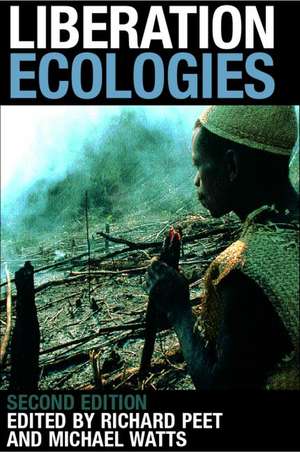
Liberation Ecologies: Environment, Development and Social Movements
Editat de Richard Peet, Michael Wattsen Limba Engleză Paperback – 8 apr 2004
Preț: 630.10 lei
Preț vechi: 741.30 lei
-15%
Carte tipărită la comandă
Livrare economică 04-18 decembrie
Specificații
ISBN-10: 0415312361
Pagini: 464
Ilustrații: 15 black & white tables, 12 black & white line drawings
Dimensiuni: 156 x 234 x 26 mm
Greutate: 0.86 kg
Ediția:Revizuită
Editura: Taylor & Francis
Colecția Routledge
Locul publicării:Oxford, United Kingdom
V-ar putea interesa
-
 -15%Preț: 163.38 lei193.05 lei
 -
 Preț: 190.71 lei
 -
 Preț: 408.25 lei
 -
 Adaptive GovernanceRonald BrunnerPreț: 331.66 lei
 -
 Modernity and TechnologyThomas J. MisaPreț: 282.36 lei
 -
 Nature and Society: Anthropological PerspectivesPhilippe Descola-15%Preț: 425.17 lei500.20 lei
 -
 Navigating Social-Ecological SystemsFikret BerkesPreț: 464.80 lei
 -
 Biodiversity, Sustainability and Human CommunitiesTimothy O'RiordanPreț: 303.00 lei
 -
 Preț: 174.19 lei
 -
 Networks of PowerThomas Parker HughesPreț: 443.93 lei
 -
 Preț: 265.53 lei
 -
 -37%Preț: 207.47 lei329.56 lei
 -
 A History of Environmentalism: Local Struggles, Global HistoriesDr Marco Armiero-14%Preț: 236.99 lei274.38 lei
 -
 Law and Politics of the DanubeStephen GorovePreț: 370.05 lei
Public țintă
Postgraduate, Professional, and UndergraduateCuprins
Part 1: Renewing Political Ecology Part 2: Discourse and Practice Part 3: Institutions and Governance Part 4: Conflict and Struggle Part 5: Movement
Notă biografică
Descriere
At the beginning of the 21st century, the environment and the future of development continue to be issues of crucial importance. Most explanations of environmental crisis emphasize the role of population growth, thus focusing their attention on the poor. By comparison, Liberation Ecologies elaborates a political-economic explanation drawing from the most recent advances in social theory. The new edition has been extensively revised to reflect recent changes in debates over the real definitions of 'development' and 'environment', and contains nine completely new chapters.