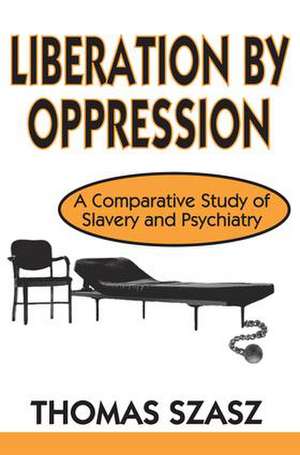
Liberation by Oppression: A Comparative Study of Slavery and Psychiatry
Autor Thomas Szaszen Limba Engleză Paperback – 31 aug 2003
The advent of private psychotherapy, at the end of the nineteenth century, split psychiatry in two: some patients continued to be the involuntary inmates of state hospitals; others became the voluntary patients of privately practicing psychotherapists. Psychotherapy was officially defined as a type of medical treatment, but actually was a secular-medical version of the cure of souls. Relationships between therapist and patient, Thomas Szasz argues, was based on cooperation and contract, as is relationships between employer and employee, or, between clergyman and parishioner. Psychotherapy, its emblem the therapist's office, was a part of the private sphere, the contract.
Through most of the twentieth century, psychiatry was a house divided-half-slave, and half-free. During the past few decades, psychiatry became united again: all relations between psychiatrists and patients, regardless of the nature of the interaction between them, are now based on actual or potential coercion. This situation is the result of two major "reforms" that deprive therapist and patient alike of the freedom to contract with one another: Therapists now have a double duty: they must protect all mental patients-involuntary and voluntary, hospitalized or outpatient, incompetent or competent-from themselves. They must also protect the public from all patients.
Persons designated as mental patients may be exempted from responsibility for the deleterious consequences of their own behavior if it is attributed to mental illness. The radical differences between the coercive character of mental hospital practices in the public sphere, and the consensual character of psychotherapeutic practices in the private sphere, are thus destroyed. At the same time, as the scope of psychiatric coercion expands from the mental hospital to the psychiatrist's office, its reach extends into every part of society, from early childhood to old age.
Preț: 478.32 lei
Puncte Express: 717
Carte tipărită la comandă
Livrare economică 30 noiembrie-14 decembrie
Livrare prin curier în România Termenul estimat este afișat lângă disponibilitate.
Transport gratuit pentru acest produs Plată online sau ramburs, în funcție de opțiunile comenzii.
Retur gratuit în 14 zile Comandă securizată și suport în română.
Specificații
ISBN-13: 9780765805409
ISBN-10: 0765805405
Pagini: 252
Dimensiuni: 152 x 229 x 18 mm
Greutate: 0.47 kg
Ediția:1
Editura: Taylor & Francis
Colecția Routledge
Locul publicării:Oxford, United Kingdom
ISBN-10: 0765805405
Pagini: 252
Dimensiuni: 152 x 229 x 18 mm
Greutate: 0.47 kg
Ediția:1
Editura: Taylor & Francis
Colecția Routledge
Locul publicării:Oxford, United Kingdom
V-ar putea interesa
-
 -23%Preț: 590.58 lei766.98 lei
 -
 Foundations of Behavioral TherapyDonald Levis-15%Preț: 420.47 lei494.67 lei
 -
 The Pacific War: Japan versus the AlliesAlan Levine-30%Preț: 471.98 lei674.08 lei
 -
 The Poet's Voice in the Making of MindRussell Meares-5%Preț: 339.32 lei357.18 lei
 -
 -18%Preț: 1114.82 lei1359.54 lei
 -
 Rewriting the Self: Psychotherapy and MidrashMordechai RotenbergPreț: 472.27 lei
 -
 Therapeutic Culture: Triumph and DefeatDonileen Loseke-8%Preț: 436.17 lei474.10 lei
 -
 The Child's Conception of Physical CausalityJean PiagetPreț: 478.57 lei
 -
 Healing Symbols in Psychotherapy: A Ritual ApproachErik D. GoodwynPreț: 367.33 lei
 -
 -18%Preț: 1348.19 lei1644.14 lei
 -
 Coercion as Cure: A Critical History of PsychiatryThomas Szasz-18%Preț: 1121.09 lei1367.19 lei
 -
 -15%Preț: 426.04 lei501.22 lei
 -
 Art Therapy, Trauma, and NeuroscienceJuliet L King-5%Preț: 381.12 lei401.18 lei
 -
 -5%Preț: 398.70 lei419.68 lei
 -
 Cultural Theory and Psychoanalytic TraditionDavid FisherPreț: 464.26 lei
 -
 Preț: 481.23 lei
 -
 Preț: 462.25 lei
 -
 Preț: 458.47 lei
 -
 The Freudians: A Comparative PerspectiveEdith KurzweilPreț: 471.04 lei
 -
 Living Your Own Life: Existential Analysis in ActionSilvia Laengle-5%Preț: 304.91 lei320.96 lei
 -
 Breathing as a Tool for Self-Regulation and Self-ReflectionPaivi Lehtinen-5%Preț: 314.31 lei330.85 lei
 -
 Married Life and its Vicissitudes: A Therapeutic ApproachArturo Varchevker-5%Preț: 217.85 lei229.31 lei
Cuprins
Introduction: Perilous Rescues; 1: Psychiatric Slavery: Legal Fiction and the Rhetoric of Therapeutic Oppression; 2: The Psychiatric Slave Status: From Dred Scott to Tarasoff; 3: Psychiatric Slavery as Public Health: Infection and Insanity; 4: Justifying Psychiatric Slavery: “Dangerousness” as Disease; 5: Jim Crow Psychiatry I: The Psychiatric Will and Its Enemies; 6: Jim Crow Psychiatry II: The Patient Self-Determination Act; 7: Expanding Psychiatric Slavery: Outpatient Commitment; 8: Glorifying Psychiatric Slavery: Therapeutic Jurisprudence; 9: Epilogue: “Liberty is the Prevention of Control by Others” 1
Descriere
Originally called mad-doctoring, psychiatry began in the seventeenth century with the establishing of madhouses and the legal empowering of doctors to incarcerate persons denominated as insane