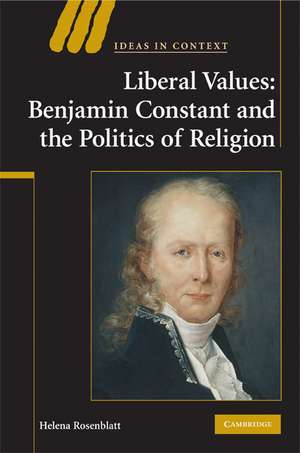
Liberal Values
Autor Helena Rosenblatten Limba Engleză Hardback – 29 apr 2016
Preț: 698.91 lei
Preț vechi: 785.29 lei
-11%
Puncte Express: 1048
Carte tipărită la comandă
Livrare economică 30 noiembrie-14 decembrie
Livrare prin curier în România Termenul estimat este afișat lângă disponibilitate.
Transport gratuit pentru acest produs Plată online sau ramburs, în funcție de opțiunile comenzii.
Retur gratuit în 14 zile Comandă securizată și suport în română.
Specificații
ISBN-13: 9780521898256
ISBN-10: 0521898250
Pagini: 300
Dimensiuni: 157 x 235 x 21 mm
Greutate: 0.59 kg
Ediția:New.
Editura: Cambridge University Press
Locul publicării:Cambridge, United Kingdom
ISBN-10: 0521898250
Pagini: 300
Dimensiuni: 157 x 235 x 21 mm
Greutate: 0.59 kg
Ediția:New.
Editura: Cambridge University Press
Locul publicării:Cambridge, United Kingdom
V-ar putea interesa
-
 1434Gavin MenziesPreț: 79.43 lei
 -
 Koba The DreadMartin Amis-19%Preț: 75.65 lei93.27 lei
 -
 EmergenceSteven Johnson-30%Preț: 65.17 lei93.50 lei
 -
 -16%Preț: 125.25 lei148.56 lei
 -
 -20%Preț: 83.71 lei105.03 lei
 -
 -21%Preț: 410.74 lei518.63 lei
 -
 Essays on the History of Moral PhilosophyJ. B. Schneewind-21%Preț: 374.95 lei477.54 lei
 -
 Dialogism: Bakhtin and His WorldMichael HolquistPreț: 272.59 lei
 -
 Moral Philosophy from Montaigne to KantJerome B. SchneewindPreț: 390.73 lei
 -
 Arabic Thought in the Liberal Age 1798-1939Albert HouraniPreț: 279.33 lei
 -
 The Foundations of Modern Political ThoughtQuentin SkinnerPreț: 206.54 lei
 -
 SenecaSenecaPreț: 369.30 lei
 -
 MarxKarl MarxPreț: 136.34 lei
 -
 The Taming of ChanceIan HackingPreț: 232.86 lei
 -
 The Cambridge Companion to Logical EmpiricismAlan RichardsonPreț: 291.06 lei
 -
 Ideas: A history from fire to FreudPeter Watson-20%Preț: 122.89 lei152.85 lei
Cuprins
Acknowledgments; Abbreviations; Introduction; Part I. Constant's Education: the French, Scottish, and German Enlightenments: 1. Childhood; 2. Edinburgh; 3. Paris; 4. Protestantism and the Enlightenment; 5. Brunswick; 6. Mauvillon, the new German theology and the idea of progressive revelation; 7. Constant's 'The Spirit of Religions'; 8. Madame de Staël; Part II. The Crucible of the Directory Years: 1. The see-saw policy of the directory; 2. Catholicism and the need for 'Republican Institutions'; 3. Catholic counter-arguments; 4. Constant during the Directory; 5. Critics of the Directory's Religious Policies; 6. The second Directory and the renewed campaign for Republican institutions; 7. Theophilanthropy; 8. Lessons of the Directory: William Godwin and Des circonstances actuelles; Part III. Napoleon, or Battling 'the New Cyrus': 1. Napoleon and the Catholic Revival; 2. Enlightened responses and the plan to 'Protestantize' France; 3. Charles de Villers; 4. Bonaparte's decision; 5. Portalis on the Utility of Religion; 6. The Concordat and the Organic Articles; 7. Friends and foes of the Concordat: from the Génie du christianisme to Delphine; 8. Constant's trip to Germany; 9. The Sentiment/Form Distinction; 10. Return to Paris (December 1804) and the Debate on a National Religion; Part IV. Constant becomes Constant: From the Principles of Politics (1806) to the Spirit of Conquest and Usurpation (1814): 1. Constant's Political Principles in 1806; 2. 'Private judgement' in Protestant Polemics; 3. Book VIII: On Religious Freedom; 4. Constant's 'Corner of Religion': from the 'Letter about Julie' to the Correspondence with Prosper de Barante, a. The 'Letter about Julie', b. Adolphe and Cecile, c. Correspondence with Prosper de Barante; 5. De l'Allemagne (1810); 6. Constant's return to Germany; 7. The spirit of conquest and usurpation (1814); Part V. Politics and Religion during the Restoration (1814–24): 1. Keeping Political Liberty Alive; 2. Keeping Religious Liberty Alive; Part VI. The 'Protestant Bossuet': De la religion in Political Context (1824–30): 1. De la religion, volume I (May 1824), Reviews of volume I; 2. Charles X and 'the invasion of priests', Constant's article 'Christianity', Professions of Protestantism; 3. De la religion, volume II (October 1825); 4. The Problem with Industrie: Constant and religion seen from the Left; 1. Saint-Simon's 'New Christianity' (1825); 2. Auguste Comte, Le Producteur, and the search for a new 'spiritual authority'; Part VII. Constant's Legacy: 1. The Revolution of 1830; 2. Constant's declining reputation.
Recenzii
Review of the hardback: '… a valuable addition to our knowledge of Constant's unfolding political concerns …' History of Political Thought
Descriere
Constant's intellectual development into a founding father of modern liberalism is examined through an analysis of his evolving religious philosophy.