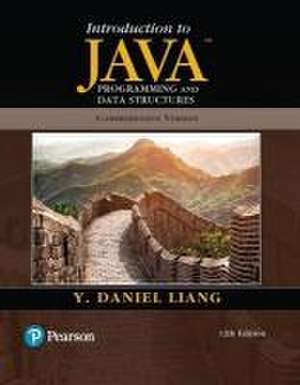
Liang, Y: Introduction to Java Programming and Data Structur
Autor Y. Daniel Liangen Limba Engleză Paperback – 4 dec 2019
Provocarea principală pentru orice viitor dezvoltator software nu este memorarea sintaxei, ci dezvoltarea unei gândiri algoritmice care să permită rezolvarea unor probleme tehnice complexe. În Liang, Y: Introduction to Java Programming and Data Structur, autorul Y. Daniel Liang propune o strategie pedagogică de tipul „bazele mai întâi”. Ne-a atras atenția modul în care volumul prioritizează structurile de control, metodele și tablourile ca fundament necesar înainte de a trece la paradigma programării orientate pe obiecte. Putem afirma că această ediție a 12-a, publicată de Pearson Education, este una dintre cele mai dense resurse didactice disponibile, oferind peste 1200 de pagini de conținut tehnic.
Merită menționat că textul nu se limitează la teorie, ci adoptă o abordare orientată spre rezolvarea de probleme practice din domenii variate, de la matematică și afaceri până la multimedia. Complementar volumului Starting Out with Java de Tony Gaddis, care oferă o introducere pas cu pas axată pe lizibilitatea codului, lucrarea lui Y. Daniel Liang merge mult mai în profunzime în zona structurilor de date avansate. În timp ce alte manuale se opresc la utilizarea colecțiilor standard, acest titlu ghidează cititorul prin procesul de proiectare și implementare a propriilor structuri pentru arbori și grafuri. Față de Core Java for the Impatient, care este un ghid rapid pentru noutățile limbajului, volumul de față este un curs complet ce acoperă inclusiv programarea bazelor de date, rețelistica și concurența, fiind ideal pentru formarea unei viziuni de ansamblu asupra ecosistemului Java.
Preț: 919.52 lei
Preț vechi: 1194.18 lei
-23%
Carte disponibilă
Livrare economică 03-17 noiembrie
Specificații
ISBN-10: 0136520235
Pagini: 1240
Dimensiuni: 201 x 251 x 43 mm
Greutate: 2.18 kg
Ediția:12th edition
Editura: Pearson Education
V-ar putea interesa
-
 Thinking in JavaBruce Eckel-20%Preț: 406.17 lei507.71 lei
 -
 -23%Preț: 837.79 lei1088.04 lei
 -
 -20%Preț: 223.44 lei279.31 lei
 -
 We, ProgrammersRobert Martin-20%Preț: 241.94 lei302.42 lei
 -
 Core Java for the ImpatientCay Horstmann-20%Preț: 364.02 lei455.03 lei
 -
 -23%Preț: 1124.30 lei1460.13 lei
 -
 Java for ProgrammersPaul Deitel-20%Preț: 350.53 lei438.16 lei
 -
 Absolute Beginner's Guide to AlgorithmsKirupa Chinnathambi-20%Preț: 202.22 lei252.78 lei
 -
 ProgrammingBjarne Stroustrup-20%Preț: 455.97 lei569.95 lei
 -
 -20%Preț: 588.01 lei735.01 lei
 -
 AlgorithmsRobert Sedgewick-20%Preț: 521.68 lei652.09 lei
 -
 Data Structures & Algorithms in Java 6e International Student VersionMichael H. Goldwasser-20%Preț: 475.89 lei594.86 lei
 -
 -20%Preț: 441.34 lei551.67 lei
 -
 C++ How to Program, Global EditionPaul Deitel-20%Preț: 496.44 lei620.55 lei
 -
 Objects First with JavaDavid Barnes-9%Preț: 489.49 lei537.89 lei
 -
 Real-World Java: Helping You Navigate the Java Eco systemJeanne Boyarsky-20%Preț: 320.06 lei400.08 lei
 -
 Java Essentials for DummiesDoug Lowe-20%Preț: 78.97 lei98.70 lei
 -
 Coding For Dummies, All New EditionPaul McFedries-20%Preț: 116.94 lei146.18 lei
 -
 Troubleshooting Java, Second EditionLaurentiu Spilca-20%Preț: 407.57 lei509.47 lei
 -
 .NET 10 RevealedKajetan Duszy¿ski-20%Preț: 240.60 lei300.75 lei
De ce să citești această carte
Recomandăm acest volum studenților și autodidacților care doresc o pregătire riguroasă în dezvoltarea software. Cititorul câștigă nu doar competențe de scriere a codului în Java, ci și o înțelegere profundă a eficienței algoritmilor prin implementarea practică a structurilor de date. Este resursa ideală pentru cei care vor să treacă de la nivelul de începător la cel de programator capabil să gestioneze proiecte complexe de backend și baze de date.