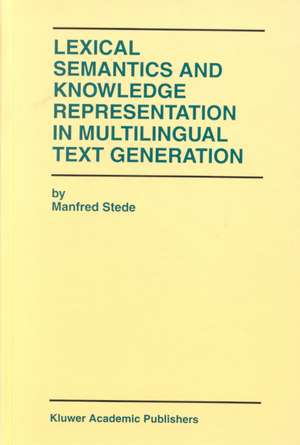
Lexical Semantics and Knowledge Representation in Multilingual Text Generation: The Springer International Series in Engineering and Computer Science, cartea 492
Autor Manfred Stedeen Limba Engleză Hardback – 31 ian 1999
Lexical Semantics and Knowledge Representation in Multilingual Text Generation develops the means for systematically deriving a set of paraphrases from the same underlying representation with the emphasis on events and verb meaning. Furthermore, the same mapping mechanism is used to achieve multilingual generation: English and German output are produced in parallel, on the basis of an adequate division between language-neutral and language-specific (lexical and grammatical) knowledge.
Lexical Semantics and Knowledge Representation in Multilingual Text Generation provides detailed insights into designing the representations and organizing the generation process. Readers with a background in artificial intelligence, cognitive science, knowledge representation, linguistics, or natural language processing will find a model of language production that can be adapted to a variety of purposes.
Din seria The Springer International Series in Engineering and Computer Science
- 18%
 Preț: 1263.85 lei
 - 18%
 Preț: 921.36 lei
 - 20%
 Preț: 633.65 lei
 - 20%
 Preț: 665.64 lei
 - 20%
 Preț: 662.69 lei
 - 24%
 Preț: 876.97 lei
 - 20%
 Preț: 663.58 lei
 - 20%
 Preț: 950.07 lei
 - 20%
 Preț: 665.12 lei
 - 18%
 Preț: 903.90 lei
 - 20%
 Preț: 950.72 lei
 - 18%
 Preț: 985.84 lei
 - 15%
 Preț: 621.23 lei
 - 18%
 Preț: 979.41 lei
 - 18%
 Preț: 907.54 lei
 - 18%
 Preț: 1173.85 lei
 - 15%
 Preț: 663.24 lei
 - 18%
 Preț: 976.26 lei
 - 18%
 Preț: 904.83 lei
 - 18%
 Preț: 904.83 lei
 - 20%
 Preț: 1325.05 lei
 - 20%
 Preț: 1725.82 lei
 - 20%
 Preț: 1326.15 lei
 - 20%
 Preț: 989.14 lei
 -
 Preț: 381.30 lei
 - 20%
 Preț: 635.71 lei
 - 18%
 Preț: 1193.58 lei
 - 20%
 Preț: 622.65 lei
 - 20%
 Preț: 1319.14 lei
 - 18%
 Preț: 974.15 lei
 - 20%
 Preț: 670.15 lei
 - 15%
 Preț: 664.58 lei
 - 18%
 Preț: 1179.97 lei
 - 15%
 Preț: 670.25 lei
 - 15%
 Preț: 663.36 lei
 - 20%
 Preț: 620.83 lei
 - 18%
 Preț: 990.04 lei
 - 15%
 Preț: 660.75 lei
 - 18%
 Preț: 1266.48 lei
Preț: 1020.83 lei
Preț vechi: 1276.04 lei
-20%
Puncte Express: 1531
Carte tipărită la comandă
Livrare economică 27 noiembrie-11 decembrie
Livrare prin curier în România Termenul estimat este afișat lângă disponibilitate.
Transport gratuit pentru acest produs Plată online sau ramburs, în funcție de opțiunile comenzii.
Retur gratuit în 14 zile Comandă securizată și suport în română.
Specificații
ISBN-13: 9780792384199
ISBN-10: 0792384199
Pagini: 240
Ilustrații: XV, 219 p.
Dimensiuni: 160 x 241 x 18 mm
Greutate: 0.48 kg
Ediția:1999
Editura: Springer
Colecția The Springer International Series in Engineering and Computer Science
Seria The Springer International Series in Engineering and Computer Science
Locul publicării:New York, NY, United States
ISBN-10: 0792384199
Pagini: 240
Ilustrații: XV, 219 p.
Dimensiuni: 160 x 241 x 18 mm
Greutate: 0.48 kg
Ediția:1999
Editura: Springer
Colecția The Springer International Series in Engineering and Computer Science
Seria The Springer International Series in Engineering and Computer Science
Locul publicării:New York, NY, United States
V-ar putea interesa
-
 Statistical Methods for Recommender SystemsDeepak K. Agarwal-20%Preț: 401.31 lei501.64 lei
 -
 Safety-Critical Real-Time SystemsBernd Krämer-20%Preț: 611.19 lei763.98 lei
 -
 Real-Time Systems in Mechatronic ApplicationsJan Wikander-20%Preț: 613.08 lei766.34 lei
 -
 Internet of Things. IoT InfrastructuresRaffaele Giaffreda-20%Preț: 327.54 lei409.42 lei
 -
 Enhanced Building Information ModelsUmit Isikdag-20%Preț: 326.32 lei407.89 lei
 -
 -20%Preț: 345.90 lei432.37 lei
 -
 Introducing the Oscillations Based ParadigmDarius Plikynas-20%Preț: 678.02 lei847.53 lei
 -
 Critical Systems: Formal Methods and Automated VerificationMaurice H. Ter Beek-20%Preț: 333.13 lei416.42 lei
 -
 -20%Preț: 340.00 lei425.01 lei
 -
 Communication Technologies for VehiclesAlain Pirovano-20%Preț: 314.81 lei393.51 lei
 -
 -18%Preț: 984.21 lei1200.27 lei
 -
 OntologiesDieter FenselPreț: 371.87 lei
 -
 Towards Useful Services for Elderly and People with DisabilitiesBessam Abdulrazak-20%Preț: 337.58 lei421.98 lei
 -
 -20%Preț: 396.70 lei495.88 lei
 -
 -20%Preț: 400.33 lei500.42 lei
 -
 -20%Preț: 335.91 lei419.88 lei
 -
 Computer-Based Problem Solving ProcessTeodor Rus-20%Preț: 781.87 lei977.34 lei
Public țintă
ResearchCuprins
1. Introduction.- 1.1 Natural language generation.- 1.2 Goals of this research.- 1.3 Overview of the book.- 2. Lexicalization in NLG.- 2.1 Introduction.- 2.2 The nature of lexical items in NLP.- 2.3 Linking concepts to lexical items.- 2.4 Criteria for lexical choice.- 2.5 Placing lexicalization in the generation process.- 2.6 Conclusions: making progress on lexicalization.- 3. Classifying Lexical Variation.- 3.1 Intra-lingual paraphrases.- 3.2 Inter-lingual divergences.- 3.3 Divergences as paraphrases.- 4. Modelling the Domain.- 4.1 Building domain models for NLG.- 4.2 Knowledge representation in LOOM.- 4.3 Ontological categories.- 4.4 The domain model.- 5. Levels of Representation: Sitspec and Semspec.- 5.1 Finding appropriate representation levels in NLG.- 5.2 Linguistic ontology: adapting the ‘Upper Model’.- 5.3 SitSpecs.- 5.4 SemSpecs.- 6. Representing the Meaning of Words.- 6.1 Introduction: Lexical semantics.- 6.2 Denotation and covering.- 6.3 Partial SemSpecs.- 6.4 Connotation.- 6.5 Salience.- 7. Verb Alternations and Extensions.- 7.1 Background: verb alternations.- 7.2 Alternations as meaning extensions.- 7.3 Lexical rules for alternations and extensions.- 7.4 Extension rules for circumstances.- 7.5 Examples: lexical entries for verbs.- 7.6 Summary.- 8. A System Architecture for Multilingual Generation.- 8.1 Lexicalization with constraints and preferences.- 8.2 The computational problem.- 8.3 Architecture and algorithm.- 8.4 Implementation: MOOSE.- 8.5 Summary: lexicalization qua subsumption.- 9. Generating Paraphrases.- 9.1 Verbalizing states.- 9.2 Verbalizing activities.- 9.3 Verbalizing events.- 9.4 Solutions to legalization problems.- 10. From Sentences to Text.- 10.1 Text representation.- 10.2 Embedding MOOSE in a text generator.- 10.3 Example:technical documentation.- 11. Summary and Conclusions.- 11.1 Summary of the work.- 11.2 Comparison to related work.- 11.3 Directions for future research.- References.
Recenzii
`I recommend the book not only to researchers interested in text generation and in machine translation, but to everybody interested in the relationship between language-independent knowledge representation and language-specific ontologies... Stede's specific proposal is well defined and effective.'
Computational Linguistics, 26:2
Computational Linguistics, 26:2
Notă biografică
Manfred Stede is a professor of Applied Computational Linguistics at the University of Potsdam, Germany. He obtained his Ph.D. in Computer Science from the University of Toronto in 1996 with a thesis on language generation; in those years he studied discourse structure primarily for its role in text generation. After working for five years in a machine translation project at TU Berlin, he moved to Potsdam in 2001, where his interests shifted to text analysis. He conducted research projects on applications like information extraction and text summarization, and on more theoretical matters like the semantics and pragmatics of connectives. In conjunction with research on discourse parsing, he began to work on argumentation in the 2000s, focusing first on newspaper editorials. Following the design of an annotation scheme, he proceeded to work on approaches to deriving argumentation structure trees from short texts, and on various other aspects of argumentation mining.