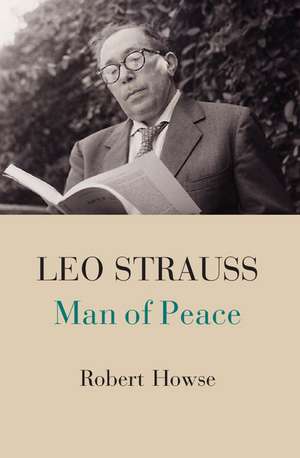
Leo Strauss: Man of Peace
Autor Robert Howseen Limba Engleză Hardback – 7 sep 2014
Subliniem apariția acestui volum semnat de Robert Howse, care funcționează ca o monografie critică esențială pentru reevaluarea moștenirii intelectuale a lui Leo Strauss. Publicată sub egida Cambridge University Press, lucrarea deconstruiește mitul conform căruia Strauss ar fi fost arhitectul ideologic al militarismului neoconservator american. Considerăm că forța acestui volum rezidă în rigoarea cu care autorul explorează sursele primare, inclusiv notele de curs și corespondența privată, pentru a-l prezenta pe Strauss nu ca pe un promotor al forței brute, ci ca pe un „om al păcii”, sceptic față de ideologiile radicale și profund atașat de valorile societății civile.
Structura cărții urmărește o progresie logică, de la confruntarea lui Strauss cu nihilismul german și juriul nazist Carl Schmitt, până la analiza profundă a operelor lui Machiavelli și Thucydides. Un punct central îl reprezintă capitolul dedicat dreptului internațional modern, unde Howse demonstrează afinitatea lui Strauss pentru ordinea juridică globală. Această perspectivă este o alternativă necesară la Cloaked in Virtue de Nicholas Xenos pentru cursurile de filosofie politică, cu avantajul că Robert Howse nu se limitează la o critică a „straussienilor” contemporani, ci se întoarce la textele fundamentale ale filosofului. În contextul operei sale, Howse continuă preocupările din The Federal Vision privind legitimitatea guvernării, aplicând aici o lentilă filosofică asupra violenței politice. Recomandăm acest volum pentru modul în care reușește să clarifice distincția dintre interpretările politice post-factum și gândirea originală a lui Strauss.
Preț: 611.34 lei
Preț vechi: 686.90 lei
-11%
Carte tipărită la comandă
Livrare economică 16-30 noiembrie
Specificații
ISBN-10: 1107074991
Pagini: 196
Dimensiuni: 157 x 235 x 18 mm
Greutate: 0.45 kg
Ediția:New.
Editura: Cambridge University Press
Colecția Cambridge University Press
Locul publicării:New York, United States
V-ar putea interesa
-
 -32%Preț: 684.18 lei1009.86 lei
 -
 The Glorious Art of Peace: From the Iliad to IraqJohn Gittings-19%Preț: 138.14 lei170.26 lei
 -
 Reconciling Enemy States in Europe and AsiaSeunghoon Emilia HeoPreț: 389.49 lei
 -
 Preț: 126.52 lei
 -
 Why Men FightBertrand RussellPreț: 154.88 lei
 -
 -15%Preț: 460.99 lei542.35 lei
 -
 Understanding Peace: A Comprehensive IntroductionMichael Allen FoxPreț: 472.07 lei
 -
 At War's EndRoland ParisPreț: 236.30 lei
 -
 Preț: 165.99 lei
 -
 A Liberal Peace?: The Problems and Practices of PeacebuildingSusanna Campbell-17%Preț: 186.82 lei225.25 lei
De ce să citești această carte
Recomandăm această carte cercetătorilor și studenților la științe politice care doresc să depășească clișeele jurnalistice despre Leo Strauss. Cititorul va câștiga o înțelegere nuanțată a modului în care filosofia clasică poate informa dezbaterile moderne despre război, pace și drept internațional. Este un argument solid pentru recuperarea unui gânditor complex dincolo de etichetele partizane, oferind o perspectivă rară asupra modului în care Strauss a predat aceste concepte în sala de curs.
Despre autor
Robert Howse este profesor de drept internațional (catedra Lloyd C. Nelson) la New York University Law School și membru în consiliul consultativ al Centrului pentru Drept și Filosofie. Cu o carieră academică distinsă, a predat la universități de prestigiu precum Harvard, Sorbona și Universitatea Ebraică din Ierusalim. Expertiza sa vastă în drept internațional și filosofie politică este reflectată în lucrări precum The Legitimacy of International Trade Courts and Tribunals și traducerea comentată a operei lui Alexandre Kojève. Contribuția sa în volumul Leo Strauss integrează riguros jurisprudența cu teoria politică.
Descriere scurtă
Cuprins
Recenzii
'Robert Howse's incisive reconstruction of Leo Strauss' views on the task of political philosophy and the case for liberal democracy makes a superb contribution to the burgeoning body of scholarship on a thinker who is increasingly recognized as a towering figure of twentieth century thought. Drawing on Strauss' intellectual encounters with Carl Schmitt and Alexandre Kojeve, Strauss' interpretations of an array of major figures in the history of political philosophy, and recently released transcripts of Strauss' legendary classes at the University of Chicago, Howse shows that the question of the status of international law was integral to Strauss' philosophical explorations. Howse's book should inspire lively and illuminating debate.' Peter Berkowitz, Tad and Dianne Taube Senior Fellow, Hoover Institution, Stanford University
'As the title makes clear, this book offers the reader a very different Leo Strauss: not one committed to permanent war for the sake of preserving humanity's noble ends against degradation, but rather a profound thinker committed to peace as the only condition in which philosophy, justice and individuality can flourish. Although willing to admit that war is sometimes necessary, Howse's Strauss articulates an extra-legal and moral-political standard that can be used to judge actions taken during war. Every chapter of this book is filled with a startling number of brilliant and original insights into Leo Strauss' relationship to his contemporaries, his understanding of key texts in the history of political thought, and the character of his overall project. Howse's book will not only spark new debates about, and a renewed interest in Leo Strauss' life and works, but I am convinced that it will also become the new standard by which any books on Strauss are measured.' Christina Tarnopolsky, McGill University
'… what is undeniable is that Howse has produced the clearest articulation of the fundamental role that 'the international' occupies in Strauss' thought. … Howse has done all of us a great service by writing this book.' Michael N. Di Gregorio, E-International Relations
'Robert Howse's Leo Strauss: Man of Peace is an effort to rehabilitate Strauss without supporting those whom he terms the 'Straussians' … [b]ut beyond Howse's meditations on Strauss, war and peace … thoughtful, inventive and well-argued … [this] book also makes an important contribution by inquiring into Strauss' views on philosophers and political life.' Benjamin Aldes Wurgaft, Los Angeles Review of Books
'In Leo Strauss: Man of Peace, the New York University law professor Robert Howse, with the blessing of the Straussian faithful … seeks to set the record straight … [w]hat we gain from Howse's reinterpretation of Strauss's views in light of casual remarks that Strauss made in his lectures and seminars is a slightly more capacious view of Strauss as a theorist of international relations.' Richard Wolin, The Chronicle of Higher Education
'In his own contribution to this discussion, Howse seeks to understand Strauss as Strauss understood himself (to borrow a venerable Straussian precept). He is thus preoccupied with Strauss' writings, lectures and letters. Like previous authors plowing these fields, however, Howse is also interested to some extent in the phenomenon of the Strauss 'cult' - that is, the fervent, often-cliquish group of Straussian teachers and students whose devotion to the Straussian 'project' has now stretched over several generations.' Gary Rosen, The National Interest