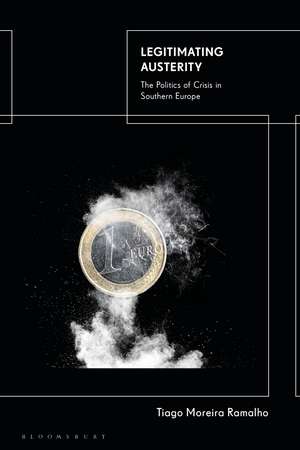
Legitimating Austerity: The Politics of Crisis in Southern Europe
Autor Tiago Moreira Ramalhoen Limba Engleză Hardback – 20 mar 2025
Preț: 552.03 lei
Preț vechi: 816.85 lei
-32%
Puncte Express: 828
Carte tipărită la comandă
Livrare economică 21 noiembrie-05 decembrie
Livrare express 17-23 octombrie pentru 151.32 lei
Livrare prin curier în România Termenul estimat este afișat lângă disponibilitate.
Transport gratuit pentru acest produs Plată online sau ramburs, în funcție de opțiunile comenzii.
Retur gratuit în 14 zile Comandă securizată și suport în română.
Specificații
ISBN-13: 9781350405295
ISBN-10: 1350405299
Pagini: 240
Dimensiuni: 164 x 238 x 22 mm
Greutate: 0.54 kg
Editura: Bloomsbury Publishing
Colecția Bloomsbury Academic
Locul publicării:London, United Kingdom
ISBN-10: 1350405299
Pagini: 240
Dimensiuni: 164 x 238 x 22 mm
Greutate: 0.54 kg
Editura: Bloomsbury Publishing
Colecția Bloomsbury Academic
Locul publicării:London, United Kingdom
Cuprins
1. Introduction: Where Does Austerity Come From?
2. Making the Southern European Crises
3. Austerity at Work I: Bailing-out Greece
4. Austerity at Work II: Bailing-out Southern Europe
5. Does Austerity Work?
6. Anti-Austerity: From the Streets to Government
7. Beyond Austerity? From the Euro Crisis to the Pandemic
8. Conclusion
2. Making the Southern European Crises
3. Austerity at Work I: Bailing-out Greece
4. Austerity at Work II: Bailing-out Southern Europe
5. Does Austerity Work?
6. Anti-Austerity: From the Streets to Government
7. Beyond Austerity? From the Euro Crisis to the Pandemic
8. Conclusion
Recenzii
Tiago Moreira Ramalho's important new book provides crucial new insights on the politics of crisis in southern Europe, undermining and revising many existing interpretations. In a skillful exercise of "constructivist institutionalism", Legitimating Austerity shows that the highly debatable case for austerity was woven together by supranational entities and domestic political actors within Greece, Portugal and Spain. Although their efforts failed in various economically relevant ways, they succeeded in persuading much of the public, winning decisive elections through a pro-austerity framing of economic challenges.
Legitimating Austerity is a timely and essential contribution to the field of political economy. Through rich empirical research and sharp analysis, Moreira Ramalho masterfully unpacks how austerity was not merely a response to economic crises, but a deeply political project that influenced the course of Southern Europe. His nuanced examination of the narratives and legitimation processes behind austerity reveals the complexity of crisis management, offering fresh insights into the interplay of politics, economics, and power. This book is an indispensable read for anyone seeking to understand the lasting impacts of austerity in Europe and beyond.
In this vital contribution to the field, Tiago Moreira Ramalho brilliantly challenges our understanding of the politics of European austerity. He shows that national elites across Southern Europe were not simply the victims of an inevitable austerity imposed from without. They were its architects. Deftly navigating across a range of cases, Moreira Ramalho brings piercing new insights into the making of European austerity.
This is a book about austerity as a political project, not an economic necessity or moral imperative. Tiago Moreira Ramalho succeeds two tasks simultaneously: he provides a nuanced picture of sovereign debt crises and responses in Southern Europe and paints a broad and convincing picture of the political origins of austerity, anchored both at the domestic and at the international level. A perspective much needed on economic policy with relevance well beyond Europe.
Legitimating Austerity is to my knowledge the most complete account of the imposition, legitimation and contestation of austerity as it took place across Southern Europe during the 2010s.
Legitimating Austerity is a timely and essential contribution to the field of political economy. Through rich empirical research and sharp analysis, Moreira Ramalho masterfully unpacks how austerity was not merely a response to economic crises, but a deeply political project that influenced the course of Southern Europe. His nuanced examination of the narratives and legitimation processes behind austerity reveals the complexity of crisis management, offering fresh insights into the interplay of politics, economics, and power. This book is an indispensable read for anyone seeking to understand the lasting impacts of austerity in Europe and beyond.
In this vital contribution to the field, Tiago Moreira Ramalho brilliantly challenges our understanding of the politics of European austerity. He shows that national elites across Southern Europe were not simply the victims of an inevitable austerity imposed from without. They were its architects. Deftly navigating across a range of cases, Moreira Ramalho brings piercing new insights into the making of European austerity.
This is a book about austerity as a political project, not an economic necessity or moral imperative. Tiago Moreira Ramalho succeeds two tasks simultaneously: he provides a nuanced picture of sovereign debt crises and responses in Southern Europe and paints a broad and convincing picture of the political origins of austerity, anchored both at the domestic and at the international level. A perspective much needed on economic policy with relevance well beyond Europe.
Legitimating Austerity is to my knowledge the most complete account of the imposition, legitimation and contestation of austerity as it took place across Southern Europe during the 2010s.