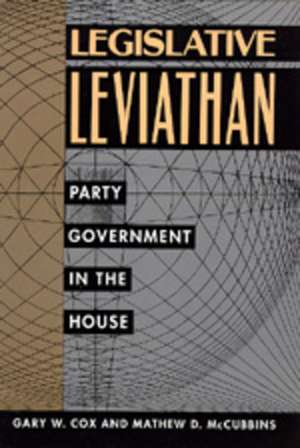
Legislative Leviathan: University of California Press
Autor Gary W. Cox, Mathew D. McCubbinsen Limba Engleză Paperback – 5 apr 1993
Debunking prevailing arguments about the weakening of congressional parties, Cox and McCubbins powerfully illuminate the ways in which parties exercise considerable discretion in organizing the House to carry out its work.
This work will have an important impact on the study of American politics, and will greatly interest students of Congress, the presidency, and the political party system.
Din seria University of California Press
- 15%
 Preț: 489.42 lei
 - 16%
 Preț: 603.40 lei
 - 27%
 Preț: 718.91 lei
 -
 Preț: 319.08 lei
 - 23%
 Preț: 559.15 lei
 -
 Preț: 280.76 lei
 -
 Preț: 250.38 lei
 - 23%
 Preț: 523.05 lei
 - 23%
 Preț: 563.01 lei
 -
 Preț: 259.09 lei
 -
 Preț: 265.86 lei
 -
 Preț: 285.25 lei
 - 23%
 Preț: 468.62 lei
 -
 Preț: 314.96 lei
 - 23%
 Preț: 562.36 lei
 - 23%
 Preț: 507.53 lei
 - 23%
 Preț: 564.30 lei
 -
 Preț: 294.63 lei
 -
 Preț: 288.38 lei
 -
 Preț: 279.19 lei
 -
 Preț: 287.15 lei
 - 23%
 Preț: 561.82 lei
 - 23%
 Preț: 560.56 lei
 - 23%
 Preț: 561.87 lei
 - 23%
 Preț: 560.85 lei
 - 23%
 Preț: 566.17 lei
 -
 Preț: 166.31 lei
 -
 Preț: 544.54 lei
 -
 Preț: 286.67 lei
 - 23%
 Preț: 568.62 lei
 -
 Preț: 327.81 lei
 - 23%
 Preț: 563.97 lei
 -
 Preț: 336.69 lei
 -
 Preț: 515.97 lei
 -
 Preț: 203.00 lei
 -
 Preț: 255.56 lei
 - 23%
 Preț: 565.31 lei
 -
 Preț: 278.09 lei
 - 23%
 Preț: 565.58 lei
 -
 Preț: 356.53 lei
 - 23%
 Preț: 565.70 lei
 - 23%
 Preț: 562.07 lei
 -
 Preț: 295.42 lei
 - 23%
 Preț: 564.09 lei
Preț: 264.89 lei
Puncte Express: 397
Carte tipărită la comandă
Livrare economică 27 noiembrie-11 decembrie
Livrare prin curier în România Termenul estimat este afișat lângă disponibilitate.
Transport gratuit de la 400.00 lei Plată online sau ramburs, în funcție de opțiunile comenzii.
Retur gratuit în 14 zile Comandă securizată și suport în română.
Specificații
ISBN-13: 9780520072206
ISBN-10: 0520072200
Pagini: 344
Dimensiuni: 151 x 225 x 21 mm
Greutate: 0.46 kg
Ediția:Revised
Editura: UCAL POD
Colecția University of California Press
Seria University of California Press
Locul publicării:United States
ISBN-10: 0520072200
Pagini: 344
Dimensiuni: 151 x 225 x 21 mm
Greutate: 0.46 kg
Ediția:Revised
Editura: UCAL POD
Colecția University of California Press
Seria University of California Press
Locul publicării:United States
V-ar putea interesa
-
 ISISJ. M. BergerPreț: 106.17 lei
 -
 How to Run A GovernmentMichael Barber-18%Preț: 65.48 lei79.80 lei
 -
 Panchayati Raj: Oxford India Short IntroductionsKuldeep MathurPreț: 95.95 lei
 -
 After the SheikhsChristopher DavidsonPreț: 211.29 lei
 -
 Republic of FearKanan MakiyaPreț: 266.52 lei
 -
 Global CommunityAkira IriyePreț: 244.57 lei
 -
 Storming the Gates of ParadiseRebecca SolnitPreț: 150.70 lei
 -
 The Honest BrokerJr Roger A. PielkePreț: 345.28 lei
 -
 Neoclassical Realism, the State, and Foreign PolicySteven E. LobellPreț: 296.04 lei
 -
 International Relations Theory TodayKen BoothPreț: 360.16 lei
 -
 The UK ParliamentMoyra Grant-9%Preț: 137.12 lei150.87 lei
 -
 More HumanJason Bade-18%Preț: 87.53 lei107.12 lei
 -
 Inside the New Mexico SenateDede FeldmanPreț: 145.38 lei
 -
 Public Forces and Private Politics in American Big BusinessTimothy Werner-14%Preț: 720.28 lei837.54 lei
 -
 Enterprise Risk ManagementKaren Hardy-8%Preț: 376.13 lei408.85 lei
 -
 Preț: 217.56 lei
 -
 -25%Preț: 116.19 lei155.58 lei
 -
 How to be an MPPaul FlynnPreț: 93.88 lei
 -
 Mossad: The Greatest Missions of the Israeli Secret ServiceMichael Bar-ZoharPreț: 86.66 lei
 -
 -22%Preț: 41.70 lei53.54 lei
Notă biografică
Gary W. Cox and Mathew D. McCubbins are both Professors of Political Science at the University of California, San Diego.
Descriere
Looks at the inner workings of the House of Representatives in the post-World War II era. Reevaluating the role of parties and committees, this book views parties in the House - especially majority parties - as a species of 'legislative cartel.' It is suitable for students of Congress, the presidency, and the political party system.
Cuprins
Part I. The Autonomy and Distinctiveness of Committees: 1. Self-selection and the subgovernment thesis; 2. The seniority system in Congress; 3. Subgovernments and the representativeness of committees; Part II. A Theory of Party Organization: 4. Institutions as solutions to collective dilemmas; 5. A theory of legislative parties; Part III. Parties as Floor Voting Coalitions: 6. On the decline of party voting in Congress; Part IV. Parties as Procedural Coalitions: Committee Appointments: 7. Party loyalty and committee assignments; 8. Contingents and parties; Part V. Parties as Procedural Coalitions: The Scheduling Power: 9. The majority party and the legislative agenda; 10. Controlling the legislative agenda.
Recenzii
"Legislative Leviathan was a stellar piece of research that had a profound impact on how scholars thought about the Congress. It was marked by clear and compelling theory, sophisticated analysis, and an enormous amount of relevant and convincing evidence. In this revised edition, updated by consideration of the period of the Republican majority and with discussions of recent research, ’Leviathan’ remains one of the truly essential works for students of the legislative politics."
David Rohde, Duke University
"In Legislative Leviathan, Cox and McCubbins have produced the most sophisticated, nuanced theoretical treatment of congressional parties to date. It is a special treat to see that they have incorporated the most recent thinking about congressional parties in this new edition. If you read and learned from the first edition, you must read this edition, too. If you are new to the subject of congressional parties, then start here."
Steven S. Smith, Washington University, St. Louis
David Rohde, Duke University
"In Legislative Leviathan, Cox and McCubbins have produced the most sophisticated, nuanced theoretical treatment of congressional parties to date. It is a special treat to see that they have incorporated the most recent thinking about congressional parties in this new edition. If you read and learned from the first edition, you must read this edition, too. If you are new to the subject of congressional parties, then start here."
Steven S. Smith, Washington University, St. Louis