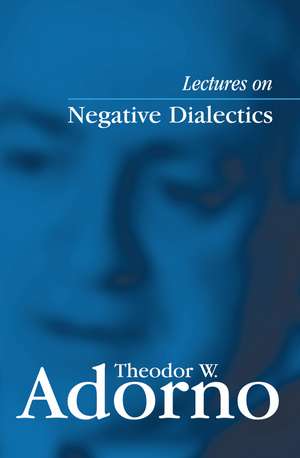
Lectures on Negative Dialectics
Autor Theodor W Adornoen Limba Engleză Hardback – 9 sep 2008
Adresăm acest volum studenților la filozofie, cercetătorilor interesați de Școala de la Frankfurt și specialiștilor în teorie literară, care vor descoperi aici geneza uneia dintre cele mai complexe lucrări ale secolului XX. Lectures on Negative Dialectics reprezintă transcrierea cursurilor susținute de Theodor W Adorno în perioada premergătoare publicării tratatului său fundamental din 1966. Observăm în aceste pagini un filozof aflat într-o luptă intelectuală activă, care își definește metodologia prin contrast cu tendințele epocii: empirismul american, marxismul dogmatic din blocul sovietic și ontologia lui Heidegger. Remarcăm claritatea neașteptată a expunerii; fiind destinate studenților, cursurile explică termenii abstracți ai dialecticii negative mai direct decât versiunea publicată ulterior. Ediția de față, publicată de Polity Press, păstrează tonul viu al prelegerilor, unde rigoarea academică este întreruptă de referințe la Proust sau Brecht și de analize ale evenimentelor politice curente din 1961. Acoperă o arie tematică similară cu An Introduction to Dialectics (1958), însă, spre deosebire de acel volum care se concentra pe rădăcinile istorice (Platon, Hegel, Marx), cursul de față are o abordare mult mai critică și aplicată la realitatea post-Auschwitz, punând accent pe rezistența individului în fața sistemelor totalizante.
Preț: 461.85 lei
Carte tipărită la comandă
Livrare economică 26 noiembrie-10 decembrie
Specificații
ISBN-10: 0745635091
Pagini: 352
Dimensiuni: 158 x 236 x 27 mm
Greutate: 0.64 kg
Ediția:1
Editura: Polity Press
Locul publicării:Chichester, United Kingdom
V-ar putea interesa
-
 DeleuzeReidar Andreas DuePreț: 192.64 lei
 -
 Correspondence 1943-1955Theodor W AdornoPreț: 470.03 lei
 -
 Dead End FeminismElisabeth BadinterPreț: 147.41 lei
 -
 The CenturyAlain BadiouPreț: 174.58 lei
 -
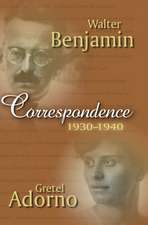 Correspondence 1930-1940Gretel Adorno-19%Preț: 455.62 lei562.49 lei
 -
 The Art of Shrinking HeadsDany-Robert DufourPreț: 150.07 lei
 -
 An Introduction to Feminist PhilosophyAlison StonePreț: 156.54 lei
 -
 The Epistemological Argument Against AtheismHugo MeynellPreț: 492.54 lei
 -
 Gesammelte Schriften in 20 BändenTheodor W. AdornoPreț: 80.59 lei
 -
 Musikalische Schriften 5Theodor W. AdornoPreț: 170.81 lei
 -
 Religion und SexHannah FrenzelPreț: 75.18 lei
 -
 Der private BriefwechselBernhard KrallerPreț: 199.64 lei
 -
 BEING AND LOGOSAgnieszka WoszczykPreț: 71.74 lei
Public țintă
Philosophy students, those interested in Literary Theory and The Frankfurt School.De ce să citești această carte
Recomandăm această carte celor care doresc să înțeleagă gândirea lui Theodor W Adorno fără barierele stilistice ale textelor sale scrise. Cititorul câștigă o perspectivă privilegiată asupra modului în care s-a format conceptul de dialectică negativă, beneficiind de explicații pedagogice și exemple culturale concrete. Este un instrument esențial pentru studiul criticii sistemelor de dominare și a libertății individuale în filozofia contemporană.