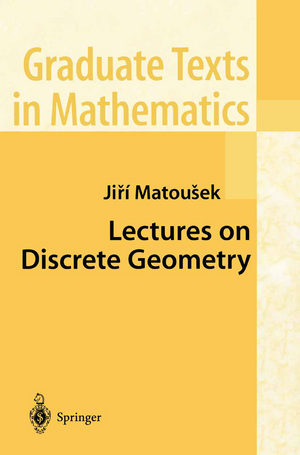
Lectures on Discrete Geometry
Autor Ji& Matouseken Limba Engleză Hardback – 2 mai 2002
Evoluția geometriei discrete în ultimele decenii a transformat acest domeniu dintr-o ramură teoretică a matematicii într-un fundament indispensabil pentru geometria computațională și optimizarea combinatorie. Notăm cu interes modul în care lucrarea Lectures on Discrete Geometry, semnată de Ji& Matousek, reușește să sintetizeze această tranziție, oferind un cadru riguros pentru studiul proprietăților combinatorii ale configurațiilor geometrice. Ediția din 2002 de la Springer se distinge printr-o abordare pedagogică rar întâlnită la nivel de studii masterale, făcând accesibile rezultate sofisticate fără a sacrifica profunzimea matematică. Subliniem organizarea logică a conținutului, care ghidează cititorul de la fundamentele convexității și Teorema lui Minkowski către subiecte avansate precum complexitatea combinatorie a configurațiilor geometrice și scufundările spațiilor metrice finite în spații normate. Față de alte lucrări ale autorului, precum Geometry, Structure and Randomness in Combinatorics, care se concentrează pe tendințe curente și articole de cercetare în teoria grafurilor și Ramsey, volumul de față servește drept bază solidă, un manual de referință ce pune accent pe metode și demonstrații clare. Putem afirma că acest titlu completează perspectiva oferită de Combinatorial and Computational Geometry de Jacob E. Goodman. În timp ce volumul lui Goodman este o colecție de lucrări de cercetare și studii ce explorează sinergia dintre discipline, lucrarea lui Matoušek oferă o structură de curs coerentă, axată pe construcția progresivă a competențelor necesare unui matematician sau informatician. Stilul este concret, evitând abstractizarea excesivă, dar incluzând secțiuni separate pentru material avansat, ceea ce o face utilă și ca resursă de referință pentru experți.
Preț: 712.12 lei
Preț vechi: 837.78 lei
-15%
Carte tipărită la comandă
Livrare economică 23 noiembrie-07 decembrie
Specificații
ISBN-10: 0387953736
Pagini: 486
Ilustrații: XVI, 486 p.
Dimensiuni: 159 x 241 x 35 mm
Greutate: 0.92 kg
Ediția:2002 edition
Editura: Springer
Locul publicării:New York, NY, United States
V-ar putea interesa
-
 Linear GeometryK. W. Gruenberg-15%Preț: 547.93 lei644.62 lei
 -
 Transformation GeometryGeorge E. Martin-15%Preț: 600.00 lei705.88 lei
 -
 Modern Geometry with ApplicationsGeorge A. JenningsPreț: 434.70 lei
 -
 Fractals in ScienceEugene StanleyPreț: 382.67 lei
 -
 Geometry for the ClassroomC. Herbert ClemensPreț: 98.33 lei
 -
 -15%Preț: 616.89 lei725.76 lei
 -
 Gaussian Self-Affinity and FractalsBenoit Mandelbrot-15%Preț: 738.97 lei869.37 lei
 -
 Algebraic Geometry and its ApplicationsChandrajit L. Bajaj-15%Preț: 658.36 lei774.55 lei
 -
 Stability of Einstein ManifoldsKlaus KrönckePreț: 408.68 lei
 -
 Preț: 149.06 lei
 -
 Preț: 239.42 lei
 -
 Geometrie der ZahlenHermann MinkowskiPreț: 244.72 lei
 -
 Absolute Geometrie nach Johann BolyaiJ. FrischaufPreț: 184.02 lei
 -
 Preț: 495.95 lei
 -
 Preț: 292.55 lei
 -
 Preț: 486.89 lei
 -
 Preț: 372.21 lei
 -
 Surfaces procéduralesStéphane ChauPreț: 458.74 lei
 -
 DOING MATHEMATICS (2ND ED)Krieger Martin H-15%Preț: 539.68 lei634.92 lei
Public țintă
GraduateDe ce să citești această carte
Recomandăm această carte studenților și cercetătorilor care doresc o introducere sistematică în geometria discretă. Veți câștiga o înțelegere profundă a metodelor combinatorii aplicate în geometrie, esențiale pentru algoritmi și optimizare. Este un instrument de lucru clar, scris de unul dintre cei mai respectați pedagogi ai domeniului, oferind un echilibru perfect între teoria convexității și aplicațiile sale practice în informatică.
Cuprins
Recenzii
"Discrete geometry is not quite a newcomer on the stage of mathematics. … The book under review covers … a gap in the pedagogical literature, providing an expository treatment of a wide range of topics in discrete geometry, without assuming too many prerequisites from the reader. … it will be ideal to be used both as a textbook and for self-study. … In fact … this book can be used as a ‘mathematical companion’ to a textbook on computational geometry … ." (Paul A. Blaga, Studia Universitatis Babes-Bolyai Mathematica, Vol. XLVIII (1), March, 2004)
"Matoušek’s excellent new book concerns discrete geometry. … The style is clear and pleasant; things are streamlined and collected in one place, and are explained on simple, concrete examples. … a final chapter on ‘What was it about? An informal summary’ was an innovation that I found to be an excellent idea. Lectures on discrete geometry is a splendid book. I recommend it both to students and researchers in the field, as well as to those who like mathematics for its own inherent beauty." (Imre Bárány, Bulletin of the London Mathematical Society, Issue 35, 2003)
"This book is primarily a textbook introduction to various areas of discrete geometry. In each area, it explains several key results and methods, in an accessible and concrete manner. It also contains more advanced material in separate sections, and thus, it can serve as a collection of surveys in several narrower subfields." (L’ENSEIGNEMENT MATHEMATIQUE, Vol. 48 (3-4), 2002)
"This is an introduction to the field of discrete geometry understood as the investigation of combinatorial properties of configurations of (usually finitely many) geometric objects … . The book is written in a lively and stimulating but very precise style and contains many figures. It gives a good impression of the richness and the relevance of the field." (Johann Linhart, Zentralblatt Math, Vol. 999 (24), 2002)
Textul de pe ultima copertă
This book is primarily a textbook introduction to various areas of discrete geometry. In each area, it explains several key results and methods, in an accessible and concrete manner. It also contains more advanced material in separate sections and thus it can serve as a collection of surveys in several narrower subfields. The main topics include: basics on convex sets, convex polytopes, and hyperplane arrangements; combinatorial complexity of geometric configurations; intersection patterns and transversals of convex sets; geometric Ramsey-type results; polyhedral combinatorics and high-dimensional convexity; and lastly, embeddings of finite metric spaces into normed spaces.
Jiri Matousek is Professor of Computer Science at Charles University in Prague. His research has contributed to several of the considered areas and to their algorithmic applications. This is his third book.