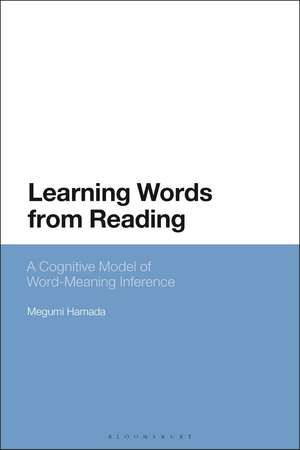
Learning Words from Reading: A Cognitive Model of Word-Meaning Inference
Autor Dr Megumi Hamadaen Limba Engleză Paperback – 23 feb 2023
Tackling these questions head-on, this book provides researchers and educators with a more specific account of the processes behind the seemingly naturalistic method. Clarifying the connection between reading and word learning processes, Megumi Hamada proposes a new model, the Cognitive Model of Word-Meaning Inference, to describe how we obtain and use word-form and contextual information for learning words and the pedagogical applications of this. A significant new contribution to research in the field, Learning Words from Reading provides a cognitive perspective on how students learn new words from reading in a second or foreign language.
Preț: 208.18 lei
Preț vechi: 291.63 lei
-29%
Puncte Express: 312
Carte tipărită la comandă
Livrare economică 18 noiembrie-02 decembrie
Livrare prin curier în România Termenul estimat este afișat lângă disponibilitate.
Transport gratuit de la 400.00 lei Plată online sau ramburs, în funcție de opțiunile comenzii.
Retur gratuit în 14 zile Comandă securizată și suport în română.
Specificații
ISBN-13: 9781350251700
ISBN-10: 1350251704
Pagini: 172
Dimensiuni: 156 x 234 x 25 mm
Greutate: 0.25 kg
Editura: Bloomsbury Publishing
Colecția Bloomsbury Academic
Locul publicării:London, United Kingdom
ISBN-10: 1350251704
Pagini: 172
Dimensiuni: 156 x 234 x 25 mm
Greutate: 0.25 kg
Editura: Bloomsbury Publishing
Colecția Bloomsbury Academic
Locul publicării:London, United Kingdom
Cuprins
Part I: What Do We Know About Incidental Word Learning from Reading?
1. Theoretical Background in Word Learning from Reading
2. Mechanism of Word Learning from Reading
3. Factors in Word Learning from Reading
Part II: How Do We Obtain Information from Reading and Use It for Learning Words?
4. Introducing the Cognitive Model of Word-Meaning Inference
5. Extracting Word-Form Information and Using It for Word Learning
6. Generating Contextual Information and Using It for Word Learning
7. Pedagogical Applications
Bibliography
Index
1. Theoretical Background in Word Learning from Reading
2. Mechanism of Word Learning from Reading
3. Factors in Word Learning from Reading
Part II: How Do We Obtain Information from Reading and Use It for Learning Words?
4. Introducing the Cognitive Model of Word-Meaning Inference
5. Extracting Word-Form Information and Using It for Word Learning
6. Generating Contextual Information and Using It for Word Learning
7. Pedagogical Applications
Bibliography
Index
Recenzii
This book effectively draws together key theories and empirical findings from various disciplines to clearly describe the processes involved in incidental learning of second language vocabulary from reading.
Hamada addresses a fundamental issue in L2 reading: How we Learn Words from Reading. She carefully reviews and categorizes the large and growing research on types of L1-L2 transfer effects (linguistic and contextual) and uses these findings to develop a coherent model of second-language word recognition and word learning: The Cognitive Model of Word-Meaning Inference.
Taking an interdisciplinary approach to research synthesis, Megumi Hamada explores incidental vocabulary learning from multiple perspectives, including linguistics, reading, and psychology. The book will serve as an insightful and valuable resource for students, teachers, and scholars in second language acquisition and language education.
This book provides a valuable resource on reading and vocabulary learning. It provides a succinct overview of the theoretical and empirical literature on incidental word learning and also covers the processes involved in inferring word meaning from reading. The book is laudable for its quality and clarity of presentation.
Hamada addresses a fundamental issue in L2 reading: How we Learn Words from Reading. She carefully reviews and categorizes the large and growing research on types of L1-L2 transfer effects (linguistic and contextual) and uses these findings to develop a coherent model of second-language word recognition and word learning: The Cognitive Model of Word-Meaning Inference.
Taking an interdisciplinary approach to research synthesis, Megumi Hamada explores incidental vocabulary learning from multiple perspectives, including linguistics, reading, and psychology. The book will serve as an insightful and valuable resource for students, teachers, and scholars in second language acquisition and language education.
This book provides a valuable resource on reading and vocabulary learning. It provides a succinct overview of the theoretical and empirical literature on incidental word learning and also covers the processes involved in inferring word meaning from reading. The book is laudable for its quality and clarity of presentation.