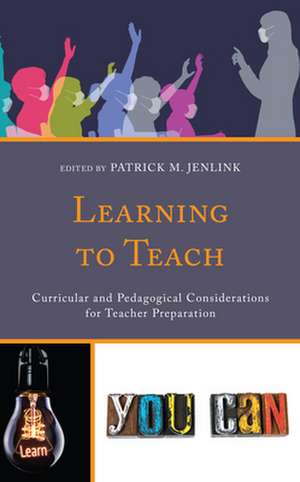
Learning to Teach: Curricular and Pedagogical Considerations for Teacher Preparation
Editat de Patrick M. Jenlinken Limba Engleză Paperback – 14 aug 2021
Preț: 328.87 lei
Preț vechi: 406.86 lei
-19%
Puncte Express: 493
Carte tipărită la comandă
Livrare economică 24 noiembrie-08 decembrie
Livrare prin curier în România Termenul estimat este afișat lângă disponibilitate.
Transport gratuit de la 400.00 lei Plată online sau ramburs, în funcție de opțiunile comenzii.
Retur gratuit în 14 zile Comandă securizată și suport în română.
Specificații
ISBN-13: 9781475860207
ISBN-10: 147586020X
Pagini: 226
Ilustrații: 5 b/w illustrations; 11 tables
Dimensiuni: 148 x 226 x 16 mm
Greutate: 0.34 kg
Editura: Bloomsbury Publishing
Colecția Rowman & Littlefield
Locul publicării:New York, United States
ISBN-10: 147586020X
Pagini: 226
Ilustrații: 5 b/w illustrations; 11 tables
Dimensiuni: 148 x 226 x 16 mm
Greutate: 0.34 kg
Editura: Bloomsbury Publishing
Colecția Rowman & Littlefield
Locul publicării:New York, United States
Cuprins
Preface
Acknowledgments
Chapter 1. Learning to Teach, Teaching to Learn: The Importance of Symmetry in Preparation and Practice
Patrick M. Jenlink
Chapter 2. Developing Learning Trajectories for Teacher Learning
Anna E. Bargagliotti
Chapter 3. Connecting Curricular Contexts: A National Survey and Two Exemplary Cases of Teacher Educators Bridging Coursework and Fieldwork
Courtney Shimek, Marliese R. Peltier, Elizabeth M. Bemiss, Ann Van Wig, Laura J. Hopkins, Stephanie G. Davis, Roya Q. Scales, and W. David Scales
Chapter 4. Preparing Special Educators for Inclusive Classes: Focusing Experiential Learning Experiences on Content and Disciplinary Literacy Instruction
Marie Tejero Hughes, Gina Braun, and Courtney BarcusChapter 5. What Do They Want to Know: Exploring What Preservice Teachers Want and Expect from Their Preparation Coursework
Rory P. Tannebaum
Chapter 6. Examining Coping Strategies of Pre-Service Teachers Completing Different Routes to Certification
Amanda A. Olsen and Roberta J. Scholes
Chapter 7.Preparing Teachers for Literacy Instruction Across and Within the Disciplines:
The What and the How
Chyllis E. Scott, Diane M. Miller, Erin K. Washburn, and Erin M. McTigue
Chapter 8. We Need Better, Not More: Results from a Study Examining the Impact of Duration and Quality of Field Experience on Teacher Preparation
Amanda L. Nolen and Karina R. Clemmons
Chapter 9. Implementing Professional Development Days Within the Elementary Methods Semester
Patricia Paulson, Geri Von Grey, Danny Swensen, Jay Rasmussen, and Katie Bonawitz
Chapter 10. English as a Foreign Language (EFL) Teaching Experiences of Mainstream Pre-service Teachers in an International Service-Learning Project
Burcu Ates, Yurimi Grigsby, Helen Berg, and Soonhyang Kim
Chapter 11. Epilogue: The Importance of First Lessons in Learning to Teach
Patrick M. Jenlink
About the Editor and Authors
Acknowledgments
Chapter 1. Learning to Teach, Teaching to Learn: The Importance of Symmetry in Preparation and Practice
Patrick M. Jenlink
Chapter 2. Developing Learning Trajectories for Teacher Learning
Anna E. Bargagliotti
Chapter 3. Connecting Curricular Contexts: A National Survey and Two Exemplary Cases of Teacher Educators Bridging Coursework and Fieldwork
Courtney Shimek, Marliese R. Peltier, Elizabeth M. Bemiss, Ann Van Wig, Laura J. Hopkins, Stephanie G. Davis, Roya Q. Scales, and W. David Scales
Chapter 4. Preparing Special Educators for Inclusive Classes: Focusing Experiential Learning Experiences on Content and Disciplinary Literacy Instruction
Marie Tejero Hughes, Gina Braun, and Courtney BarcusChapter 5. What Do They Want to Know: Exploring What Preservice Teachers Want and Expect from Their Preparation Coursework
Rory P. Tannebaum
Chapter 6. Examining Coping Strategies of Pre-Service Teachers Completing Different Routes to Certification
Amanda A. Olsen and Roberta J. Scholes
Chapter 7.Preparing Teachers for Literacy Instruction Across and Within the Disciplines:
The What and the How
Chyllis E. Scott, Diane M. Miller, Erin K. Washburn, and Erin M. McTigue
Chapter 8. We Need Better, Not More: Results from a Study Examining the Impact of Duration and Quality of Field Experience on Teacher Preparation
Amanda L. Nolen and Karina R. Clemmons
Chapter 9. Implementing Professional Development Days Within the Elementary Methods Semester
Patricia Paulson, Geri Von Grey, Danny Swensen, Jay Rasmussen, and Katie Bonawitz
Chapter 10. English as a Foreign Language (EFL) Teaching Experiences of Mainstream Pre-service Teachers in an International Service-Learning Project
Burcu Ates, Yurimi Grigsby, Helen Berg, and Soonhyang Kim
Chapter 11. Epilogue: The Importance of First Lessons in Learning to Teach
Patrick M. Jenlink
About the Editor and Authors
Recenzii
Learning to Teach: Curricular and Pedagogical Considerations for Teacher Preparation is a "must read" for faculty and staff in teacher education programs across the nation. The chapters in this book explore fundamental connections between teacher preparation and P-12 classrooms. Research-supported topics on pre-service teacher perceptions, preparation to practice, preparing to teach in diverse settings, and preparation of depth in content knowledge are the focus of this book. Are we making the connections for our teachers to meet the needs of an ever-changing society? That is the question we should be asking ourselves as we reflect on these chapters.
Learning to Teach: Curricular and Pedagogical Considerations for Teacher Preparation is a great book for educators interested in making teacher preparation more meaningful. Each chapter provides a unique look into one aspect of teacher preparation, with an emphasis on the interactions between clinical practice and coursework. This book is helpful for educators and programs interested in making stronger connections between theory and practice for teacher candidates.
Teacher preparation is more significant now than ever as teachers are adapting to extraordinary complexities in the context of schooling. In Learning to Teach: Curricular and Pedagogical Considerations for Teacher Preparation, Patrick Jenlink weaves together expertise from current scholars who are examining the ways that teacher preparation programs can cultivate the knowledge, skills, and dispositions of the next generation of teachers so that they are ready to guide students and families through current and future challenges. There is no profession more critical and no time more crucial for this examination.
How to effectively support preservice teachers to connect what they learn in program courses to what they do in classrooms meaningfully has been one of the persistent and predominant challenges facing scholars, teacher educators, and policymakers in teacher preparation. Learning to Teach: Curricular and Pedagogical Considerations for Teacher Preparation, contributes to an extensive and deep understanding of the challenge and offers useful approaches to addressing it using studies featuring research-based conceptualization, systematic literature review, qualitative and quantitative examination, and theory-based intervention in different content areas and fields. A resourceful and inspiring read for researchers, policymakers, teacher educators, and teachers interested in the issues of teacher preparation and learning to teach.
Learning to Teach: Curricular and Pedagogical Considerations for Teacher Preparation masterfully argues that effective teacher preparation programs include classroom-based instruction complemented by relevant clinical experiences. In teacher preparation classes, pre-service teachers "learn to teach" by discussing educational theories and cases studies and by observing and analyzing models of effective teaching. Integrated, systematic, and progressive clinical experiences then provide opportunities for pre-service teachers to "teach to learn" through practical application and reflection of their theoretical knowledge bases. The authors also effectively identify variables that influence pre-service teachers during their professional development journeys. These variables include backgrounds, experiences, and beliefs of pre-service teachers and their university professors, clinical educators, and mentor teachers. Supporting pre-service teachers as they "learn to teach" and "teach to learn" is truly a shared responsibility. Given this, Learning to Teach: Curricular and Pedagogical Considerations for Teacher Preparation is a must-have resource for teacher educators, P-12 teachers, curriculum specialists, and school/district administrators, all of whom will appreciate reaffirmation of their roles in, and influences upon, the lives of pre-service teachers.
Learning to Teach: Curricular and Pedagogical Considerations for Teacher Preparation is a great book for educators interested in making teacher preparation more meaningful. Each chapter provides a unique look into one aspect of teacher preparation, with an emphasis on the interactions between clinical practice and coursework. This book is helpful for educators and programs interested in making stronger connections between theory and practice for teacher candidates.
Teacher preparation is more significant now than ever as teachers are adapting to extraordinary complexities in the context of schooling. In Learning to Teach: Curricular and Pedagogical Considerations for Teacher Preparation, Patrick Jenlink weaves together expertise from current scholars who are examining the ways that teacher preparation programs can cultivate the knowledge, skills, and dispositions of the next generation of teachers so that they are ready to guide students and families through current and future challenges. There is no profession more critical and no time more crucial for this examination.
How to effectively support preservice teachers to connect what they learn in program courses to what they do in classrooms meaningfully has been one of the persistent and predominant challenges facing scholars, teacher educators, and policymakers in teacher preparation. Learning to Teach: Curricular and Pedagogical Considerations for Teacher Preparation, contributes to an extensive and deep understanding of the challenge and offers useful approaches to addressing it using studies featuring research-based conceptualization, systematic literature review, qualitative and quantitative examination, and theory-based intervention in different content areas and fields. A resourceful and inspiring read for researchers, policymakers, teacher educators, and teachers interested in the issues of teacher preparation and learning to teach.
Learning to Teach: Curricular and Pedagogical Considerations for Teacher Preparation masterfully argues that effective teacher preparation programs include classroom-based instruction complemented by relevant clinical experiences. In teacher preparation classes, pre-service teachers "learn to teach" by discussing educational theories and cases studies and by observing and analyzing models of effective teaching. Integrated, systematic, and progressive clinical experiences then provide opportunities for pre-service teachers to "teach to learn" through practical application and reflection of their theoretical knowledge bases. The authors also effectively identify variables that influence pre-service teachers during their professional development journeys. These variables include backgrounds, experiences, and beliefs of pre-service teachers and their university professors, clinical educators, and mentor teachers. Supporting pre-service teachers as they "learn to teach" and "teach to learn" is truly a shared responsibility. Given this, Learning to Teach: Curricular and Pedagogical Considerations for Teacher Preparation is a must-have resource for teacher educators, P-12 teachers, curriculum specialists, and school/district administrators, all of whom will appreciate reaffirmation of their roles in, and influences upon, the lives of pre-service teachers.