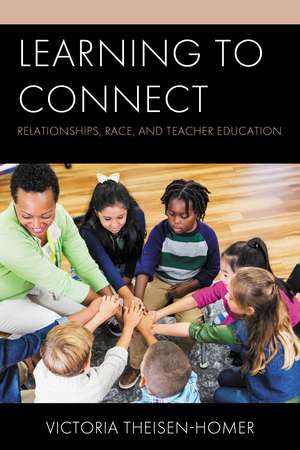
Learning to Connect
Autor Victoria Theisen-Homeren Limba Engleză Paperback – 2 oct 2020
| Toate formatele și edițiile | Preț | Express |
|---|---|---|
| Paperback (1) | 171.84 lei 6-8 săpt. | |
| Bloomsbury Publishing – 2 oct 2020 | 171.84 lei 6-8 săpt. | |
| Hardback (1) | 357.12 lei 6-8 săpt. | |
| Bloomsbury Publishing – 15 sep 2020 | 357.12 lei 6-8 săpt. |
Preț: 171.84 lei
Preț vechi: 223.69 lei
-23%
Puncte Express: 258
Preț estimativ în valută:
30.39€ • 35.66$ • 26.36£
30.39€ • 35.66$ • 26.36£
Carte tipărită la comandă
Livrare economică 10-24 martie
Specificații
ISBN-13: 9781475855449
ISBN-10: 1475855443
Pagini: 242
Ilustrații: 1 b/w illustration; 1 table
Dimensiuni: 152 x 229 x 14 mm
Greutate: 0.4 kg
Editura: Bloomsbury Publishing
Locul publicării:New York, United States
ISBN-10: 1475855443
Pagini: 242
Ilustrații: 1 b/w illustration; 1 table
Dimensiuni: 152 x 229 x 14 mm
Greutate: 0.4 kg
Editura: Bloomsbury Publishing
Locul publicării:New York, United States
Cuprins
Preface
Acknowledgements
Introduction
Part 1: No Excuses Teacher Residency
Chapter 1: An Instrumental Approach
Chapter 2: License for Navigation
Chapter 3: The NETR Brand
Part 2: Progressive Teacher Residency
Chapter 4: Cultivating Reciprocal Relationships
Chapter 5: Below the Surface
Chapter 6: Learning the Ropes
Part 3: Into the Field and Beyond
Chapter 7: From Learning to Teaching
Chapter 8: Contradictions in the Field
Chapter 9: Lessons on Relationships
Epilogue
Methodological Appendix
Bibliography
Acknowledgements
Introduction
Part 1: No Excuses Teacher Residency
Chapter 1: An Instrumental Approach
Chapter 2: License for Navigation
Chapter 3: The NETR Brand
Part 2: Progressive Teacher Residency
Chapter 4: Cultivating Reciprocal Relationships
Chapter 5: Below the Surface
Chapter 6: Learning the Ropes
Part 3: Into the Field and Beyond
Chapter 7: From Learning to Teaching
Chapter 8: Contradictions in the Field
Chapter 9: Lessons on Relationships
Epilogue
Methodological Appendix
Bibliography
Recenzii
The expertly crafted "Learning to Connect" makes a valuable contribution to the field of teacher preparation. The book gives examples on well-prepared teachers who are nevertheless relatively helpless to sustain relationships in schools where relationships are not prioritized.
In Learning to Connect, Theisen-Homer (Arizona State Univ.) explores the complexity of training teachers to connect with students through a two-year ethnographic study of two teacher residency programs located in the same city. One, Progressive Teacher Residency (PTR), is located at a well-established progressive school and emphasizes a constructivist approach to learning. The other, No Excuses Teacher Residency (NETR), is based at a charter school and prepares participating teachers to focus on "closing the achievement gap." Accordingly, NETR teachers convey to students that "forces like poverty, racism, and hunger are no excuse" for falling behind. Theisen-Homer selected these programs based on their missions, which include an intentional and explicit focus on the development of teacher-student relationships. Each aims to achieve its own "social justice" vision. PRT's social justice goal is preparing teachers to be "change agents" who serve all students, including privileged students and those with limited access to education. NETR's goal is achieving social justice through good teaching techniques. Though both programs had shortcomings, they did offer guidance in better preparing teachers for meaningful relationships with all students. Finally, the author upholds meaningful teacher-student relationships as possibly the most important aspect of teaching. This book should be widely read. Summing Up: Highly recommended. Lower-division undergraduates through faculty; professionals.
In this probing and revelatory book, Theisen-Homer examines the ways that two teacher training programs seek to prepare teachers to build and sustain relationships-of authenticity, respect, and trust-with their students who come from backgrounds culturally and racially different from theirs. Through vivid and evocative portraits, the author offers us an interior view of the programs, documenting the perspective and voices of the participants, the challenges and resistance, the blind spots and breakthroughs that are embedded in nourishing and sustaining human connection in classrooms. Learning to Connect is at once a richly detailed narrative, a discerning analysis, a rigorous roadmap, and a powerful call to action.
Thiesen-Homer's exploration of two starkly contrasting teacher preparation programs is as startling as it is beautiful. Nothing less than the question of what American society wants from its K-12 schools is at stake in this incisive, illuminating, and thickly-textured portrait. A must-read for educators and policymakers interested in the limits and possibilities of 21st century teacher preparation.
As conversations about the increasingly racially and ethnically diverse U.S. student population continue, Victoria Theisen-Homer calls on educators to examine the taken-for-granted assumptions about teacher-student relationships. In Learning to Connect: Relationships, Race, and Teacher Education, Theisen-Homer offers lessons from her extensive research on two established teaching residency programs. Her findings reveal the tension between schools' social justice aspirations and the ways teachers are prepared to address students' racial, ethnic, ability, linguistic, and other intersectional differences. This book is a thoughtful, theoretically-grounded contribution that compels those of us charged with equipping teachers in traditional, alternative, or residential teacher preparation programs to interrogate and center student-teacher relationality.
This terrific book offers a rare inside look into two teacher preparation programs that offer starkly different visions of what it entails to develop teachers who care. Weaving together powerfully detailed portraits with incisive analysis, Theisen-Homer's closely observed ethnography shows how teachers' visions of care are deeply shaped by the assumptions of the programs in which they reside. Infused by a rich sense of what the student-teacher relationship can be at its best, this book should be read by all who care about creating humane, powerful, and equitable schools.
In Learning to Connect, Theisen-Homer (Arizona State Univ.) explores the complexity of training teachers to connect with students through a two-year ethnographic study of two teacher residency programs located in the same city. One, Progressive Teacher Residency (PTR), is located at a well-established progressive school and emphasizes a constructivist approach to learning. The other, No Excuses Teacher Residency (NETR), is based at a charter school and prepares participating teachers to focus on "closing the achievement gap." Accordingly, NETR teachers convey to students that "forces like poverty, racism, and hunger are no excuse" for falling behind. Theisen-Homer selected these programs based on their missions, which include an intentional and explicit focus on the development of teacher-student relationships. Each aims to achieve its own "social justice" vision. PRT's social justice goal is preparing teachers to be "change agents" who serve all students, including privileged students and those with limited access to education. NETR's goal is achieving social justice through good teaching techniques. Though both programs had shortcomings, they did offer guidance in better preparing teachers for meaningful relationships with all students. Finally, the author upholds meaningful teacher-student relationships as possibly the most important aspect of teaching. This book should be widely read. Summing Up: Highly recommended. Lower-division undergraduates through faculty; professionals.
In this probing and revelatory book, Theisen-Homer examines the ways that two teacher training programs seek to prepare teachers to build and sustain relationships-of authenticity, respect, and trust-with their students who come from backgrounds culturally and racially different from theirs. Through vivid and evocative portraits, the author offers us an interior view of the programs, documenting the perspective and voices of the participants, the challenges and resistance, the blind spots and breakthroughs that are embedded in nourishing and sustaining human connection in classrooms. Learning to Connect is at once a richly detailed narrative, a discerning analysis, a rigorous roadmap, and a powerful call to action.
Thiesen-Homer's exploration of two starkly contrasting teacher preparation programs is as startling as it is beautiful. Nothing less than the question of what American society wants from its K-12 schools is at stake in this incisive, illuminating, and thickly-textured portrait. A must-read for educators and policymakers interested in the limits and possibilities of 21st century teacher preparation.
As conversations about the increasingly racially and ethnically diverse U.S. student population continue, Victoria Theisen-Homer calls on educators to examine the taken-for-granted assumptions about teacher-student relationships. In Learning to Connect: Relationships, Race, and Teacher Education, Theisen-Homer offers lessons from her extensive research on two established teaching residency programs. Her findings reveal the tension between schools' social justice aspirations and the ways teachers are prepared to address students' racial, ethnic, ability, linguistic, and other intersectional differences. This book is a thoughtful, theoretically-grounded contribution that compels those of us charged with equipping teachers in traditional, alternative, or residential teacher preparation programs to interrogate and center student-teacher relationality.
This terrific book offers a rare inside look into two teacher preparation programs that offer starkly different visions of what it entails to develop teachers who care. Weaving together powerfully detailed portraits with incisive analysis, Theisen-Homer's closely observed ethnography shows how teachers' visions of care are deeply shaped by the assumptions of the programs in which they reside. Infused by a rich sense of what the student-teacher relationship can be at its best, this book should be read by all who care about creating humane, powerful, and equitable schools.