
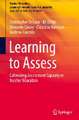
Learning to Assess: Teacher Education, Learning Innovation and Accountability
Autor Christopher DeLuca, Jill Willis, Andrew Coombs, Christine Harrison, Bronwen Cowieen Limba Engleză Paperback – 24 dec 2024
| Toate formatele și edițiile | Preț | Express |
|---|---|---|
| Paperback (1) | 731.63 lei 38-45 zile | |
| Springer Nature Singapore – 24 dec 2024 | 731.63 lei 38-45 zile | |
| Hardback (1) | 751.66 lei 6-8 săpt. | |
| Springer Nature Singapore – 2 ian 2024 | 751.66 lei 6-8 săpt. |

Preț: 731.63 lei
Preț vechi: 962.68 lei
-24%
Puncte Express: 1097
Preț estimativ în valută:
129.34€ • 151.41$ • 112.95£
129.34€ • 151.41$ • 112.95£
Carte tipărită la comandă
Livrare economică 02-09 martie
Specificații
ISBN-13: 9789819962013
ISBN-10: 9819962013
Pagini: 188
Dimensiuni: 155 x 235 x 11 mm
Greutate: 0.3 kg
Editura: Springer Nature Singapore
Seria Teacher Education, Learning Innovation and Accountability
ISBN-10: 9819962013
Pagini: 188
Dimensiuni: 155 x 235 x 11 mm
Greutate: 0.3 kg
Editura: Springer Nature Singapore
Seria Teacher Education, Learning Innovation and Accountability
Cuprins
1 Learning to assess.- 2 Teacher education landscape.- 3 Conceptualizing assessment capacity.- 4 Epistemological capacity.- 5 Embodied capacity.- 6 Experiential capacity.- 7 Ethical capacity.- 8 Cultivating assessment capacity.- 9 A future view.
Notă biografică
Christopher DeLuca is an Associate Dean at the School of Graduate Studies and Postdoctoral Affairs and Professor in Educational Assessment at the Faculty of Education, Queen’s University (Ontario, Canada). He leads the Classroom Assessment Research Team and is Director of the Queen’s Assessment and Evaluation Group. ORCID: 0000-0001-5962-0827.
Jill Willis is an Associate Professor in the Faculty of Education at Queensland University of Technology (Brisbane, Australia). Her research focuses on reflexivity and agency in classroom assessment and evaluation processes. She currently leads research on accessibility in assessment, and student evaluations of vertical schools. ORCID: 0000-0001-5200-5039
Bronwen Cowie is Associate Dean Research Te Kura Toi Tangata, Division of Education, University of Waikato (Hamilton, New Zealand). Her research interests include assessment and assessment education, science education, and preservice and beginning teacher experiences. She has a particular interest in collaborative classroom-based research that includes student voice. ORCID: 0000-0003-3578-0791
Christine Harrison is a Professor of Science Education at King’s College (London, UK). Her research interests are in assessment and science education, especially the ways teachers deal with the interplay between assessment and teaching. She is currently working on how assessment and teaching play out in science practical lessons in primary and secondary schools. ORCID: 0000-0002-1675-6107
Andrew Coombs is a Teaching Assistant Professor at Memorial University (Newfoundland & Labrador, Canada). Andrew’s research focuses on understanding the factors shaping early career teachers’ assessment practices and assessment learning needs. He quantitative and qualitative research methods, curriculum theory, and classroom assessment.
Jill Willis is an Associate Professor in the Faculty of Education at Queensland University of Technology (Brisbane, Australia). Her research focuses on reflexivity and agency in classroom assessment and evaluation processes. She currently leads research on accessibility in assessment, and student evaluations of vertical schools. ORCID: 0000-0001-5200-5039
Bronwen Cowie is Associate Dean Research Te Kura Toi Tangata, Division of Education, University of Waikato (Hamilton, New Zealand). Her research interests include assessment and assessment education, science education, and preservice and beginning teacher experiences. She has a particular interest in collaborative classroom-based research that includes student voice. ORCID: 0000-0003-3578-0791
Christine Harrison is a Professor of Science Education at King’s College (London, UK). Her research interests are in assessment and science education, especially the ways teachers deal with the interplay between assessment and teaching. She is currently working on how assessment and teaching play out in science practical lessons in primary and secondary schools. ORCID: 0000-0002-1675-6107
Andrew Coombs is a Teaching Assistant Professor at Memorial University (Newfoundland & Labrador, Canada). Andrew’s research focuses on understanding the factors shaping early career teachers’ assessment practices and assessment learning needs. He quantitative and qualitative research methods, curriculum theory, and classroom assessment.
Textul de pe ultima copertă
This book presents a new framework for how teachers develop their assessment capacity, based on a multi-year study conducted in four countries—Australia, Canada, England, and New Zealand—which focused on student-teacher learning in assessment throughout their initial teacher education programs. It examines how teacher learning is shaped by the complex dynamics of assessment capacity within larger teacher education contexts.
The framework proposed here identifies four domains involved in cultivating assessment capacity and characterizes assessment learning as always integrating cognitive, philosophical, and moral dimensions with assessment’s social, emotional, and physical dimensions, while recognizing that each capacity is continually shaped by the learning context. The book draws on the survey of teacher education programs in each of the four focal countries and data from student teachers to shed light on how the various pedagogies, program structures, andpolicies encountered provide beginning teachers with codes for classifying and framing assessment capacity and form a template for developing this capacity throughout their careers. Offering suggestions for future research and teacher education practice, the book concludes with an outlook on future steps to cultivate teachers’ assessment capacity.
The framework proposed here identifies four domains involved in cultivating assessment capacity and characterizes assessment learning as always integrating cognitive, philosophical, and moral dimensions with assessment’s social, emotional, and physical dimensions, while recognizing that each capacity is continually shaped by the learning context. The book draws on the survey of teacher education programs in each of the four focal countries and data from student teachers to shed light on how the various pedagogies, program structures, andpolicies encountered provide beginning teachers with codes for classifying and framing assessment capacity and form a template for developing this capacity throughout their careers. Offering suggestions for future research and teacher education practice, the book concludes with an outlook on future steps to cultivate teachers’ assessment capacity.
Caracteristici
Provides a cross-country empirical analysis of beginning teachers’ efforts to learn assessment Includes a novel model for conceptualizing assessment capability Documents the challenges and opportunities for assessment education