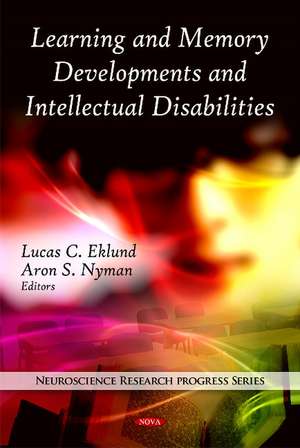
Learning & Memory Developments & Intellectual Disabilities
Editat de Lucas C Eklund, Aron S Nymanen Limba Engleză Hardback – iul 2010
Preț: 1619.82 lei
Preț vechi: 2112.10 lei
-23%
Puncte Express: 2430
Carte disponibilă
Livrare economică 16-30 noiembrie
Livrare prin curier în România Termenul estimat este afișat lângă disponibilitate.
Transport gratuit pentru acest produs Plată online sau ramburs, în funcție de opțiunile comenzii.
Retur gratuit în 14 zile Comandă securizată și suport în română.
Specificații
ISBN-13: 9781608763979
ISBN-10: 1608763978
Pagini: 313
Ilustrații: tables
Dimensiuni: 260 x 180 x 26 mm
Greutate: 0.83 kg
Editura: Nova Science Publishers Inc
Colecția Nova Science Publishers, Inc (US)
Locul publicării:United States
ISBN-10: 1608763978
Pagini: 313
Ilustrații: tables
Dimensiuni: 260 x 180 x 26 mm
Greutate: 0.83 kg
Editura: Nova Science Publishers Inc
Colecția Nova Science Publishers, Inc (US)
Locul publicării:United States
V-ar putea interesa
-
 The Promise of SleepWilliam C. DementPreț: 123.88 lei
 -
 Trauma and Addiction: Ending the Cycle of Pain Through Emotional LiteracyDr. Tian Dayton PhD, TEPPreț: 107.97 lei
 -
 Depression: The Way Out of Your PrisonDorothy Rowe-5%Preț: 182.03 lei191.61 lei
 -
 Rett Syndrome: Therapeutic InterventionsMeir Lotan-23%Preț: 1959.35 lei2529.67 lei
 -
 Striatum: Anatomy, Functions & Role in DiseaseHugo T Maldonado-23%Preț: 1273.67 lei1661.18 lei
 -
 Cerebellar Mutism: From Definition to TreatmentMehmet Turget-23%Preț: 518.39 lei675.82 lei
 -
 Advances in Brain ResearchOwen B Williams-23%Preț: 1911.08 lei2493.26 lei
 -
 Neurogenesis Research: New DevelopmentsGerry J Clark-23%Preț: 1305.50 lei1703.23 lei
 -
 -21%Preț: 107.90 lei136.37 lei
 -
 I Had a Black DogMatthew JohnstonePreț: 71.10 lei
Cuprins
Preface; Emotion's Effects on Attention & Memory: Relevance to Post-traumatic Stress Disorder; Life Skills Instruction in a Time of Accountability; Pro-Inflammatory Cytokines in Learning & Memory; Perceptions of Forgetfulness in Adulthood: Does Memory Knowledge Matter?; Memory Reconsolidation: History, Research, & Implications for Treatment of Psychiatric Disorders; Intellectual Disability: Beyond IQ Scores; Facilitatory Effects of Music on Memory: A Review of the Potential Role of Emotional Arousal; Spatial Memory & Large-Scale Ecological Environments; Does Disregard of Transient Changes in the Environment Differentiate Behaviour of Children with Autism from Typically Developing Children & Those with Down Syndrome & Idiopathic Intellectual Disability?; Studying Memory: From the Frontal to the Temporal Lobe & Vice-Versa; Learning Deficits in Presenilin Mutant Mice; Assessing Alertness in Children with Profound Intellectual & Multiple Disabilities; Assessment of Time Processing Ability & Daily Time Management in Children with & without Developmental Disabilities; A Geography of Intellectual Disabilities; Index.