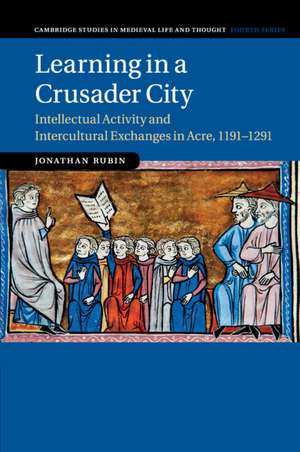
Learning in a Crusader City
Autor Jonathan Rubinen Limba Engleză Paperback – 5 mar 2020
Preț: 297.32 lei
Puncte Express: 446
Carte tipărită la comandă
Livrare economică 03-17 decembrie
Livrare prin curier în România Termenul estimat este afișat lângă disponibilitate.
Transport gratuit de la 400.00 lei Plată online sau ramburs, în funcție de opțiunile comenzii.
Retur gratuit în 14 zile Comandă securizată și suport în română.
Specificații
ISBN-13: 9781316637715
ISBN-10: 1316637719
Pagini: 236
Ilustrații: 1 b/w illus.
Dimensiuni: 152 x 229 x 13 mm
Greutate: 0.35 kg
Editura: Cambridge University Press
Locul publicării:Cambridge, United Kingdom
ISBN-10: 1316637719
Pagini: 236
Ilustrații: 1 b/w illus.
Dimensiuni: 152 x 229 x 13 mm
Greutate: 0.35 kg
Editura: Cambridge University Press
Locul publicării:Cambridge, United Kingdom
Cuprins
Introduction; 1. Intellectual activity in Acre: socio-cultural characteristics; 2. Acre's Christian and Jewish centres of teaching and learning; 3. Language and translation; 4. Acre as a meeting point of juridical traditions; 5. The study of Islam; 6. Theological exchanges with oriental Christians; Conclusion; Appendix: the relation of the used texts to Acre; Bibliography.
Recenzii
'… Learning in a Crusader City offers a refreshing look at thirteenth-century Acre as a crossroads of languages and cultures where intellectuals worked and thrived. Scholars of many different disciplines, including interfaith contact, jurisprudence, and translation, will find much to ponder in this narrow, yet illuminating, case study.' Scott G. Bruce, The Medieval Review
'… this is a very strong piece of work and its overall conclusion is both plausible and very well evidenced … Acre's centrality within the commercial, diplomatic, and crusading networks of the thirteenth century, as well as Rubin's scrupulous attention to other texts connected to the Franks' other Levantine cities, give this work a scope and reach that extends far beyond Acre's ramparts.' Nicholas Morton, The Journal of Religious History, Literature and Culture
'… this book makes valuable contributions to the field of intercultural exchanges … Rubin draws attention to the wide range of genres available in French, Latin and Hebrew and the intercultural exchanges that took place in the city, in the process relocating Acre from the periphery of the Latin West to identify the city as a centre of cultural exchange in the Latin East.' Danielle E. A. Park, The English Historical Review
'Rubin has successfully put Acre back on the medieval intellectual map, and his work should be of interest not only to historians of the Crusades, but also to anyone interested in the wider topics of learning and intercultural interaction in the Mediterranean World.' George Summers, Comitatus: A Journal of Medieval and Renaissance Studies
'… this is a very strong piece of work and its overall conclusion is both plausible and very well evidenced … Acre's centrality within the commercial, diplomatic, and crusading networks of the thirteenth century, as well as Rubin's scrupulous attention to other texts connected to the Franks' other Levantine cities, give this work a scope and reach that extends far beyond Acre's ramparts.' Nicholas Morton, The Journal of Religious History, Literature and Culture
'… this book makes valuable contributions to the field of intercultural exchanges … Rubin draws attention to the wide range of genres available in French, Latin and Hebrew and the intercultural exchanges that took place in the city, in the process relocating Acre from the periphery of the Latin West to identify the city as a centre of cultural exchange in the Latin East.' Danielle E. A. Park, The English Historical Review
'Rubin has successfully put Acre back on the medieval intellectual map, and his work should be of interest not only to historians of the Crusades, but also to anyone interested in the wider topics of learning and intercultural interaction in the Mediterranean World.' George Summers, Comitatus: A Journal of Medieval and Renaissance Studies
Descriere
Offers an unprecedentedly rich portrait of the vibrant intellectual and intercultural exchanges sparked by the Crusades in thirteenth-century Acre.