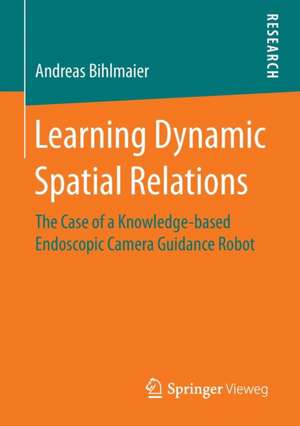
Learning Dynamic Spatial Relations
Autor Andreas Bihlmaieren Limba Engleză Paperback – 18 aug 2016
Preț: 319.36 lei
Preț vechi: 399.20 lei
-20%
Puncte Express: 479
Carte tipărită la comandă
Livrare economică 26 noiembrie-10 decembrie
Livrare prin curier în România Termenul estimat este afișat lângă disponibilitate.
Transport gratuit de la 400.00 lei Plată online sau ramburs, în funcție de opțiunile comenzii.
Retur gratuit în 14 zile Comandă securizată și suport în română.
Specificații
ISBN-13: 9783658149130
ISBN-10: 3658149132
Pagini: 284
Ilustrații: XV, 267 p. 120 illus.
Dimensiuni: 148 x 210 x 16 mm
Greutate: 0.37 kg
Ediția:1st edition 2016
Editura: Springer
Locul publicării:Wiesbaden, Germany
ISBN-10: 3658149132
Pagini: 284
Ilustrații: XV, 267 p. 120 illus.
Dimensiuni: 148 x 210 x 16 mm
Greutate: 0.37 kg
Ediția:1st edition 2016
Editura: Springer
Locul publicării:Wiesbaden, Germany
V-ar putea interesa
-
 Understanding BeliefsNils J Nilsson-18%Preț: 77.30 lei94.68 lei
 -
 Pattern Recognition and Machine LearningChristopher M Bishop-20%Preț: 646.10 lei807.62 lei
 -
 Connectionism and the MindBechtelPreț: 519.37 lei
 -
 Type-2 Fuzzy Logic ControlMendel-20%Preț: 768.63 lei960.78 lei
 -
 DATA BonanzaAtkinson-20%Preț: 714.60 lei893.25 lei
 -
 Dragon Professional Individual for DummiesStephanie Diamond-20%Preț: 180.15 lei225.19 lei
 -
 Practical OpenCVSamarth Brahmbhatt-20%Preț: 306.69 lei383.37 lei
 -
 Designing Voice User InterfacesCathy Pearl-20%Preț: 195.53 lei244.41 lei
 -
 Computational IntelligenceAlexandru Floares-35%Preț: 1012.79 lei1567.33 lei
 -
 Artificial Intelligence for Building Energy AnalysisFr'd'ric Magoul's-20%Preț: 923.76 lei1154.70 lei
Textul de pe ultima copertă
Andreas Bihlmaier describes a novel method to model dynamic spatial relations by machine learning techniques. The method is applied to the task of representing the tacit knowledge of a trained camera assistant in minimally-invasive surgery. The model is then used for intraoperative control of a robot that autonomously positions the endoscope. Furthermore, a modular robotics platform is described, which forms the basis for this knowledge-based assistance system. Promising results from a complex phantom study are presented.
Contents
- Endoscope Robots and Automated Camera Guidance
- Knowledge-based Cognitive Systems
- Modular Research Platform for Robot-Assisted Surgery based on ROS
- Learning of Surgical Know-how by Models of Spatial Relations
- Intraoperative Camera Assistance
- Evaluation Study: TME in the Open Source Heidelberg Laparoscopic Phantom (OpenHELP)
- Scientists and students in the field of robotics, surgical assistance systems, cognitive and knowledge-based systems
- Practitioners in companies selling manually controlled robots or motorized endoscope holders
About the Author
Andreas Bihlmaier is leader of the Cognitive Medical Technologies group in the Institute for Anthropomatics and Robotics – Intelligent Process Control and Robotics Lab (IAR-IPR) at the Karlsruhe Institute of Technology (KIT). His research focuses on cognitive surgical robotics for minimally-invasive surgery, as part of the SFB/Transregio 125 “Cognition-Guided Surgery”.
Caracteristici
Publication in the field of technical sciences Includes supplementary material: sn.pub/extras