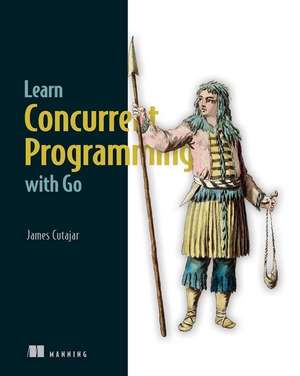
Learn Concurrent Programming with Go
Autor James Cutajaren Limba Engleză Paperback – 9 ian 2024
Considerăm că stăpânirea execuției paralele este punctul în care un programator devine cu adevărat eficient, iar Learn Concurrent Programming with Go oferă exact instrumentele necesare pentru a construi software scalabil și responsiv, capabil să utilizeze la maximum hardware-ul multi-procesor modern. Rezultatul concret al parcurgerii acestei lucrări este capacitatea de a descompune sarcini complexe în părți independente ce rulează simultan, fără a compromite integritatea datelor. Descoperim aici o abordare tehnică și extrem de aplicată asupra modelării concurenței. James Cutajar ghidează cititorul de la fundamentele firelor de execuție (threads) și partajarea memoriei, până la tehnici sofisticate de comunicare prin mesaje folosind canale. Spre deosebire de Effective Concurrency in Go, care pune un accent mai mare pe algoritmi teoretici de mare viteză, volumul de față este mai mult aplicabil în scenarii de zi cu zi, concentrându-se pe identificarea și implementarea pattern-urilor de tip worker pools sau pipelining. Suntem de părere că rigoarea tehnică este bine echilibrată de exemplele practice. Autorul nu evită subiectele dificile, dedicând secțiuni clare pentru evitarea blocajelor de tip deadlock și gestionarea condițiilor de cursă (race conditions). În ultima parte, cartea explorează zone avansate, precum variabilele atomice și futex-urile, oferind o perspectivă completă asupra multithreading-ului. Față de Go in Action, care servește ca o introducere generală în ecosistemul limbajului, lucrarea de față se specializează strict pe mecanismele de concurență, fiind un ghid esențial pentru optimizarea performanței aplicațiilor scrise în Go.
Preț: 340.61 lei
Preț vechi: 425.76 lei
-20%
Carte disponibilă
Livrare economică 05-19 noiembrie
Specificații
ISBN-10: 1633438384
Pagini: 328
Dimensiuni: 185 x 233 x 20 mm
Greutate: 0.57 kg
Editura: Manning Publications
V-ar putea interesa
-
 -20%Preț: 914.01 lei1142.51 lei
 -
 Oracle Apex Reporting Tips & TricksGeorge BaraPreț: 208.18 lei
 -
 User-Centered DesignTravis Lowdermilk-20%Preț: 132.07 lei165.09 lei
 -
 Instant SASS CSS How-toAlex Libby-20%Preț: 127.89 lei159.86 lei
 -
 Instant jQuery 2.0 Table Manipulation How-toCharlie Griefer-20%Preț: 126.34 lei157.93 lei
 -
 Instant HTML5 Geolocation How-ToBen Werdmuller-20%Preț: 126.62 lei158.27 lei
 -
 -20%Preț: 126.00 lei157.50 lei
 -
 Instant Hands-on Testing with PHPUnit How-toMike Lively-20%Preț: 137.75 lei172.19 lei
 -
 Beginning Java Data Structures and AlgorithmsJames Cutajar-20%Preț: 154.92 lei193.65 lei
 -
 Osgi StarterJamie Goodyear-20%Preț: 136.24 lei170.31 lei
 -
 Instant Adobe Edge Inspect StarterJoseph Khan-20%Preț: 126.48 lei158.11 lei
 -
 Hlsl Development CookbookDoron Feinstein-20%Preț: 287.81 lei359.76 lei
 -
 Instant HTML5 Responsive Table Design How-toFernando Monteiro-20%Preț: 126.48 lei158.11 lei
 -
 The Scalability CoefficientTrevor HallPreț: 202.53 lei
 -
 -20%Preț: 319.42 lei399.28 lei
 -
 Arquitetura de um sistema de consultas e visualização gráficaHenrique T. Machado-20%Preț: 283.74 lei354.67 lei
 -
 Migração de processos em aplicações JavaLucas Graebin-20%Preț: 284.60 lei355.76 lei
 -
 Reescalonamento dinâmico de processosRoberto de Quadros Gomes-20%Preț: 369.61 lei462.02 lei
 -
 Sinfonia: orquestrando processos de negócioLuiz Fernando Batista Loja-20%Preț: 285.27 lei356.59 lei
 -
 Uma abordagem multicritério para seleção de portfólio de projetosRodolfo Miranda de Barros-20%Preț: 284.60 lei355.76 lei
 -
 Auto-Regulação da AprendizagemAllen Fernando Oberleitner Lima-20%Preț: 312.88 lei391.10 lei
 -
 -20%Preț: 312.00 lei390.00 lei
 -
 Compressão de vídeoRobson Cavalcanti Lins-20%Preț: 311.13 lei388.92 lei
 -
 -20%Preț: 266.92 lei333.65 lei
 -
 Adaptive Immune-Inspired Text ClassificationAbi Haidar Alaa-20%Preț: 370.94 lei463.67 lei
 -
 -20%Preț: 435.68 lei544.60 lei
 -
 Discrete Approximations and TransformsGadzhiev Yuri-20%Preț: 267.57 lei334.45 lei
 -
 Emerging Applications of Cellular AutomataAlejandro Salcido-20%Preț: 894.24 lei1117.79 lei
De ce să citești această carte
Recomandăm această carte dezvoltatorilor care vor să treacă de la cod secvențial la sisteme paralele performante. Veți câștiga o înțelegere profundă a modului în care goroutine-urile și canalele din Go simplifică sarcini complexe. Este o investiție necesară pentru oricine dorește să prevină erorile de sincronizare și să livreze aplicații capabile să gestioneze volume mari de date pe infrastructuri moderne.