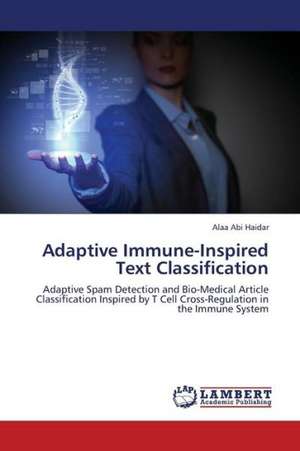
Adaptive Immune-Inspired Text Classification
Autor Abi Haidar Alaaen Limba Engleză Paperback – 6 mar 2013
Preț: 370.94 lei
Preț vechi: 463.67 lei
-20%
Puncte Express: 556
Carte tipărită la comandă
Livrare economică 08-22 decembrie
Livrare prin curier în România Termenul estimat este afișat lângă disponibilitate.
Transport gratuit de la 400.00 lei Plată online sau ramburs, în funcție de opțiunile comenzii.
Retur gratuit în 14 zile Comandă securizată și suport în română.
Specificații
ISBN-13: 9783659360688
ISBN-10: 3659360686
Pagini: 180
Dimensiuni: 152 x 229 x 11 mm
Greutate: 0.27 kg
Editura: LAP Lambert Academic Publishing AG & Co. KG
Colecția LAP Lambert Academic Publishing
ISBN-10: 3659360686
Pagini: 180
Dimensiuni: 152 x 229 x 11 mm
Greutate: 0.27 kg
Editura: LAP Lambert Academic Publishing AG & Co. KG
Colecția LAP Lambert Academic Publishing
V-ar putea interesa
-
 Linux Programming: A Beginner's GuideRichard PetersenPreț: 216.21 lei
 -
 SQLForrest HoulettePreț: 237.97 lei
 -
 Teach Yourself JavaJoseph O'Neil-20%Preț: 257.19 lei321.49 lei
 -
 -20%Preț: 165.68 lei207.10 lei
 -
 Fuzzy Sets & their Application to Clustering & TrainingBeatrice Lazzerini-20%Preț: 1453.59 lei1816.98 lei
 -
 -20%Preț: 1145.10 lei1431.38 lei
 -
 Software Process Improvement With CMMJoseph Raynus-20%Preț: 611.54 lei764.43 lei
 -
 Programming Internet EmailDavid Wood-20%Preț: 171.72 lei214.65 lei
 -
 Writing Word MacrosSteven Roman-20%Preț: 307.99 lei384.99 lei
 -
 Strategic Software Production with Domain-Oriented ReusePaolo Predonzani-20%Preț: 624.55 lei780.70 lei
 -
 Grundlagen funktionaler ProgrammierungMartin Erwig-20%Preț: 710.89 lei888.61 lei
Notă biografică
Alaa is a postodoctoral fellow at the university of Pierre et Marie Curie (LIP6/CNRS) in Paris. He obtained his PhD at the school of Informatics and computing at Indiana University. His research focuses on information extraction and visualization, bio-inspired computing, and agent-based modeling of T-cell dynamics and other complex systems.