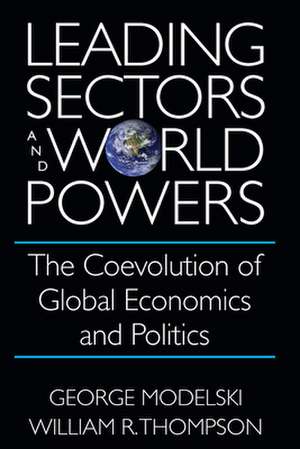
Leading Sectors and World Powers
Autor George Modelski, George Madelski Editat de Charles W. Kegleyen Limba Engleză Hardback – dec 1995
Contending that K-waves (processes delineating the wax and wane of industrial sectors) appear in paired sets correlated to long-cycle shifts (phases of world order punctuated by intensive bouts of global war), Modelski and Thompson construct a linked sequence of political-economic leadership extending from tenth-century China to the contemporary United States.
Preț: 367.01 lei
Puncte Express: 551
Preț estimativ în valută:
64.89€ • 76.48$ • 56.67£
64.89€ • 76.48$ • 56.67£
Carte tipărită la comandă
Livrare economică 09-23 aprilie
Specificații
ISBN-13: 9781570030543
ISBN-10: 1570030545
Pagini: 282
Dimensiuni: 157 x 233 x 24 mm
Greutate: 0.61 kg
Ediția:New.
Editura: University of South Carolina Press
ISBN-10: 1570030545
Pagini: 282
Dimensiuni: 157 x 233 x 24 mm
Greutate: 0.61 kg
Ediția:New.
Editura: University of South Carolina Press
V-ar putea interesa
-
 Common WealthJeffrey SachsPreț: 89.72 lei
 -
 -13%Preț: 385.63 lei445.72 lei
 -
 Debating Varieties of Capitalism: A ReaderBob Hancké-12%Preț: 382.75 lei435.86 lei
 -
 Human Security Report 2009/2010Human Security Report ProjectPreț: 266.82 lei
 -
 Preț: 121.64 lei
 -
 Global Imbalances and the Lessons of Bretton WoodsBarry EichengreenPreț: 223.31 lei
 -
 The Secret History of the American EmpireJohn PerkinsPreț: 112.14 lei
 -
 Asset Pricing for Dynamic EconomiesSumru AltugPreț: 354.00 lei
 -
 Doing Business GloballyFifty LessonsPreț: 49.71 lei
 -
 The World Is Curved: Hidden Dangers to the Global EconomyDavid M. SmickPreț: 129.71 lei
 -
 MeltdownPaul MasonPreț: 158.97 lei
 -
 Preț: 124.72 lei
 -
 Bad SamaritansHa-Joon Chang-20%Preț: 65.98 lei82.62 lei
 -
 Preț: 186.96 lei
 -
 -41%Preț: 181.16 lei307.86 lei
Textul de pe ultima copertă
The idea that political and economic power moves in coordinated cycles has long intrigued political scientists and political economists, for if a pattern exists in the rise and fall of international political power, a model explaining this pattern gains predictive qualities. In Leading Sectors and World Powers, George Modelski and William R. Thompson venture beyond previous attempts to explain why major powers rise, fall, and fight about their changing status to establish an explicit connection between war, economic innovation, and world leadership. They argue that surges in economic innovation, which in turn are tied to global war, determine leadership in the global system. Modelski and Thompson base their theory on the coordination of long cycles (phases of world order and decay punctuated by intensive bouts of global war) and K-waves (cycles delineating the wax and wane of leading industrial sectors). They contend that K-waves appear in paired sets correlated to long-cycle shifts in political power. Modelski and Thompson conclude by discussing the nature and timing of the next K-wave/long cycle peak, commenting on the relevance of it for U.S. industrial policy and speculating on the possibility of evolving away from this pattern in the near future.