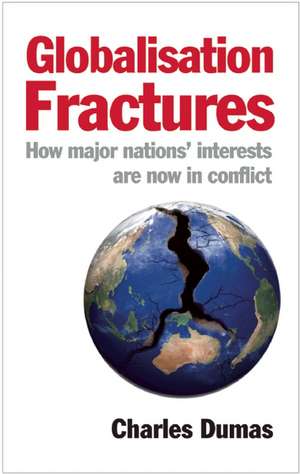
Globalisation Fractures: How major nations' interests are now in conflict
Autor Charles Dumasen Limba Engleză Paperback – 8 iul 2010
Preț: 124.72 lei
Puncte Express: 187
Carte disponibilă
Livrare economică 12-26 noiembrie
Livrare prin curier în România Termenul estimat este afișat lângă disponibilitate.
Transport gratuit de la 400.00 lei Plată online sau ramburs, în funcție de opțiunile comenzii.
Retur gratuit în 14 zile Comandă securizată și suport în română.
Specificații
ISBN-13: 9781846684241
ISBN-10: 1846684242
Pagini: 277
Dimensiuni: 140 x 218 x 20 mm
Greutate: 0.46 kg
Ediția:Main
Editura: Profile
Colecția Profile Books
Locul publicării:London, United Kingdom
ISBN-10: 1846684242
Pagini: 277
Dimensiuni: 140 x 218 x 20 mm
Greutate: 0.46 kg
Ediția:Main
Editura: Profile
Colecția Profile Books
Locul publicării:London, United Kingdom
V-ar putea interesa
-
 Federalism and Economic ReformJessica WallackPreț: 356.03 lei
 -
 Business Opportunities in EstoniaU S Dept of CommercePreț: 97.01 lei
 -
 Business Opportunities in LatviaU S Dept of CommercePreț: 98.77 lei
 -
 Business Opportunities in MaltaU S Dept of CommercePreț: 99.77 lei
 -
 Business Opportunities in the United KingdomU S Dept of CommercePreț: 103.34 lei
 -
 Business Opportunities in PortugalU S Dept of CommercePreț: 103.34 lei
 -
 Business Opportunities in SwedenU S Dept of CommercePreț: 101.94 lei
 -
 Business Opportunities in ItalyU S Dept of CommercePreț: 105.93 lei
 -
 Business Opportunities in IrelandU S Dept of CommercePreț: 100.38 lei
 -
 Business Opportunities in PolandU S Dept of CommercePreț: 104.93 lei
 -
 Business Opportunities in GermanyU S Dept of CommercePreț: 99.98 lei
 -
 Business Opportunities in GhanaU S Dept of CommercePreț: 97.58 lei
 -
 Business Opportunities in GuatemalaU S Dept of CommercePreț: 101.57 lei
 -
 Business Opportunities in HondurasU S Dept of CommercePreț: 103.34 lei
 -
 Business Opportunities in IndiaU S Dept of CommercePreț: 102.56 lei
 -
 Populism and EconomicsCharles Dumas-20%Preț: 84.94 lei105.99 lei
 -
 DECARBONOMICS: & the post-pandemic worldCharles Dumas-21%Preț: 64.75 lei82.24 lei
 -
 China And America: A Time of ReckoningCharles DumasPreț: 127.17 lei
 -
 Preț: 138.04 lei
Notă biografică
Charles Dumas is Chairman of Lombard Street Research, where he has been Head of the World Service since 1998. He is one of the world's leading macroeconomic forecasters. He was previously a journalist at The Economist, an economist at General Motors and J. P. Morgan, and then managing director in JPM's M&A department in New York.
Recenzii
To understand the causes of the financial crisis, read this insightful analysis of how globalisation led to our present predicament. This book will teach you more about why the crisis happened than any blow-by-blow account by an alleged protagonist
Charles Dumas has consistently been one of the ablest communicators on the financial crisis - a man with a nose for danger. In characteristically acerbic style, he sets out the causes of our distress, seeks out those to blame and maps out the escape routes. Required reading
Unless we correctly analyse the cause of the current crisis, we will never be able to cure it or prevent a recurrence. Most analysis does not get beneath the symptoms, but Charles Dumas gets to the root problem.
Thank God for Charles Dumas. He displays a true economist's understanding that most things in economics are the opposite of what you would suppose - that for example the global crisis has been as much the work of savings gluttons as of wanton debtors.
The question of who is to blame for the global financial crisis has been entertaining analysts - and presidents - for three years. As Charles Dumas points out in an amusingly dry introduction to his latest book, a case can be made for almost everyone. The service he performs is to focus on the responsibility of those countries that have made their way through the turmoil with a high level of savings and strong surpluses. China and Germany, then, are his prime villains, and, to some extent, Japan. They have sold their goods to an increasingly indebted world and ... lent that world the money to do so. ... the countries that have enjoyed an export-led boom cannot, as a point of logic, expect others to follow their model or they will have no one to whom to sell. He is right, too, to point to the way that China, in pegging its currency to the dollar, and Germany, within the euro, used partially fixed exchange rates to keep their already low labour costs competitive ... He has performed the service of turning the spotlight on to those hiding under a disguise of self-proclaimed virtue.
Charles Dumas has consistently been one of the ablest communicators on the financial crisis - a man with a nose for danger. In characteristically acerbic style, he sets out the causes of our distress, seeks out those to blame and maps out the escape routes. Required reading
Unless we correctly analyse the cause of the current crisis, we will never be able to cure it or prevent a recurrence. Most analysis does not get beneath the symptoms, but Charles Dumas gets to the root problem.
Thank God for Charles Dumas. He displays a true economist's understanding that most things in economics are the opposite of what you would suppose - that for example the global crisis has been as much the work of savings gluttons as of wanton debtors.
The question of who is to blame for the global financial crisis has been entertaining analysts - and presidents - for three years. As Charles Dumas points out in an amusingly dry introduction to his latest book, a case can be made for almost everyone. The service he performs is to focus on the responsibility of those countries that have made their way through the turmoil with a high level of savings and strong surpluses. China and Germany, then, are his prime villains, and, to some extent, Japan. They have sold their goods to an increasingly indebted world and ... lent that world the money to do so. ... the countries that have enjoyed an export-led boom cannot, as a point of logic, expect others to follow their model or they will have no one to whom to sell. He is right, too, to point to the way that China, in pegging its currency to the dollar, and Germany, within the euro, used partially fixed exchange rates to keep their already low labour costs competitive ... He has performed the service of turning the spotlight on to those hiding under a disguise of self-proclaimed virtue.