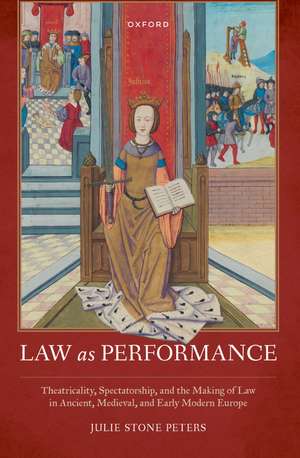
Law as Performance: Theatricality, Spectatorship, and the Making of Law in Ancient, Medieval, and Early Modern Europe: Law and Literature
Autor Julie Stone Petersen Limba Engleză Paperback – 16 apr 2026




Preț: 237.83 lei
Preț vechi: 296.00 lei
-20%
Puncte Express: 357
Carte disponibilă
Livrare economică 06-11 noiembrie
Livrare express 21-27 octombrie pentru 94.64 lei
Livrare prin curier în România Termenul estimat este afișat lângă disponibilitate.
Transport gratuit de la 400.00 lei Plată online sau ramburs, în funcție de opțiunile comenzii.
Retur gratuit în 14 zile Comandă securizată și suport în română.
Specificații
ISBN-13: 9780197903957
ISBN-10: 0197903959
Pagini: 368
Dimensiuni: 158 x 235 x 17 mm
Greutate: 0.61 kg
Editura: OUP OXFORD
Colecția OUP Oxford
Seria Law and Literature
Locul publicării:Oxford, United Kingdom
ISBN-10: 0197903959
Pagini: 368
Dimensiuni: 158 x 235 x 17 mm
Greutate: 0.61 kg
Editura: OUP OXFORD
Colecția OUP Oxford
Seria Law and Literature
Locul publicării:Oxford, United Kingdom
Recenzii
Julie Stone Peters has written a book remarkable for both its multimillennial, polyglot breadth and its numerous outrageous particulars.... [A]n impossibly erudite, analytically acute, and very funny tour of European law, as it was practiced: messily, showily, and humanly.... A wonderful book, which mobilizes vast linguistic skill, legal acumen, and general erudition to produce ... a rich, entertaining archive, which it analyzes sensitively and with a fine eye for detail, and in lucid, beautiful prose. Law and Performance is itself a bravura performance, to which future scholars will return as both a treasure trove and a model for imitation.
Justice can't be done to the depth and breadth of Peters' arguments and ideas.
Law as Performance is an adventure and a provocation that will energize the field and re-map its contours.
This is wonderful history, not only because of the deftness of its arguments but also because of the rich anecdotal detail that enlivens nearly every page. [A] marvelous book."
The volume, accompanied by an extensive bibliography and a final index of names and concepts, is well edited and easy to read...the book, thanks to the extensive number of citations and references with which it is shaped, is a masterful work in providing a comprehensive and convincing picture of the relationship between performance and law over many centuries.
Peters pursues the puzzle of law's vividae rationes, its speaking to the eye, with her characteristic erudition, analytic acuity and verbal verve. The long history of legal theatrics, of air filled with gestures, of the clamor of the pit, of costume, contumely and conflict here find their appositely dramatic inscription. Exhaustive and meticulous, the history of the myriad forms in which jurists have staged legal judgement takes on an urgent topicality as social media and its omnivoyant lenses fulminate the forensic forum into the viral voracity and extravagant exposure of an increasingly populist online public sphere. In sum and pestle, Law as Performance brilliantly transforms the cold gray Janus face of the jurist into the terpsichorean and tempestive figure of justice being done.
In this extraordinarily detailed study, Julie Stone Peters lays out the rich tradition of lawyerly performance and establishes in an entirely persuasive manner the uneasy, tension-filled and yet symbiotic relationship between law's desire to inhabit a cool rational center and the inevitable eruption of eloquence and emotion in the services of causes both noble and savage. A fine achievement.
In this fascinating and elegantly written monograph, Julie Stone Peters explores the theatricality of trials and punishments in ancient, medieval, and Early Modern Europe. She profoundly interrogates the somewhat Whiggish notion that one can draw a clear line between justice and the performance of the law, let alone that there is an increasing dissonance between the two as England entered modernity. This is wonderful history, not only because of the deftness of its arguments but also because of the rich anecdotal detail that enlivens nearly every page. Legal studies have been well served by this marvelous book.
The jury is in: with compelling scholarship that matches evidence and argument across 2,000 years of legal rhetorical practice, Julie Stone Peters proves that the continuities of law as performance are as startling as the changes, and she dramatizes how theatricality and anti-theatricality plead their cases before the bar of Janus-faced Lady Justice with adversarial vehemence and at times shocking irreverence.
To make authority requires being seen as having the capacity to call the disobedient to account. As Julie Stone Peters brilliantly excavates in her analysis of the 'performance of law' in literary and legal accounts, the audience regularly took center stage. This volume is a treasure trove of ideas and images illuminating the interwoven fabric of courts and theater, as both genres are dependent on spectatorship for their vitality.
The book has great significance, not only for discussing the role of jurisprudence and the production of law, it is also important for those working on history of legal jurisprudence beyond the confines of law as a set of rules, doctrines and concepts...it is important for various disciplines like history, European studies and language and literature.
This wonderfully kaleidoscopic collection of thematic essays reveals hidden doors to various legal cultures. Peters has woven together the history of procedural law, rhetoric, theatre, the development of legal professions and legal iconography into the rich canvas of her highly original book. This indicates that scholars from many disciplines will find the book to be of interest.
Law is everywhere and all around us... Her book offers both a history and jurisprudential-or legal philosophical-rethinking of the opacity of lawyers' law, drawing on her field of performance studies to return law to a world of visibility.
This book could mark the beginning of a theoretical renewal of legal history.
Law and Performance is itself a bravura performance, to which future scholars will return as both a treasure trove and a model for imitation.
Julie Stone Peters's Law as Performance invites readers to step away from the decrees, doctrines, and debates that dominate the Western legal tradition and turn instead to how the law was experienced by ordinary people who not only observed it in action but also found ways to challenge and subvert it.
[A]n authoritative, book-length study of legal-theatrical practice, staggering in its breadth and erudition, spanning the history of Ancient, Mediaeval and Early Modern European courts, which offers to become a field-defining work of scholarship.
This book is a major contribution to the study of theatricality and law in not only the period surveyed but in the European tradition as a whole.
Justice can't be done to the depth and breadth of Peters' arguments and ideas.
Law as Performance is an adventure and a provocation that will energize the field and re-map its contours.
This is wonderful history, not only because of the deftness of its arguments but also because of the rich anecdotal detail that enlivens nearly every page. [A] marvelous book."
The volume, accompanied by an extensive bibliography and a final index of names and concepts, is well edited and easy to read...the book, thanks to the extensive number of citations and references with which it is shaped, is a masterful work in providing a comprehensive and convincing picture of the relationship between performance and law over many centuries.
Peters pursues the puzzle of law's vividae rationes, its speaking to the eye, with her characteristic erudition, analytic acuity and verbal verve. The long history of legal theatrics, of air filled with gestures, of the clamor of the pit, of costume, contumely and conflict here find their appositely dramatic inscription. Exhaustive and meticulous, the history of the myriad forms in which jurists have staged legal judgement takes on an urgent topicality as social media and its omnivoyant lenses fulminate the forensic forum into the viral voracity and extravagant exposure of an increasingly populist online public sphere. In sum and pestle, Law as Performance brilliantly transforms the cold gray Janus face of the jurist into the terpsichorean and tempestive figure of justice being done.
In this extraordinarily detailed study, Julie Stone Peters lays out the rich tradition of lawyerly performance and establishes in an entirely persuasive manner the uneasy, tension-filled and yet symbiotic relationship between law's desire to inhabit a cool rational center and the inevitable eruption of eloquence and emotion in the services of causes both noble and savage. A fine achievement.
In this fascinating and elegantly written monograph, Julie Stone Peters explores the theatricality of trials and punishments in ancient, medieval, and Early Modern Europe. She profoundly interrogates the somewhat Whiggish notion that one can draw a clear line between justice and the performance of the law, let alone that there is an increasing dissonance between the two as England entered modernity. This is wonderful history, not only because of the deftness of its arguments but also because of the rich anecdotal detail that enlivens nearly every page. Legal studies have been well served by this marvelous book.
The jury is in: with compelling scholarship that matches evidence and argument across 2,000 years of legal rhetorical practice, Julie Stone Peters proves that the continuities of law as performance are as startling as the changes, and she dramatizes how theatricality and anti-theatricality plead their cases before the bar of Janus-faced Lady Justice with adversarial vehemence and at times shocking irreverence.
To make authority requires being seen as having the capacity to call the disobedient to account. As Julie Stone Peters brilliantly excavates in her analysis of the 'performance of law' in literary and legal accounts, the audience regularly took center stage. This volume is a treasure trove of ideas and images illuminating the interwoven fabric of courts and theater, as both genres are dependent on spectatorship for their vitality.
The book has great significance, not only for discussing the role of jurisprudence and the production of law, it is also important for those working on history of legal jurisprudence beyond the confines of law as a set of rules, doctrines and concepts...it is important for various disciplines like history, European studies and language and literature.
This wonderfully kaleidoscopic collection of thematic essays reveals hidden doors to various legal cultures. Peters has woven together the history of procedural law, rhetoric, theatre, the development of legal professions and legal iconography into the rich canvas of her highly original book. This indicates that scholars from many disciplines will find the book to be of interest.
Law is everywhere and all around us... Her book offers both a history and jurisprudential-or legal philosophical-rethinking of the opacity of lawyers' law, drawing on her field of performance studies to return law to a world of visibility.
This book could mark the beginning of a theoretical renewal of legal history.
Law and Performance is itself a bravura performance, to which future scholars will return as both a treasure trove and a model for imitation.
Julie Stone Peters's Law as Performance invites readers to step away from the decrees, doctrines, and debates that dominate the Western legal tradition and turn instead to how the law was experienced by ordinary people who not only observed it in action but also found ways to challenge and subvert it.
[A]n authoritative, book-length study of legal-theatrical practice, staggering in its breadth and erudition, spanning the history of Ancient, Mediaeval and Early Modern European courts, which offers to become a field-defining work of scholarship.
This book is a major contribution to the study of theatricality and law in not only the period surveyed but in the European tradition as a whole.
Notă biografică
JULIE STONE PETERS (B.A. Yale, Ph.D. Princeton, J.D. Columbia) is the H. Gordon Garbedian Professor of English and Comparative Literature at Columbia University, an Affiliated faculty member at Columbia Law School, and a Global Professorial Fellow at Queen Mary University School of Law. A scholar of law and humanities and media history, she studies performance, film, digital, and legal cultures across the longue durée. Her books include Staging Witchcraft Before the Law: Skepticism, Performance as Proof, and Law as Magic in Early Modern Witch Trials (Cambridge UP, 2024) and Theatre of the Book: Print, Text, and Performance in Europe 1480-1880 (OUP, 2000, winner of the MLA's Harry Levin Prize and English Association's Beatrice White Prize, and finalist for the Barnard Hewitt Award). Her more public-facing essays have appeared in the New York Times Book Review, London Review of Books, Slate, the Village Voice, Public Books, and elsewhere.