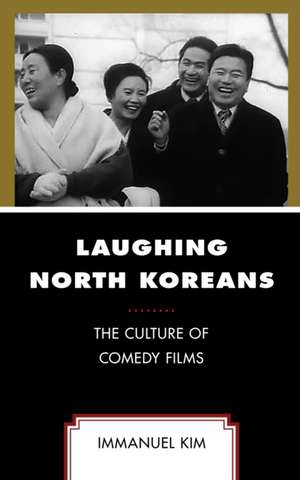
Laughing North Koreans: The Culture of Comedy Films
Autor Immanuel Kimen Limba Engleză Paperback – 21 dec 2021
| Toate formatele și edițiile | Preț | Express |
|---|---|---|
| Paperback (1) | 242.07 lei 6-8 săpt. | |
| Bloomsbury Publishing – 21 dec 2021 | 242.07 lei 6-8 săpt. | |
| Hardback (1) | 623.64 lei 6-8 săpt. | |
| Bloomsbury Publishing – 22 iun 2020 | 623.64 lei 6-8 săpt. |
Preț: 242.07 lei
Preț vechi: 338.52 lei
-28%
Puncte Express: 363
Preț estimativ în valută:
42.80€ • 50.46$ • 37.42£
42.80€ • 50.46$ • 37.42£
Carte tipărită la comandă
Livrare economică 04-18 aprilie
Specificații
ISBN-13: 9781793608314
ISBN-10: 1793608318
Pagini: 178
Ilustrații: 15 b/w illustrations;1 tables;
Dimensiuni: 153 x 231 x 10 mm
Greutate: 0.25 kg
Editura: Bloomsbury Publishing
Colecția Lexington Books
Locul publicării:New York, United States
ISBN-10: 1793608318
Pagini: 178
Ilustrații: 15 b/w illustrations;1 tables;
Dimensiuni: 153 x 231 x 10 mm
Greutate: 0.25 kg
Editura: Bloomsbury Publishing
Colecția Lexington Books
Locul publicării:New York, United States
Cuprins
Introduction: Let's Proceed With Laughter
Chapter 1: Comedian Comedy: Faces of the Industry
Chapter 2: I Spy a Spy: Social Anxiety and Farce in Boasting Too Much
Chapter 3: Taming of the Chief: Interruptive Laughter and Gender Politics in My Family's Problem
Chapter 4: Mind Your Manners: Comedy of Manners in Day at the Amusement Park
Chapter 5: Love and Marriage: Romantic Comedy as Visual Culture
Chapter 1: Comedian Comedy: Faces of the Industry
Chapter 2: I Spy a Spy: Social Anxiety and Farce in Boasting Too Much
Chapter 3: Taming of the Chief: Interruptive Laughter and Gender Politics in My Family's Problem
Chapter 4: Mind Your Manners: Comedy of Manners in Day at the Amusement Park
Chapter 5: Love and Marriage: Romantic Comedy as Visual Culture
Recenzii
Laughing North Koreans: The Culture of Comedy Films is ultimately a fascinating and extensive study of a subject seldom covered in this way. Immanuel Kim draws the reader into a cultural space where unexpectedly there are starts like Kim Se-yong and franchises such as the My Family's Problem series, which North Korean audiences really could have engaged with and followed through the years. Readers will be more than satisfied with Kim's careful analysis of these films and the legacies and histories they leave.
At last there is a book that reads North Korean cinema beyond the usual focus on political events, personality cult, and propaganda function. Focusing on seldom-studied comedy films from North Korea, Laughing North Koreans: The Culture of Comedy Films opens up the field by situating North Korean cinema at the confluence of national cinema, film genre, cultural studies, and identity politics. Immanuel Kim's exciting, finely-researched book is a must-read for anyone interested in socialist cinema, Korean film history, and North Korean history, film, and culture.
Kim (Korean literature and culture, George Washington Univ.) analyzes film comedy in the Democratic People's Republic of Korea, looking at the impact comedians have had there. Kim provides a fascinating discussion of how filmmakers and actors negotiate required ideological and political rhetoric, reinforcing Juche (the state ideology) and the dictates of the ruling Kim family, while at the same time provoking laughter. In the book's five chapters Kim examines "comedian comedy," Boasting Too Much (a 1970 spy satire), the My Family's Problem films (1973 onward), A Day at the Amusement Park (1978), and the visual and traditional culture found in North Korean romantic comedies. The volume doubles as a study of Kim Se-yongin (winner of the People's Actor award), who stars in most of these films and is, Kim argues, "the most important actor in North Korean comedy films" (p. 12). The volume is well written and eminently readable. . . this is a valuable book on an underrepresented topic and on what Kim refers to as "the process in which films are conceived, negotiated and produced in the North Korean film industry" (p. 58). Summing Up: Highly recommended. Upper-division undergraduates through faculty.
At last there is a book that reads North Korean cinema beyond the usual focus on political events, personality cult, and propaganda function. Focusing on seldom-studied comedy films from North Korea, Laughing North Koreans: The Culture of Comedy Films opens up the field by situating North Korean cinema at the confluence of national cinema, film genre, cultural studies, and identity politics. Immanuel Kim's exciting, finely-researched book is a must-read for anyone interested in socialist cinema, Korean film history, and North Korean history, film, and culture.
Kim (Korean literature and culture, George Washington Univ.) analyzes film comedy in the Democratic People's Republic of Korea, looking at the impact comedians have had there. Kim provides a fascinating discussion of how filmmakers and actors negotiate required ideological and political rhetoric, reinforcing Juche (the state ideology) and the dictates of the ruling Kim family, while at the same time provoking laughter. In the book's five chapters Kim examines "comedian comedy," Boasting Too Much (a 1970 spy satire), the My Family's Problem films (1973 onward), A Day at the Amusement Park (1978), and the visual and traditional culture found in North Korean romantic comedies. The volume doubles as a study of Kim Se-yongin (winner of the People's Actor award), who stars in most of these films and is, Kim argues, "the most important actor in North Korean comedy films" (p. 12). The volume is well written and eminently readable. . . this is a valuable book on an underrepresented topic and on what Kim refers to as "the process in which films are conceived, negotiated and produced in the North Korean film industry" (p. 58). Summing Up: Highly recommended. Upper-division undergraduates through faculty.