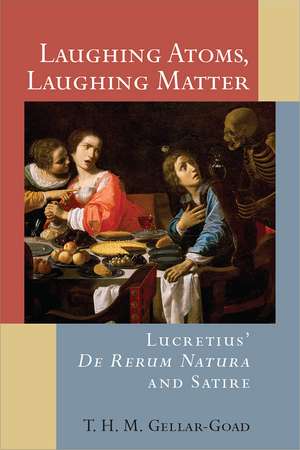
Laughing Atoms, Laughing Matter: Lucretius' De Rerum Natura and Satire
Autor T. H. M. Gellar-Goaden Limba Engleză Hardback – 14 feb 2020
Gellar-Goad aims to track De Rerum Natura along two paths of satire: first, the broad boulevard of satiric literature from the beginnings of Greek poetry to the plays, essays, and broadcast media of the modern world; and second, the narrower lane of Roman verse satire, satura, beginning with early authors Ennius and Lucilius and closing with Flavian poet Juvenal. Lucilius is revealed as a major, yet overlooked, influence on Lucretius.
By examining how Lucretius’ poem employs the tools of satire, we gain a richer understanding of how it interacts with its purported philosophical program.
Preț: 581.64 lei
Preț vechi: 718.07 lei
-19% Nou
Puncte Express: 872
Preț estimativ în valută:
102.92€ • 120.69$ • 90.39£
102.92€ • 120.69$ • 90.39£
Carte indisponibilă temporar
Doresc să fiu notificat când acest titlu va fi disponibil:
Se trimite...
Preluare comenzi: 021 569.72.76
Specificații
ISBN-13: 9780472131808
ISBN-10: 047213180X
Pagini: 290
Ilustrații: 2 tables
Dimensiuni: 152 x 229 x 25 mm
Greutate: 0.51 kg
Editura: UNIVERSITY OF MICHIGAN PRESS
Colecția University of Michigan Press
ISBN-10: 047213180X
Pagini: 290
Ilustrații: 2 tables
Dimensiuni: 152 x 229 x 25 mm
Greutate: 0.51 kg
Editura: UNIVERSITY OF MICHIGAN PRESS
Colecția University of Michigan Press
Notă biografică
T. H. M. Gellar-Goad is Associate Professor of Classics and Zachary T. Smith Fellow, Wake Forest University.
Recenzii
"This is a dense and thoughtful book that makes an important contribution to studies of Lucretius and satire. It well repays time spent with it."
--ExClass
--ExClass
"Impeccably researched and accompanied by an exhaustive panoply of scholarly citations (conveniently offered as actual footnotes), this is a remarkable and magisterial contribution to Lucretian scholarship." —CHOICE
"G.-G.’s engagingly written analysis of DRN’s satirical aspects and its influence on subsequent Roman satire is both illuminating and convincing, as is his analysis of satire itself and of the interaction between satire and philosophy."
—The Classical Review
—The Classical Review
"[T]his insightful book, showing us for the first time how pervasive Lucretius’ satiric usage is, becomes an important one for a broad range of scholars from the history of physics to classicists and those who study the crucial role of poetry on the development of Western thought over the last two millennia."
-- Sun News Tucson
-- Sun News Tucson
Descriere
Unexpected satire in a classic philosophical text