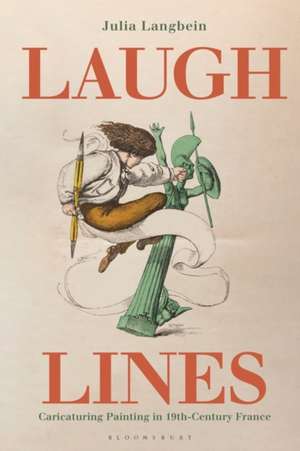
Laugh Lines
Autor Julia Langbeinen Limba Engleză Paperback – 11 iul 2024
Supported by ample primary sources, from Baudelaire and Champfleury, to Grand-Carteret and Duret, as well as archival material made available here for the first time, Laugh Lines explores not only 19th-century caricature but a larger history of reproductive image technologies, including photography, and their relation to painting during the period of modernist emergence.
In bringing to light this rich register of art criticism-in-pictures, Laugh Lines offers new material and methods for the study of 19th-century painting, modernism, and art historiography, notably repositioning Édouard Manet in relation to public laughter and comic press art. More generally, Langbein draws back the curtain on a robust culture of comedy around fine art and its reception in 19th-century France, one in which artists of every stripe, including the most sentimental or conservative, were ripe to be made hilarious.
| Toate formatele și edițiile | Preț | Express |
|---|---|---|
| Paperback (1) | 172.49 lei 3-5 săpt. | +80.75 lei 4-10 zile |
| BLOOMSBURY ACADEMIC – 11 iul 2024 | 172.49 lei 3-5 săpt. | +80.75 lei 4-10 zile |
| Hardback (1) | 558.52 lei 23-29 zile | |
| Bloomsbury Publishing – 10 mar 2022 | 558.52 lei 23-29 zile |
Preț: 172.49 lei
Preț vechi: 234.35 lei
-26%
Puncte Express: 259
Preț estimativ în valută:
30.54€ • 35.56$ • 26.53£
30.54€ • 35.56$ • 26.53£
Carte disponibilă
Livrare economică 03-17 februarie
Livrare express 17-23 ianuarie pentru 90.74 lei
Preluare comenzi: 021 569.72.76
Specificații
ISBN-13: 9781350186897
ISBN-10: 1350186899
Pagini: 256
Ilustrații: 43 colour and 46 bw illus
Dimensiuni: 156 x 232 x 18 mm
Greutate: 0.45 kg
Editura: BLOOMSBURY ACADEMIC
Locul publicării:London, United Kingdom
ISBN-10: 1350186899
Pagini: 256
Ilustrații: 43 colour and 46 bw illus
Dimensiuni: 156 x 232 x 18 mm
Greutate: 0.45 kg
Editura: BLOOMSBURY ACADEMIC
Locul publicării:London, United Kingdom
Cuprins
Introduction
1. Comic Reproduction in July Monarchy Paris
2. Dueling and Doubling: The Antagonism of Salon Caricature (1843-1852)
3. Physiognomy and Salon Caricature's Comic Perception
4. Salon Caricature and Reproductive Etching: The Critical Picture in the Age of Photography
5. Gravity and Graphic Medium in Cham and Daumier
6. Caricature and Comic Spectacle at the Paris Salon (1852-1881)
7. Salon Caricature, Public Laughter and the Making of Manet
Index
1. Comic Reproduction in July Monarchy Paris
2. Dueling and Doubling: The Antagonism of Salon Caricature (1843-1852)
3. Physiognomy and Salon Caricature's Comic Perception
4. Salon Caricature and Reproductive Etching: The Critical Picture in the Age of Photography
5. Gravity and Graphic Medium in Cham and Daumier
6. Caricature and Comic Spectacle at the Paris Salon (1852-1881)
7. Salon Caricature, Public Laughter and the Making of Manet
Index
Recenzii
Widely researched, and lavishly illustrated, Laugh Lines makes both a challenging and inspirational reading. Supported by ample studies of the abundant primary sources, the book straddles several areas: reproductive technologies, the practices of physiognomy, photography, and Salon history.
Laugh Lines makes a significant contribution to our understanding of cultural and artistic changes in France from the 1840s to 1880s. It offers an important corrective to the historiography on caricature and modernist painting, and illuminates shifting relations between visual art, literature, and journalism.
In this enthralling study of nineteenth-century Salon caricature, distinctive but neglected artists like Bertall and Cham benefit from being compared with Daumier and Nadar in a wide-ranging historical analysis which explores the extensive variety of printmaking techniques available at the time.
Julia Langbein's engaging and impeccably researched volume enriches our comprehension of the spatial and social dynamics of Salon spectatorship. It will become required reading for anyone interested in art headquartered in nineteenth-century Paris.
Laugh Lines makes a significant contribution to our understanding of cultural and artistic changes in France from the 1840s to 1880s. It offers an important corrective to the historiography on caricature and modernist painting, and illuminates shifting relations between visual art, literature, and journalism.
In this enthralling study of nineteenth-century Salon caricature, distinctive but neglected artists like Bertall and Cham benefit from being compared with Daumier and Nadar in a wide-ranging historical analysis which explores the extensive variety of printmaking techniques available at the time.
Julia Langbein's engaging and impeccably researched volume enriches our comprehension of the spatial and social dynamics of Salon spectatorship. It will become required reading for anyone interested in art headquartered in nineteenth-century Paris.