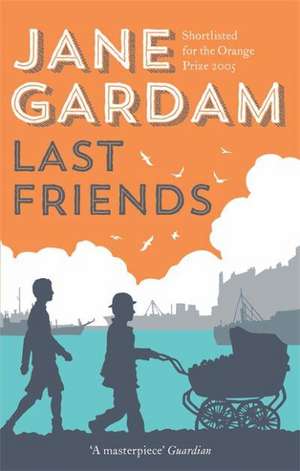
Last Friends
Autor Jane Gardamen Limba Engleză Paperback – 18 feb 2014
Înscriindu-se în genul ficțiunii contemporane de factură psihologică, Last Friends subversează așteptările unei încheieri liniare, oferind în schimb o meditație circulară despre memorie și rivalitate. Notăm cu interes cum Jane Gardam alege să închidă trilogia începută cu Old Filth nu prin ochii protagonistului deja cunoscut, ci prin perspectiva lui Terence Veneering. Acesta, marele rival de la tribunalele din Hong Kong, devine lentila prin care retrăim o epocă apusă a Imperiului, marcată de o etichetă rigidă și pasiuni reprimate. Reținem finețea cu care autoarea explorează „ferocitatea blândă” a singurătății și a bătrâneții, transformând o dispută de o viață într-o formă stranie de camaraderie. Forța narativă a lui Jane Gardam combinată cu sensibilitatea explorării relațiilor umane regăsită la Joanna Trollope în The Best Of Friends — dar cu un glas propriu, marcat de un umor sec și o precizie aproape chirurgicală a frazei — conferă acestui volum statutul de clasic modern. Față de volumele anterioare, Old Filth și The Man in the Wooden Hat, care disecau căsnicia și cariera lui Sir Edward Feathers, Last Friends funcționează ca o piesă de puzzle esențială care completează imaginea unei întregi generații. Dacă în culegeri precum The Stories autoarea exersa concizia, aici stăpânește arta de a sugera destine întregi prin detalii aparent banale, demonstrând de ce este considerată una dintre cele mai rafinate voci ale literaturii engleze actuale.
Preț: 58.71 lei
Preț vechi: 78.95 lei
-26%
Carte disponibilă
Livrare economică 16-30 noiembrie
Livrare express 30 octombrie-05 noiembrie pentru 39.87 lei
Specificații
ISBN-10: 0349000166
Pagini: 241
Dimensiuni: 130 x 198 x 17 mm
Greutate: 0.21 kg
Editura: Little Brown
Colecția Abacus
Locul publicării:London, United Kingdom
V-ar putea interesa
-
 The Book That Held Her HeartMark LawrencePreț: 110.05 lei
 -
 The Last WeekendHannah BegbiePreț: 71.57 lei
 -
 The OpportunistTarryn FisherPreț: 71.99 lei
 -
 The Tradwife's SecretLiane ChildPreț: 72.46 lei
 -
 The TreasuresHarriet EvansPreț: 118.91 lei
 -
 AmsterdamIan McEwan-18%Preț: 58.25 lei71.42 lei
 -
 The FavouriteFran LittlewoodPreț: 110.12 lei
 -
 The People On Privilege HillJane Gardam-26%Preț: 57.66 lei78.33 lei
 -
 The Man in the Wooden HatJane Gardam-26%Preț: 58.96 lei79.25 lei
 -
 Old FilthJane Gardam-25%Preț: 59.00 lei79.12 lei
 -
 -24%Preț: 89.39 lei117.18 lei
 -
 The Best Of FriendsJoanna Trollope-32%Preț: 57.79 lei84.70 lei
 -
 -32%Preț: 74.14 lei109.46 lei
 -
 -25%Preț: 54.52 lei72.78 lei
 -
 -24%Preț: 122.56 lei160.97 lei
 -
 We Would Have Told Each Other EverythingJudith HermannPreț: 92.76 lei
 -
 All that Remains for UsVirginie GrimaldiPreț: 71.88 lei
 -
 One Hour of FervourMuriel BarbaryPreț: 79.05 lei
 -
 AlwaysNicola GriffithPreț: 94.69 lei
De ce să citești această carte
Recomandăm această carte cititorilor care apreciază proza britanică de înaltă clasă, unde miza nu stă în acțiune, ci în nuanțele caracterului uman. Este o lectură despre demnitate, regrete și felul în care timpul transformă rivalitățile în legături indisolubile. Veți câștiga o perspectivă profundă asupra modului în care istoria personală se împletește cu istoria mare, totul într-un stil elegant care amintește de marii maeștri ai literaturii clasice.
Despre autor
Jane Gardam este o figură emblematică a literaturii britanice contemporane, fiind singura autoare distinsă de două ori cu prestigiosul premiu Whitbread/Costa pentru cel mai bun roman (pentru The Queen of the Tambourine și The Hollow Land). Născută în Yorkshire și stabilită în Kent, Gardam a construit o operă vastă ce include romane precum God on the Rocks (nominalizat la Booker Prize) și volume de povestiri premiate. Stilul său, adesea comparat cu cel al lui Jane Austen pentru ironia fină și observația socială, este dublat de o profunzime emoțională care i-a adus recunoașterea internațională și numeroase distincții pentru întreaga carieră.
Descriere
'Sharp, humane, generous and wonderfully funny, she is one of our very finest writers' Hilary Mantel
'This humorous, melancholic final volume establishes the trilogy as a modern classic' Kate Saunders, The Times
Old Filth and The Man in the Wooden Hat told with bristling tenderness and black humour the stories of that Titan of the Hong Kong law courts, Old Filth QC, and his clever, misunderstood wife Betty. Last Friends, the final volume of this trilogy, picks up with Terence Veneering, Filth's great rival in work and -though it was never spoken of - in love.
Veneering, Filth and their friends tell a tale of love, friendship, grace, the bittersweet experiences of a now-forgotten Empire and the disappointments and consolations of age.
Recenzii
'[Gardam] writes about love, death, loneliness, money, and madness with such gentle ferocity that she is often compared to Jane Austen, though a closer analogy is with Samuel Beckett. The "Old Filth" trilogy should be read by anyone who has ever been interested in how we become who we are' Amanda Craig, Independent on Sunday
Old Filth and The Man in the Wooden Hat told with bristling tenderness and black humour the stories of that Titan of the Hong Kong law courts, Old Filth QC, and his clever, misunderstood wife Betty. Last Friends, the final volume of this trilogy, picks up with Terence Veneering, Filth's great rival in work and - though it was never spoken of - in love.
Veneering, Filth and their friends tell a tale of love, friendship, grace, the bittersweet experiences of a now-forgotten Empire and the disappointments and consolations of age.
'Her writing is immaculately elegant and this humorous, melancholic final volume establishes the trilogy as a modern classic' Kate Saunders, The Times
Sharp, humane, generous and wonderfully funny, she is one of our very finest writers
Exuberant and funny and dizzy and a little bit frightening... an ambitious and complex portrait of extraordinary times
Gardam's writing is beautiful - cool clear and wickedly funny
As funny as as surreptitiously moving a novel as you'll find... her observations and sentences stalk you, making you chuckle in unexpected situations long after putting the book aside
She is a brilliant writer. Her prose sparkles with wit, compassion and humor. She keeps us entertained, and she keeps us guessing. Be thankful for her books. Be thankful for this trilogy, which is ultimately an elegy, created with deep affection
Last Friends is evocative, elegiac, and shaded in autumnal tones, as suits the final volume in a trilogy. Like Evelyn Waugh's Brideshead Revisited, the Old Filth trilogy restores us to an era rich in spectacle and bristling with insinuation and intrigue. Vivid, spacious, superbly witty, and refreshingly brisk . . . the story (and the author) will endure
Her effortless command of character and narrative sweeps you right along...Among other things, she provides an unsentimental but oddly hopeful vision of old age
The satisfying conclusion to Gardam's Old Filth trilogy offers exquisite prose, wry humor, and keen insights into aging and death
[Gardam] is the best kind of literary escape: serious, mesmerizing, and deeply satisfying
If Rudyard Kipling was the laureate of the British Empire, then Jane Gardam is surely the closest thing we have to a laureate of its demise . . . Spanning nearly a century, the three novels offer a compelling, finely nuanced tableau of the end of an era and the passing of the generation that sustained it... a perfectly balanced ending to the trilogy that is Jane Gardam's masterpiece
Gardam writes about love, death, loneliness, money and madness with such gentle ferocity that she is often compared to Jane Austen, though a closer analogy is with Samuel Beckett. The Old Filth trilogy should be read by anyone who has ever been interested in how we become who we are
It's hard...not to be charmed by a writer with Gardam's substantial gifts
A consummate storyteller, she writes of life with wonderful gusto and wry humour
Gardam's style is witty and graceful, at times reminiscent of Muriel Spark
Cinematic... the work of a maestro
There is more humour, pathos and compassion crammed into this slim volume than many a book twice its length
Her prose is so perceptive and fluid that it feels mentally healthful, exiling the noise and clutter of your mind as efficiently as a Schubert sonata
All three Gardam books are beautifully written but its a pleasure to note that Last Friends is the most enjoyable, the funniest and the most touching... Like [Robertson] Davies, she fills the pages of her trilogy with surprises that make the reader hurry forward
An ambitious and complex portrait of extraordinary times
If Rudyard Kipling was the laureate of the British Empire, then Jane Gardam is surely the closest thing we have to a laureate of its demise...Spanning nearly a century, the three novels offer a compelling, finely nuanced tableau of the end of an era and the passing of the generation that sustained it. Part of the genius of each successive book is that it does not continue the story so much as rework it from a different angle.
This is as mordantly precise and moving a novel as you will find anywhere