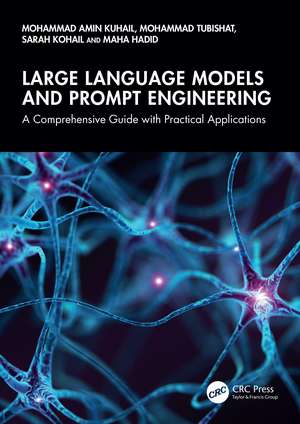
Large Language Models and Prompt Engineering: A Comprehensive Guide with Practical Applications
Autor Mohammad Amin Kuhail, Mohammad Tubishat, Sarah Kohail, Maha Hadiden Limba Engleză Paperback – 19 oct 2026
Beginning with the fundamentals of LLMs and prompt engineering, this book progressively explores advanced prompting techniques, application and interaction frameworks, and the underlying architectures that power modern language models. Dedicated chapters examine how LLMs are being applied in high-impact domains such as healthcare, customer support, and education, highlighting design principles, implementation considerations, and illustrative case studies. The book also addresses model fine-tuning, evaluation methods, and the ethical, social, and regulatory challenges associated with deploying LLMs at scale.
This book supports readers in:
· Understanding prompt engineering strategies and application frameworks
· Gaining insight into contemporary LLM architecture and capabilities
· Designing and evaluating LLM-based systems across real-world domains
· Considering ethics, safety, and human-centered aspects of LLM deployment
This book is a practical, accessible resource for those seeking to work thoughtfully and responsibly with LLMs in both academic and applied settings.
Preț: 451.96 lei
Preț vechi: 564.95 lei
-20% Precomandă
Puncte Express: 678
Carte nepublicată încă
Livrare prin curier în România Precomanda se expediază când titlul devine disponibil.
Transport gratuit pentru acest produs Plată online sau ramburs, în funcție de opțiunile comenzii.
Retur gratuit în 14 zile Comandă securizată și suport în română.
Doresc să fiu notificat când acest titlu va fi disponibil:
Se trimite...
Specificații
ISBN-13: 9781041041160
ISBN-10: 1041041160
Pagini: 238
Ilustrații: 144
Dimensiuni: 174 x 246 mm
Greutate: 0.44 kg
Ediția:1
Editura: CRC Press
Colecția Chapman and Hall/CRC
ISBN-10: 1041041160
Pagini: 238
Ilustrații: 144
Dimensiuni: 174 x 246 mm
Greutate: 0.44 kg
Ediția:1
Editura: CRC Press
Colecția Chapman and Hall/CRC
Public țintă
Postgraduate, Professional Practice & Development, and Undergraduate AdvancedCuprins
Preface
About the Authors
Chapter 1. Introduction
Chapter 2. Prompting Techniques for Large Language Models
Chapter 3. Prompting and Applications Frameworks
Chapter 4. Architectures of Large Language Models
Chapter 5. LLMs in Healthcare: Transforming Patient Care With AI
Chapter 6. LLMs in Customer Support: From Knowledge Automation to Personalized, Emotion-Aware Service
Chapter 7. LLMs in Education: Design Principles and Applications
Chapter 8. Fine-Tuning and Evaluation of LLMs
Chapter 9. Ethical Considerations and Future Trends
Index
About the Authors
Chapter 1. Introduction
Chapter 2. Prompting Techniques for Large Language Models
Chapter 3. Prompting and Applications Frameworks
Chapter 4. Architectures of Large Language Models
Chapter 5. LLMs in Healthcare: Transforming Patient Care With AI
Chapter 6. LLMs in Customer Support: From Knowledge Automation to Personalized, Emotion-Aware Service
Chapter 7. LLMs in Education: Design Principles and Applications
Chapter 8. Fine-Tuning and Evaluation of LLMs
Chapter 9. Ethical Considerations and Future Trends
Index
Notă biografică
Mohammad Amin Kuhail is an academic and researcher specializing in human–computer interaction and applied artificial intelligence. He earned his Ph.D. in Software Development from the IT University of Copenhagen, Denmark, and holds an M.Sc. in Software Engineering from the University of York, United Kingdom. He is also an IEEE AI Ethics (CertifAIEd) Authorized Lead Assessor, reflecting his expertise in responsible and human-centered AI. Kuhail is currently an Associate Professor at Zayed University’s College of Technological Innovation in the United Arab Emirates, where he teaches undergraduate and graduate courses on web technologies, human-computer interaction, and database systems. Alongside teaching, Kuhail leads research on LMMs, chatbot technologies, human–AI interaction, and user behavior. His work examines technical design challenges and the societal implications of AI adoption across domains such as education, healthcare, and digital services. Since joining Zayed University in August 2019, he has contributed to curriculum development, interdisciplinary research, and academic leadership. Previously, he served for 6 years as an Assistant Teaching Professor at the University of Missouri–Kansas City (UMKC), USA, where he received a teaching award in 2018.
Mohammad Tubishat is an Assistant Professor at Zayed University College of Technological Innovation. Tubishat received his Ph.D. in Computer Science (Artificial Intelligence and Natural Language Processing) from the University of Malaya, Malaysia. In addition, he received master's and bachelor’s degrees in Computer Science from Yarmouk University, Jordan. Before joining Zayed University, he worked at different universities, including Yarmouk University in Jordan, Taibah University in KSA, Asia Pacific University of Technology and Innovation in Malaysia, and Skyline University College in the UAE. He has been teaching different computer science courses for undergraduate and graduate programs. Tubishat's research areas are Artificial Intelligence, Machine Learning, Sentiment Analysis, Natural Language Processing, and Optimization Algorithms. He has published several peer-reviewed papers in top-ranked journals and conference proceedings.
Sarah Kohail is an Assistant Professor at Zayed University, Abu Dhabi. She holds a Ph.D. in Computer Science from the University of Hamburg and worked as a Research Assistant for several years. She has a deep academic foundation in graph-based text representations, text summarization, and semantic similarity, which she has applied in research and industry. Before joining Zayed University, Kohail spent several years in industry as a Senior Data Scientist, where she developed advanced NLP models, including recommendation systems and knowledge graphs. Her current research focuses on Arabic text detoxification, context-aware anonymization of legal texts, and the application of AI across various domains.
Maha Hadid is an experienced educator with a robust academic background and more than 15 years of teaching experience. Currently a senior instructor at Zayed University in the United Arab Emirates, she holds a Master of Science in Information Sciences and Systems from the University of Marseille, France. Hadid brings extensive expertise to teaching undergraduate IT courses, specializing in system design, database management, and data analysis. In addition to her teaching, she has co-authored a book on object-oriented programming and machine learning. Her professional credentials include being a Fellow of the Higher Education Academy (UK) and a Certified Scrum Master. She has demonstrated exceptional skills in instructional design, developing both blended and classroom-based courses through extensive training in pedagogy and learning theories. Hadid’s current focus involves leveraging advanced prompt engineering and low-code system design to develop practical applications across various disciplines.
Mohammad Tubishat is an Assistant Professor at Zayed University College of Technological Innovation. Tubishat received his Ph.D. in Computer Science (Artificial Intelligence and Natural Language Processing) from the University of Malaya, Malaysia. In addition, he received master's and bachelor’s degrees in Computer Science from Yarmouk University, Jordan. Before joining Zayed University, he worked at different universities, including Yarmouk University in Jordan, Taibah University in KSA, Asia Pacific University of Technology and Innovation in Malaysia, and Skyline University College in the UAE. He has been teaching different computer science courses for undergraduate and graduate programs. Tubishat's research areas are Artificial Intelligence, Machine Learning, Sentiment Analysis, Natural Language Processing, and Optimization Algorithms. He has published several peer-reviewed papers in top-ranked journals and conference proceedings.
Sarah Kohail is an Assistant Professor at Zayed University, Abu Dhabi. She holds a Ph.D. in Computer Science from the University of Hamburg and worked as a Research Assistant for several years. She has a deep academic foundation in graph-based text representations, text summarization, and semantic similarity, which she has applied in research and industry. Before joining Zayed University, Kohail spent several years in industry as a Senior Data Scientist, where she developed advanced NLP models, including recommendation systems and knowledge graphs. Her current research focuses on Arabic text detoxification, context-aware anonymization of legal texts, and the application of AI across various domains.
Maha Hadid is an experienced educator with a robust academic background and more than 15 years of teaching experience. Currently a senior instructor at Zayed University in the United Arab Emirates, she holds a Master of Science in Information Sciences and Systems from the University of Marseille, France. Hadid brings extensive expertise to teaching undergraduate IT courses, specializing in system design, database management, and data analysis. In addition to her teaching, she has co-authored a book on object-oriented programming and machine learning. Her professional credentials include being a Fellow of the Higher Education Academy (UK) and a Certified Scrum Master. She has demonstrated exceptional skills in instructional design, developing both blended and classroom-based courses through extensive training in pedagogy and learning theories. Hadid’s current focus involves leveraging advanced prompt engineering and low-code system design to develop practical applications across various disciplines.
Descriere
This book provides a structured and accessible introduction to the theory, design, and real-world use of large language models (LLMs). As generative AI systems become embedded across industries, this book offers readers a balanced perspective that combines technical foundations with practical guidance and critical reflection.