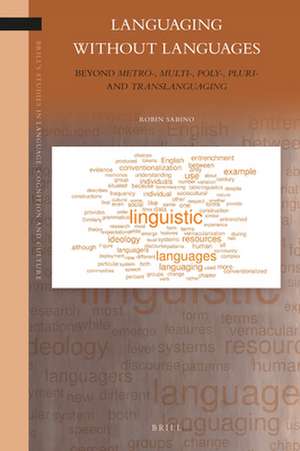
Languaging Without Languages: Beyond <i>metro-</i>, <i>multi-</i>, <i>poly-</i>, <i>pluri-</i> and <i>translanguaging</i>: Brill's Studies in Language, Cognition and Culture, cartea 18
Autor Robin Sabinoen Limba Engleză Hardback – 13 iun 2018






Preț: 641.84 lei
Preț vechi: 721.17 lei
-11% Nou
Puncte Express: 963
Preț estimativ în valută:
113.58€ • 133.18$ • 99.74£
113.58€ • 133.18$ • 99.74£
Carte tipărită la comandă
Livrare economică 09-23 februarie 26
Preluare comenzi: 021 569.72.76
Specificații
ISBN-13: 9789004364585
ISBN-10: 9004364587
Pagini: 178
Dimensiuni: 155 x 235 mm
Greutate: 0.41 kg
Ediția:approx. xiii, 139 pp.,index
Editura: Brill
Colecția Brill
Seria Brill's Studies in Language, Cognition and Culture
ISBN-10: 9004364587
Pagini: 178
Dimensiuni: 155 x 235 mm
Greutate: 0.41 kg
Ediția:approx. xiii, 139 pp.,index
Editura: Brill
Colecția Brill
Seria Brill's Studies in Language, Cognition and Culture
Cuprins
Contents
Acknowledgments
List of Illustrations
Abbreviations
Introduction: The Languages Ideology
0 Ideology
1 Discourse, Ideographs, and the Languages Ideology
2 Ongoing Signs of Discontent
3 A Plausible Alternative
1 The Staying Power of an Illusion
1.0 Introduction
1.1 A History of the Languages Ideology
1.2 The Persistent Power of False Assumptions
1.3 Dissenting Voices
1.4 Languaging, Not Languages
1.5 Summary
2 Entrenchment and the Linguistic Individual
2.0 Introduction
2.1 The Languaging Individual
2.2 Usage-based Theory and Emergent Systems
2.3 Summary
3 Conventionalization and the Illusion of Shared Grammar
3.0 Introduction
3.1 Similarities between Entrenchment and Conventionalization
3.2 Conventionalization as a Complex Emergent System: Lexical Items
3.3 Conventionalization as a Complex Emergent System: Open Slots in Constructions
3.4 The Role of Conventionalization in Linguistic Change
3.5 Summary
4 Vernacularization
4.0 Introduction
4.1 Indexes, and Indexing
4.2 Intersections: Vernacularization, Conventionalization, and the Languages Ideology
4.3 Summary
5 Conclusion
5.0 Introduction
5.1 Repeated Calls to Action, Repeated Ideological Reenactment
5.2 Liberating Insights Entrapped by the Languages Ideology
5.3 Changing the Discourse
Appendix I
Bibliography
Author Index
Subject Index
Acknowledgments
List of Illustrations
Abbreviations
Introduction: The Languages Ideology
0 Ideology
1 Discourse, Ideographs, and the Languages Ideology
2 Ongoing Signs of Discontent
3 A Plausible Alternative
1 The Staying Power of an Illusion
1.0 Introduction
1.1 A History of the Languages Ideology
1.2 The Persistent Power of False Assumptions
1.3 Dissenting Voices
1.4 Languaging, Not Languages
1.5 Summary
2 Entrenchment and the Linguistic Individual
2.0 Introduction
2.1 The Languaging Individual
2.2 Usage-based Theory and Emergent Systems
2.3 Summary
3 Conventionalization and the Illusion of Shared Grammar
3.0 Introduction
3.1 Similarities between Entrenchment and Conventionalization
3.2 Conventionalization as a Complex Emergent System: Lexical Items
3.3 Conventionalization as a Complex Emergent System: Open Slots in Constructions
3.4 The Role of Conventionalization in Linguistic Change
3.5 Summary
4 Vernacularization
4.0 Introduction
4.1 Indexes, and Indexing
4.2 Intersections: Vernacularization, Conventionalization, and the Languages Ideology
4.3 Summary
5 Conclusion
5.0 Introduction
5.1 Repeated Calls to Action, Repeated Ideological Reenactment
5.2 Liberating Insights Entrapped by the Languages Ideology
5.3 Changing the Discourse
Appendix I
Bibliography
Author Index
Subject Index
Notă biografică
Robin Sabino, Ph.D. Univeristy of Pennsylvania (1990), is a Professor of English at Auburn University. She has published on linguistic variation, contact and change, including Language Contact in the Danish West Indies: Giving Jack his Jacket (Brill, 2012).