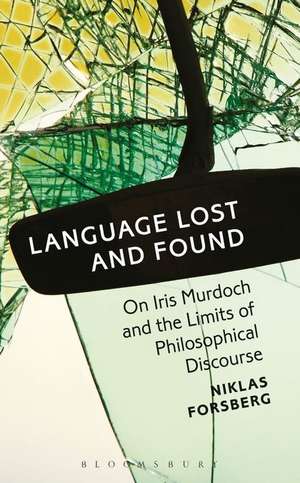
Language Lost and Found: On Iris Murdoch and the Limits of Philosophical Discourse
Autor Dr. Niklas Forsbergen Limba Engleză Paperback – 26 mar 2015
Preț: 277.79 lei
Preț vechi: 329.44 lei
-16%
Puncte Express: 417
Carte tipărită la comandă
Livrare economică 23 noiembrie-07 decembrie
Livrare prin curier în România Termenul estimat este afișat lângă disponibilitate.
Transport gratuit de la 400.00 lei Plată online sau ramburs, în funcție de opțiunile comenzii.
Retur gratuit în 14 zile Comandă securizată și suport în română.
Specificații
ISBN-13: 9781501306815
ISBN-10: 1501306812
Pagini: 256
Dimensiuni: 147 x 224 x 13 mm
Greutate: 0.35 kg
Editura: Bloomsbury Publishing
Colecția Bloomsbury Academic
Locul publicării:New York, United States
ISBN-10: 1501306812
Pagini: 256
Dimensiuni: 147 x 224 x 13 mm
Greutate: 0.35 kg
Editura: Bloomsbury Publishing
Colecția Bloomsbury Academic
Locul publicării:New York, United States
V-ar putea interesa
-
 Spandrels of TruthJc Beall-17%Preț: 170.57 lei204.98 lei
 -
 Logical PluralismJc Beall-22%Preț: 348.97 lei445.75 lei
 -
 The Philosophy of Mathematical PracticePaolo Mancosu-20%Preț: 393.03 lei493.11 lei
 -
 Truth and WordsGary Ebbs-11%Preț: 369.19 lei415.42 lei
 -
 Russell's Unknown LogicismS. Gandon-15%Preț: 608.78 lei716.22 lei
 -
 A Brief History of Analytic PhilosophyStephen P. SchwartzPreț: 259.27 lei
 -
 Naming and NecessitySaul A. KripkePreț: 208.77 lei
 -
 Log Forms 2ESainsbury-23%Preț: 440.46 lei572.03 lei
 -
 The Best Short Stories of O. HenryO. HenryPreț: 141.85 lei
 -
 PragmatismMichael BaconPreț: 203.78 lei
 -
 Meditations in an EmergencyFrank O'HaraPreț: 88.09 lei
 -
 Annie Proulx's The Shipping News: A Reader's GuideAliki Varvogli-17%Preț: 126.24 lei152.79 lei
 -
 Zadie Smith's White TeethClaire Squires-18%Preț: 126.38 lei154.21 lei
 -
 Arundhati Roy's The God of Small ThingsDr Julie Mullaney-17%Preț: 126.34 lei152.85 lei
 -
 A Companion to WittgensteinHans-Johann Glock-9%Preț: 1248.29 lei1371.75 lei
 -
 Frege on Absolute and Relative TruthU. Pardey-15%Preț: 605.06 lei711.84 lei
 -
 Wittgenstein's Ethical ThoughtY. IczkovitsPreț: 387.83 lei
 -
 Wittgenstein Reader 2eKennyPreț: 348.66 lei
 -
 Sarah Waters: Contemporary Critical PerspectivesDr Kaye Mitchell-20%Preț: 192.15 lei240.12 lei
 -
 The Life of Ian FlemingJohn Pearson-23%Preț: 101.84 lei132.81 lei
 -
 Modernism: Evolution of an IdeaProfessor Sean Latham-25%Preț: 200.84 lei266.69 lei
 -
 -24%Preț: 83.09 lei109.97 lei
 -
 Jonathan Franzen: The Comedy of RageProfessor Philip Weinstein-44%Preț: 219.16 lei390.46 lei
 -
 ThinkGuy P. HarrisonPreț: 104.18 lei
 -
 Preț: 194.78 lei
 -
 Discursive analytical strategiesNiels Åkerstrøm AndersenPreț: 326.85 lei
Cuprins
Acknowledgments ix
Introduction 1
Chapter 1
Apparent Paradoxes
1.1 The Received View and its Complications 24
1.2 Approaching "The Black Prince" 36
1.3 Localizing Murdoch 52
1.4 A Fatty Pâté and a Plateful of Cherries: On Nussbaum (on Literature) 64
1.5. The Commonplaceness of the Approach 75
1.6 Preparatory Summary: The Appearance of Paradox 90
Chapter 2
How to Make a Mirror
2.1 Murdoch on Art and Literature and Love 94
2.2 What is a Mirror? 128
2.3 Wittgenstein and the Difficulty of Acknowledging Illusions of Sense 135
2.4 Kierkegaard and Grammatical Illusions 144
2.5 Mirroring Illusions: The Thought of the Indirect Communication 152
2.6 Inheriting Wittgenstein (and Kierkegaard) 161
Chapter 3
Sensing a Sense Lost
3.1 Loss of Concepts, Loss of Questions 191
3.2 Contrasting Pictures of the Human 215
3.3 Vision over Choice 230
3.4 Making Pictures (Perfectionism and Vision) 235
Chapter 4
Reading The Black Prince
4.1 "Murdoch's Most Self-Consciously Platonic Kierkegaardian Love Story" 257
4.2 In the Context of Bradley Pearson's Form of Life 269
4.3 Passing Verdict: Who did it? 302
4.4 In Disagreement with Oneself: A Failure to Mean 310
Chapter 5
What is it Like to Be a Corpse?
5.1 Introduction: Running Out of Arguments? 318
5.2 Costello's Speechlessness and Diamond's Concerns 321
5.3 The Exemplary Bat 334
5.4 Understanding Deflection 343
5.5 Concluding Remarks 355
Chapter 6
Smashing Mirrors, Collecting the Pieces, Returning Our Words
6.1 The Concept of a Concept and the Loss of Concepts 358
6.2 Smashing Mirrors, Returning to the Ordinary 371
6.3 Literature, Distance and the Return of Our Words 376
Bibliography 389
Introduction 1
Chapter 1
Apparent Paradoxes
1.1 The Received View and its Complications 24
1.2 Approaching "The Black Prince" 36
1.3 Localizing Murdoch 52
1.4 A Fatty Pâté and a Plateful of Cherries: On Nussbaum (on Literature) 64
1.5. The Commonplaceness of the Approach 75
1.6 Preparatory Summary: The Appearance of Paradox 90
Chapter 2
How to Make a Mirror
2.1 Murdoch on Art and Literature and Love 94
2.2 What is a Mirror? 128
2.3 Wittgenstein and the Difficulty of Acknowledging Illusions of Sense 135
2.4 Kierkegaard and Grammatical Illusions 144
2.5 Mirroring Illusions: The Thought of the Indirect Communication 152
2.6 Inheriting Wittgenstein (and Kierkegaard) 161
Chapter 3
Sensing a Sense Lost
3.1 Loss of Concepts, Loss of Questions 191
3.2 Contrasting Pictures of the Human 215
3.3 Vision over Choice 230
3.4 Making Pictures (Perfectionism and Vision) 235
Chapter 4
Reading The Black Prince
4.1 "Murdoch's Most Self-Consciously Platonic Kierkegaardian Love Story" 257
4.2 In the Context of Bradley Pearson's Form of Life 269
4.3 Passing Verdict: Who did it? 302
4.4 In Disagreement with Oneself: A Failure to Mean 310
Chapter 5
What is it Like to Be a Corpse?
5.1 Introduction: Running Out of Arguments? 318
5.2 Costello's Speechlessness and Diamond's Concerns 321
5.3 The Exemplary Bat 334
5.4 Understanding Deflection 343
5.5 Concluding Remarks 355
Chapter 6
Smashing Mirrors, Collecting the Pieces, Returning Our Words
6.1 The Concept of a Concept and the Loss of Concepts 358
6.2 Smashing Mirrors, Returning to the Ordinary 371
6.3 Literature, Distance and the Return of Our Words 376
Bibliography 389
Recenzii
This fascinating book offers a valuable explication of Murdoch's relentless attempts to reveal what is missing in contemporary moral philosophy and culture. Greatly influenced by Kierkgaard, Wittgenstein, and Simone Weil, the complexity and messiness of ordinary life, and with one's deepest commitments-many of which cannot be accessed, or altered by means of arguments intended to defend philosophical "positions." Forsberg (Univ. of Uppsala, Sweden) makes excellent use of the work of Stanley Cavell, Cora Diamond, and Stephen Mulhall, who show how one might avoid the tendency of philosophers toward "deflection" from the "difficulties of reality." These are difficulties that people have when language fails in the face of experiences that refuse reduction to the abstraction of the clearly defined concepts sought after in philosophy--what Murdoch called its "dryness." Novelists like what it is like to struggle with the deeply confusing, distressing issues of the present without stepping aside from the emotional intensity of the encounters. Summing Up: Recommended. Upper-division undergraduates and above.--
A fair bang in the philosophy of literature ... Forsberg's addition to this scene is brilliant and necessary ... This [book] will reverberate.
This is one of the most philosophically sophisticated contributions to these interlinked issues that I have come across in the last decade; the care, charity and ease with which Forsberg contests and dismantles one of the most influential current readings of Murdoch (that advanced by Nussbaum) is enough on its own to make it clear that standards in this area have just been raised.
Can we lose our moral concepts? Can our culture and our understanding of the human occlude the background that alone makes sense of the ideals we want to live by? Niklas Forsberg argues that this is a basic insight of Iris Murdoch's philosophy. Moreover, this gives us the key to understanding the relation of Murdoch's philosophical writings to her novels. The latter hold a mirror to our lives, in which we could potentially become aware of this loss. This book is full of philosophical insight, not only about contemporary moral thinking but also about the relation of literature to philosophical thought.
A fair bang in the philosophy of literature ... Forsberg's addition to this scene is brilliant and necessary ... This [book] will reverberate.
This is one of the most philosophically sophisticated contributions to these interlinked issues that I have come across in the last decade; the care, charity and ease with which Forsberg contests and dismantles one of the most influential current readings of Murdoch (that advanced by Nussbaum) is enough on its own to make it clear that standards in this area have just been raised.
Can we lose our moral concepts? Can our culture and our understanding of the human occlude the background that alone makes sense of the ideals we want to live by? Niklas Forsberg argues that this is a basic insight of Iris Murdoch's philosophy. Moreover, this gives us the key to understanding the relation of Murdoch's philosophical writings to her novels. The latter hold a mirror to our lives, in which we could potentially become aware of this loss. This book is full of philosophical insight, not only about contemporary moral thinking but also about the relation of literature to philosophical thought.