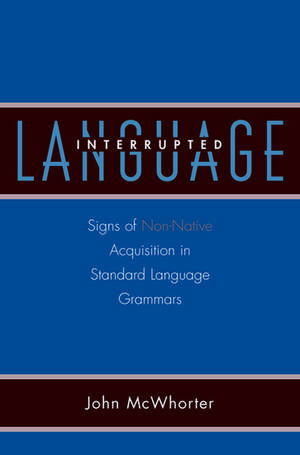
Language Interrupted: Signs of Non-Native Acquisition in Standard Language Grammars
Autor John McWhorteren Limba Engleză Hardback – 21 iun 2007
Preț: 604.21 lei
Preț vechi: 874.09 lei
-31%
Puncte Express: 906
Carte tipărită la comandă
Livrare economică 03-08 decembrie
Livrare prin curier în România Termenul estimat este afișat lângă disponibilitate.
Transport gratuit pentru acest produs Plată online sau ramburs, în funcție de opțiunile comenzii.
Retur gratuit în 14 zile Comandă securizată și suport în română.
Specificații
ISBN-13: 9780195309805
ISBN-10: 0195309804
Pagini: 304
Ilustrații: 11 illus.
Dimensiuni: 236 x 163 x 31 mm
Greutate: 0.63 kg
Editura: Oxford University Press
Colecția OUP USA
Locul publicării:New York, United States
ISBN-10: 0195309804
Pagini: 304
Ilustrații: 11 illus.
Dimensiuni: 236 x 163 x 31 mm
Greutate: 0.63 kg
Editura: Oxford University Press
Colecția OUP USA
Locul publicării:New York, United States
V-ar putea interesa
-
 Doing Our Own ThingJohn McWhorterPreț: 110.19 lei
 -
 Phraseology: Theory, Analysis, and ApplicationsA. P. Cowie-28%Preț: 432.35 lei603.12 lei
 -
 Phonological Knowledge: Conceptual and Empirical IssuesNoel Burton-Roberts-28%Preț: 361.80 lei502.49 lei
 -
 23: The Transition to LanguageAlison Wray-26%Preț: 358.40 lei487.32 lei
 -
 -28%Preț: 347.37 lei483.16 lei
 -
 Foundations of Language: Brain, Meaning, Grammar, EvolutionRay Jackendoff-10%Preț: 374.30 lei418.09 lei
 -
 Child Language: The Parametric ApproachWilliam Snyder-19%Preț: 358.15 lei442.87 lei
 -
 -28%Preț: 344.95 lei481.74 lei
 -
 The Linguistic Cycle: Language Change and the Language FacultyElly van Gelderen-25%Preț: 455.10 lei610.44 lei
 -
 Understanding Second Language AcquisitionLourdes OrtegaPreț: 422.04 lei
 -
 Alternative Approaches to Second Language AcquisitionDwight AtkinsonPreț: 455.32 lei
 -
 The Think-Aloud Controversy in Second Language ResearchMelissa A. Bowles-15%Preț: 415.55 lei488.89 lei
 -
 -35%Preț: 405.64 lei626.13 lei
 -
 -23%Preț: 482.94 lei627.19 lei
 -
 English Language Teaching MattersMichael P BermanPreț: 133.27 lei
Recenzii
The main virture of this book is that it is written in a clear way and is very readable in spite of the fact that McWhorter discusses a large amount of data from a variety of sources. Chapters 4-8, the test cases for the main claim of the book, are organized in a similar fashion and contain tables where data from languages are presented in a way that helps the reader to follow the analysis. This is important as the cases discussed come from different language families, so it is unlikely that the reader will be familiar with all of them. McWhorter's writing is engaging; he succeeds in looking at specific, local cases from a broad perspective and draws parallels between them. The presentation of the data is lucid and everything is connected to the central line of argumentation of the book in a direct way.