
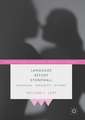
Language Before Stonewall: Palgrave Studies in Language, Gender and Sexuality
Autor William L. Leapen Limba Engleză Hardback – 30 ian 2020
Din seria Palgrave Studies in Language, Gender and Sexuality
- 15%
 Preț: 725.52 lei
 - 18%
 Preț: 749.22 lei
 - 15%
 Preț: 677.48 lei
 -
 Preț: 370.50 lei
 - 15%
 Preț: 669.51 lei
 - 18%
 Preț: 1008.34 lei
 - 18%
 Preț: 747.72 lei
 - 18%
 Preț: 1063.14 lei
 - 18%
 Preț: 1063.59 lei
 - 18%
 Preț: 738.73 lei
 - 18%
 Preț: 971.82 lei
 - 18%
 Preț: 730.36 lei
 - 18%
 Preț: 737.13 lei
 - 9%
 Preț: 746.50 lei
 - 18%
 Preț: 949.65 lei
Preț: 730.94 lei
Preț vechi: 859.92 lei
-15%
Puncte Express: 1096
Carte tipărită la comandă
Livrare economică 25 noiembrie-09 decembrie
Livrare prin curier în România Termenul estimat este afișat lângă disponibilitate.
Transport gratuit pentru acest produs Plată online sau ramburs, în funcție de opțiunile comenzii.
Retur gratuit în 14 zile Comandă securizată și suport în română.
Specificații
ISBN-13: 9783030335151
ISBN-10: 3030335151
Pagini: 436
Ilustrații: IX, 424 p. 1 illus.
Dimensiuni: 153 x 216 x 28 mm
Greutate: 0.63 kg
Ediția:1st ed. 2020
Editura: Springer
Colecția Palgrave Studies in Language, Gender and Sexuality
Seria Palgrave Studies in Language, Gender and Sexuality
Locul publicării:Cham, Switzerland
ISBN-10: 3030335151
Pagini: 436
Ilustrații: IX, 424 p. 1 illus.
Dimensiuni: 153 x 216 x 28 mm
Greutate: 0.63 kg
Ediția:1st ed. 2020
Editura: Springer
Colecția Palgrave Studies in Language, Gender and Sexuality
Seria Palgrave Studies in Language, Gender and Sexuality
Locul publicării:Cham, Switzerland
Cuprins
Chapter 1: Introduction: A Not-So-Secret "Secret Code".- Chapter 2: Discretion.- Chapter 3: Surveillance.- Chapter 4: Learning a Language of Sexuality.- Chapter 5: Circulation, Accumulation and Superdiversity.- Chapter 6: Conclusions.
Recenzii
“In Language Before Stonewall, Leap uses novel methods to elucidate a varied but thematically and affectively coherent archive. This archive reconstructs queer US history before Stonewall as a temporal location … that afforded agency to queers as expressive subjects. In doing this, Leap both gives his reader a productive method they may employ in their own queer linguistic studies if they so choose and, in a sense, prepares the US before Stonewall as a fertile site for queer linguistic scholarship.” (Jack Maginn, Journal of Language and Sexuality, Vol. 11 (2), 2022)
Textul de pe ultima copertă
This book explores the linguistic and social practices related to same-sex desires and identities that were widely attested in the USA during the years preceding the police raid on the Stonewall Inn in 1969. The author demonstrates that this language was not a unified or standardized code, but rather an aggregate of linguistic practices influenced by gender, racial, and class differences, urban/rural locations, age, erotic desires and pursuits, and similar social descriptors. Contrary to preconceptions, moreover, it circulated widely in both public and in private domains. This intriguing book will appeal to students and academics interested in the intersections of language, sexuality and history and queer historical linguistics.
William L. Leap is Emeritus Professor of Anthropology at American University and Affiliate Professor in the Center for Women’s, Gender and Sexuality Studies at Florida Atlantic University, USA.
Caracteristici
Re-imagines the history of language and sexual sameness in the US Reminds us of the importance of including discussions of language use in analyses of queer social history Demonstrates that queer linguistic history does not need to be written in terms of linear sequences and teleological goals