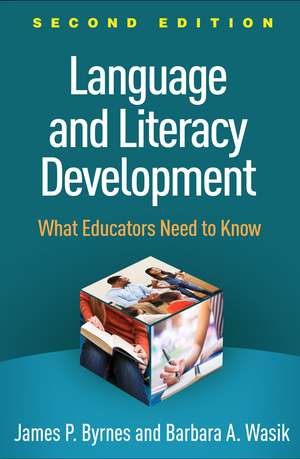
Language and Literacy Development, Second Edition: What Educators Need to Know: Solving Problems in the Teaching of Literacy
Autor James P. Byrnes, Barbara A. Wasiken Limba Engleză Paperback – 3 sep 2019
This established text--now revised and updated--reveals how spoken language skills are acquired and how they affect children’s later reading and writing achievement. With a unique focus on the needs of educators, the book examines the foundations of language in the developing brain. It explores the relationship of language processes to core literacy skills and probes the impact of motivational and sociocultural factors on children’s learning. Implications of developmental knowledge for classroom instruction are highlighted, and effective practices reviewed. Revealing vignettes, clear explanations of research, and lists of “main ideas” enhance the text’s accessibility for preservice teachers.
New to This Edition
*Chapter on emergent literacy and the predictors of reading success.
*Incorporates the latest research, including findings from key longitudinal studies.
*Increased attention to English learners, low-income children, and children with disabilities.
*Updated and expanded topics, including usage-based theories of language acquisition, morphological knowledge in vocabulary and comprehension, phonological processing skills, and writing development.
New to This Edition
*Chapter on emergent literacy and the predictors of reading success.
*Incorporates the latest research, including findings from key longitudinal studies.
*Increased attention to English learners, low-income children, and children with disabilities.
*Updated and expanded topics, including usage-based theories of language acquisition, morphological knowledge in vocabulary and comprehension, phonological processing skills, and writing development.
Din seria Solving Problems in the Teaching of Literacy
-
 Preț: 251.40 lei
 -
 Preț: 312.96 lei
 -
 Preț: 403.30 lei
 -
 Preț: 408.06 lei
 -
 Preț: 213.70 lei
 -
 Preț: 292.98 lei
 - 21%
 Preț: 202.28 lei
 - 19%
 Preț: 288.82 lei
 - 20%
 Preț: 252.61 lei
 - 18%
 Preț: 224.54 lei
 - 21%
 Preț: 378.87 lei
 - 11%
 Preț: 317.55 lei
 - 21%
 Preț: 188.34 lei
 - 11%
 Preț: 385.40 lei
 - 20%
 Preț: 206.30 lei
 - 19%
 Preț: 255.23 lei
 - 19%
 Preț: 277.62 lei
 - 10%
 Preț: 355.66 lei
Preț: 438.18 lei
Preț vechi: 476.29 lei
-8%
Puncte Express: 657
Carte disponibilă
Livrare economică 05-19 noiembrie
Livrare express 22-28 octombrie pentru 42.44 lei
Livrare prin curier în România Termenul estimat este afișat lângă disponibilitate.
Transport gratuit pentru acest produs Plată online sau ramburs, în funcție de opțiunile comenzii.
Retur gratuit în 14 zile Comandă securizată și suport în română.
Specificații
ISBN-13: 9781462540044
ISBN-10: 146254004X
Pagini: 464
Dimensiuni: 156 x 234 x 28 mm
Greutate: 0.68 kg
Ediția:2nd edition
Editura: Guilford Publications
Colecția Guilford Press
Seria Solving Problems in the Teaching of Literacy
ISBN-10: 146254004X
Pagini: 464
Dimensiuni: 156 x 234 x 28 mm
Greutate: 0.68 kg
Ediția:2nd edition
Editura: Guilford Publications
Colecția Guilford Press
Seria Solving Problems in the Teaching of Literacy
Public țintă
Professional Practice & DevelopmentCuprins
I. Introductory Issues
1. Introduction
2. Brain Development, Language, and Literacy
II. The Development of Spoken Language Competence
3. An Overview of Spoken Language Competence
4. The Development of Phonological Skills
5. The Development of Word Meaning and Vocabulary
6. The Development of Grammatical Knowledge
III. The Development of Reading and Writing Skills
7. Emergent Literacy and Predictors of Early Reading Success
8. Beginning Reading
9. The Development of Reading Comprehension
10. The Development of Writing Skills
IV. Individual and Group Differences in Language and Literacy
11. Motivational Issues in Speaking, Reading, and Writing
12. Sociocultural Issues in Speaking, Reading, and Writing
V. Instructional Techniques and Programs
13. General Principles of Effective Instruction
14. Language and Literacy Programs That Work
References
Index
1. Introduction
2. Brain Development, Language, and Literacy
II. The Development of Spoken Language Competence
3. An Overview of Spoken Language Competence
4. The Development of Phonological Skills
5. The Development of Word Meaning and Vocabulary
6. The Development of Grammatical Knowledge
III. The Development of Reading and Writing Skills
7. Emergent Literacy and Predictors of Early Reading Success
8. Beginning Reading
9. The Development of Reading Comprehension
10. The Development of Writing Skills
IV. Individual and Group Differences in Language and Literacy
11. Motivational Issues in Speaking, Reading, and Writing
12. Sociocultural Issues in Speaking, Reading, and Writing
V. Instructional Techniques and Programs
13. General Principles of Effective Instruction
14. Language and Literacy Programs That Work
References
Index
Notă biografică
James P. Byrnes, PhD, is Professor of Educational Psychology and Applied Developmental Science in the College of Education at Temple University. He was a Fellow of Division 15 (Educational Psychology) of the American Psychological Association between 2002 and 2018, has served as Vice President of the Jean Piaget Society, and was Associate Editor of the Journal of Cognition and Development. Dr. Byrnes has published over 100 books, chapters, and articles on areas of cognitive development, including language development, logical reasoning, and mathematical learning. His most recent work has focused primarily on developing and testing a comprehensive theoretical model of academic achievement (the opportunity–propensity model) in order to provide insight into ways to eliminate or substantially reduce gender, ethnic, and racial gaps in achievement. Dr. Byrnes has received awards for his teaching and mentoring of undergraduate and graduate students.
Barbara A. Wasik, PhD, is Professor of Educational Psychology and holds the PNC Endowed Chair in Early Childhood in the College of Education at Temple University. She is a recipient of the University's Paul W. Eberman Faculty Research Award. Her research interests are emergent literacy and early intervention in beginning reading, with a focus on disadvantaged children. Dr. Wasik has extensive experience in program and curriculum development and is specifically interested in the role that teachers play in the development of children’s language and literacy skills. She has written several books and numerous articles on early literacy, one of which received the Dina Feitelson Research Award from the International Literacy Association. Also interested in educational policy issues, Dr. Wasik is the author of several papers that have affected teaching practices in classrooms.
Barbara A. Wasik, PhD, is Professor of Educational Psychology and holds the PNC Endowed Chair in Early Childhood in the College of Education at Temple University. She is a recipient of the University's Paul W. Eberman Faculty Research Award. Her research interests are emergent literacy and early intervention in beginning reading, with a focus on disadvantaged children. Dr. Wasik has extensive experience in program and curriculum development and is specifically interested in the role that teachers play in the development of children’s language and literacy skills. She has written several books and numerous articles on early literacy, one of which received the Dina Feitelson Research Award from the International Literacy Association. Also interested in educational policy issues, Dr. Wasik is the author of several papers that have affected teaching practices in classrooms.
Recenzii
"This updated second edition provides an accessible yet thorough overview of how children develop critical language and literacy skills and why these skills are so important. Particularly important is the strong review of how early development fosters skilled reading comprehension later on. Byrnes and Wasik are recognized experts who translate current research in a meaningful way to help transform readers’ understanding of the remarkable task of language and literacy acquisition in children."--Laura M. Justice, PhD, EHE Distinguished Professor of Educational Psychology, The Ohio State University
“Once again, Byrnes and Wasik provide an incredibly readable summary of the latest research on language and literacy development--and, at the same time, they make strong links to the implications for classroom instruction. This is a unique volume that appropriately merges the literatures on oral language and literacy skills, while successfully bridging the divide between psychology and education. It is an essential book for graduate students who plan to be teachers, for current educators and administrators, and for psychology students with applied interests. I highly recommend this volume as a course text! It is ideal for graduate-level classes on language and literacy development. My graduate students appreciate the 'relevance' portions of the chapters, which help motivate their learning; and the main ideas that frame each chapter help me to organize class discussions. The increased focus throughout on English language learners is relevant and timely. What was already an indispensable classroom text is even better in this updated second edition."--Meredith L. Rowe, EdD, Saul Zaentz Professor of Early Learning and Development, Harvard Graduate School of Education
"The developmental perspective presented by Byrnes and Wasik is unique and important. The notion of 'education as a developmental mechanism' frames literacy learning as a pathway along which we need to recognize milestones and guide students accordingly. This book's message is that all students can achieve if we determine where they are and where they need to go--and offer experiences that are effective to help them get there."--Margaret G. McKeown, PhD, Senior Scientist, Learning Research and Development Center, University of Pittsburgh
-“Once again, Byrnes and Wasik provide an incredibly readable summary of the latest research on language and literacy development--and, at the same time, they make strong links to the implications for classroom instruction. This is a unique volume that appropriately merges the literatures on oral language and literacy skills, while successfully bridging the divide between psychology and education. It is an essential book for graduate students who plan to be teachers, for current educators and administrators, and for psychology students with applied interests. I highly recommend this volume as a course text! It is ideal for graduate-level classes on language and literacy development. My graduate students appreciate the 'relevance' portions of the chapters, which help motivate their learning; and the main ideas that frame each chapter help me to organize class discussions. The increased focus throughout on English language learners is relevant and timely. What was already an indispensable classroom text is even better in this updated second edition."--Meredith L. Rowe, EdD, Saul Zaentz Professor of Early Learning and Development, Harvard Graduate School of Education
"The developmental perspective presented by Byrnes and Wasik is unique and important. The notion of 'education as a developmental mechanism' frames literacy learning as a pathway along which we need to recognize milestones and guide students accordingly. This book's message is that all students can achieve if we determine where they are and where they need to go--and offer experiences that are effective to help them get there."--Margaret G. McKeown, PhD, Senior Scientist, Learning Research and Development Center, University of Pittsburgh
Descriere
This established text--now revised and updated--reveals how spoken language skills are acquired and how they affect children’s later reading and writing achievement. With a unique focus on the needs of educators, the book examines the foundations of language in the developing brain.