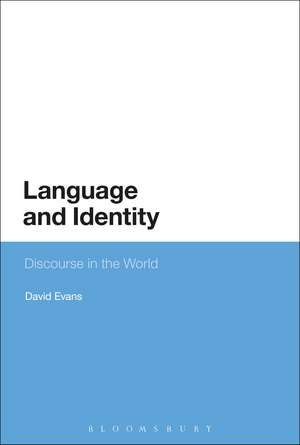
Language and Identity: Discourse in the World
Editat de David Evansen Limba Engleză Paperback – 30 iun 2016
Words and language constitute meanings within discourses and discourses vary in power. The powerful ones reproduce more powerful meanings, colonize other discourses and marginalize or silence the least powerful languages and cultures. Language and culture death occur in extreme cases of marginalization.
This book also demonstrates the socio-economic opportunities offered by language choice and the cultural allegiances of language, where groups have been able to create new lives for themselves by embracing new languages in new countries. Language can be a 'double-edged sword' of opportunity and marginalization. Language and Identity argues that bilingualism and in some cases multilingualism can both promote socio-economic opportunity and combat culture death and marginalization.
With sound theoretical perspectives drawing upon the work of Bakhtin, Vygotsky, Gumperz, Foucault and others, this book provides readers with a rationale to redress social injustice in the world by supporting minority linguistic and cultural identities and an acknowledgement that access to language can provide opportunity.
Preț: 285.24 lei
Preț vechi: 376.30 lei
-24%
Puncte Express: 428
Carte tipărită la comandă
Livrare economică 26 noiembrie-10 decembrie
Livrare prin curier în România Termenul estimat este afișat lângă disponibilitate.
Transport gratuit de la 400.00 lei Plată online sau ramburs, în funcție de opțiunile comenzii.
Retur gratuit în 14 zile Comandă securizată și suport în română.
Specificații
ISBN-13: 9781474294942
ISBN-10: 1474294944
Pagini: 248
Dimensiuni: 152 x 232 x 16 mm
Greutate: 0.35 kg
Ediția:NIPPOD
Editura: Bloomsbury Publishing
Colecția Bloomsbury Academic
Locul publicării:London, United Kingdom
ISBN-10: 1474294944
Pagini: 248
Dimensiuni: 152 x 232 x 16 mm
Greutate: 0.35 kg
Ediția:NIPPOD
Editura: Bloomsbury Publishing
Colecția Bloomsbury Academic
Locul publicării:London, United Kingdom
V-ar putea interesa
-
 Metaphor: A Practical IntroductionZoltan Kövescses-13%Preț: 279.01 lei318.89 lei
 -
 -21%Preț: 421.88 lei534.37 lei
 -
 Rhetoric: A Very Short IntroductionRichard Toye-20%Preț: 56.62 lei70.82 lei
 -
 The Code BookSimon SinghPreț: 117.88 lei
 -
 -15%Preț: 431.15 lei507.23 lei
 -
 A History of Nature Conservation in BritainDavid Evans-15%Preț: 652.64 lei767.81 lei
 -
 Toward a History of American LinguisticsE.F.K. KoernerPreț: 470.52 lei
 -
 On DialogueDavid BohmPreț: 230.67 lei
 -
 Multilingualism OnlineCarmen LeePreț: 404.47 lei
 -
 -25%Preț: 278.87 lei371.36 lei
 -
 Understanding SemanticsSebastian LöbnerPreț: 450.03 lei
 -
 Linguistics: An Introduction Answer KeyWilliam B. McGregor-16%Preț: 95.98 lei113.99 lei
 -
 Japanese Questions: Discourse, Context and LanguageLidia Tanaka-25%Preț: 278.37 lei369.72 lei
 -
 Institutional Translation for International Governance: Enhancing Quality in Multilingual Legal CommunicationProfessor Fernando Prieto Ramos-33%Preț: 646.40 lei958.66 lei
 -
 Languages in Jewish Communities, Past and PresentSarah Bunin Benor-23%Preț: 1078.40 lei1400.52 lei
 -
 Journal for the Academic Study of Magic: Issue 3David Evans-10%Preț: 137.83 lei153.50 lei
 -
 Deutsch-französische Übersetzungsübungen für das GrundstudiumCatherine RampfPreț: 143.92 lei
 -
 -14%Preț: 829.45 lei964.47 lei
Cuprins
Part 1 Theoretical Overview
1. Introduction David Evans
2. The Identities of Language David Evans
3. How Language Shapes Social Perception Philippe Chassy
Part 2 Languages, Discourses and Identities in the World
4. Quebec's Shift from Ethnic to Civic National Identity: Implications for Language Attitudes Amongst Immigrants in Montreal Ruth Kircher
5. Trilingualism and Uyghur Identity in the People's Republic of China Mamtimyn Sunuodula, Anwei Feng and Bob Adamson
6. 'Queensland for Ever & Augus un ballybug go braugh': The Expression of Identity in Nineteenth-Century Irish Emigrant Letters Marije van Hattum
7. Indigenous Languages, Cultures and Communities in the Amazon: Strengthening Identities Alex Guilherme
Part 3 Critical Pedagogies
8. The Language of Leisure and Physicality: Constructing and Re-constructing Identity Wendy Bignold
9. Drama and the Identity of the Language Learner Bernie Hughes
10. Towards a Cultural Paradigm of Alterity in Modern Foreign Language (MFL) Learning David Evans
11. English Language Teacher Identity: A Framework for Teacher Learning and Professional Development Richard Kiely
12. Conclusion
Index
1. Introduction David Evans
2. The Identities of Language David Evans
3. How Language Shapes Social Perception Philippe Chassy
Part 2 Languages, Discourses and Identities in the World
4. Quebec's Shift from Ethnic to Civic National Identity: Implications for Language Attitudes Amongst Immigrants in Montreal Ruth Kircher
5. Trilingualism and Uyghur Identity in the People's Republic of China Mamtimyn Sunuodula, Anwei Feng and Bob Adamson
6. 'Queensland for Ever & Augus un ballybug go braugh': The Expression of Identity in Nineteenth-Century Irish Emigrant Letters Marije van Hattum
7. Indigenous Languages, Cultures and Communities in the Amazon: Strengthening Identities Alex Guilherme
Part 3 Critical Pedagogies
8. The Language of Leisure and Physicality: Constructing and Re-constructing Identity Wendy Bignold
9. Drama and the Identity of the Language Learner Bernie Hughes
10. Towards a Cultural Paradigm of Alterity in Modern Foreign Language (MFL) Learning David Evans
11. English Language Teacher Identity: A Framework for Teacher Learning and Professional Development Richard Kiely
12. Conclusion
Index
Recenzii
In this three-part collection ... David Evans and other contributors explore the interrelationships between language and identity with a particular focus on how language shapes the social discourse and pedagogy of minority ethno-linguistic communities ... [A] valuable resource for students and researchers in the areas of sociolinguistics, language acquisition, and communication.
This book is brought together by its authors' fascinating discussions of culture ... [Part 1] provides a useful overview of core theoretical concepts explaining the relationship between language and identity. Part 2 delivers an accessible and very interesting account of the sociolinguistics of globalisation and multilingualism, whilst those hoping to learn more about the relationship between identity and second-language learning will certainly benefit from the chapters in Part 3.
This volume has synthesized and compiled a diversified body of research supported by accessible writing styles ... A valuable reference for readers in anthropological linguistics, sociolinguistics, and discourse analysis, especially those engaging with topics related to linguistic and cultural minorities.
[This] publication with its wide scope of topics and its vast range including highly theoretical articles as well as decidedly practice-oriented ones, represents an informative book for all those who are interested in the language learner and the language teacher, and the identities they adopt in the (different) process(es) of language acquisition ... The editor's and the authors' courage to tackle it anew is a justified - and successful - attempt to give it new impulses and new research orientations.
While language conveys information it does much more than that; it shapes the very information it conveys. It also shapes and reflects identities. Language determines how people see themselves and how they are seen by others. Language can both create identity and well as constrain it. This important book gives voice to linguistic and cultural minorities. It contains an inspiring range of discussions of how communities can navigate their way between languages and cultures and how, by adopting a critical pedagogy, people can revitalize and develop self-esteem and pride in their identities.
This book is brought together by its authors' fascinating discussions of culture ... [Part 1] provides a useful overview of core theoretical concepts explaining the relationship between language and identity. Part 2 delivers an accessible and very interesting account of the sociolinguistics of globalisation and multilingualism, whilst those hoping to learn more about the relationship between identity and second-language learning will certainly benefit from the chapters in Part 3.
This volume has synthesized and compiled a diversified body of research supported by accessible writing styles ... A valuable reference for readers in anthropological linguistics, sociolinguistics, and discourse analysis, especially those engaging with topics related to linguistic and cultural minorities.
[This] publication with its wide scope of topics and its vast range including highly theoretical articles as well as decidedly practice-oriented ones, represents an informative book for all those who are interested in the language learner and the language teacher, and the identities they adopt in the (different) process(es) of language acquisition ... The editor's and the authors' courage to tackle it anew is a justified - and successful - attempt to give it new impulses and new research orientations.
While language conveys information it does much more than that; it shapes the very information it conveys. It also shapes and reflects identities. Language determines how people see themselves and how they are seen by others. Language can both create identity and well as constrain it. This important book gives voice to linguistic and cultural minorities. It contains an inspiring range of discussions of how communities can navigate their way between languages and cultures and how, by adopting a critical pedagogy, people can revitalize and develop self-esteem and pride in their identities.