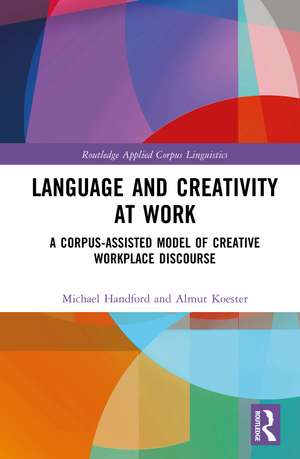
Language and Creativity at Work: A Corpus-Assisted Model of Creative Workplace Discourse: Routledge Applied Corpus Linguistics
Autor Michael Handford, Almut Koesteren Limba Engleză Paperback – 30 iul 2025
- Provides a critical comparison of previous studies in language and creativity in a linguistic context as well as in the context of businesses and entrepreneurship, and considers the insights that can be gained from both approaches
- Argues the case for workplace creativity as a linguistic and discursive phenomenon in addition to a cognitive or relational one
- Presents a model of creative workplace discourse that integrates creative language, the creative actions involving language, and alignment between speakers
- Employs spoken corpus data from a range of workplace contexts recorded over a 20-year period;
- Examines professional practice and creativity in two different professional contexts: a residential care home and a small start-up company, and explores the roles of constraints, leadership and alignment in these contexts
- Critically interrogates the notion of creativity as an inherently positive phenomenon and analyses instances of problematic creativity in the workplace
- Demonstrates how corpora can be used to underscore assessments of creativity and its realisations in real dialogic contexts.
Din seria Routledge Applied Corpus Linguistics
-
 Preț: 437.63 lei
 - 18%
 Preț: 1154.38 lei
 -
 Preț: 434.74 lei
 -
 Preț: 434.52 lei
 -
 Preț: 435.13 lei
 - 18%
 Preț: 1112.48 lei
 -
 Preț: 430.48 lei
 -
 Preț: 437.63 lei
 -
 Preț: 442.18 lei
 -
 Preț: 414.88 lei
 -
 Preț: 408.74 lei
 -
 Preț: 362.35 lei
 -
 Preț: 407.04 lei
 -
 Preț: 410.99 lei
 -
 Preț: 425.16 lei
 -
 Preț: 437.08 lei
 -
 Preț: 380.83 lei
 -
 Preț: 381.97 lei
 -
 Preț: 437.80 lei
 -
 Preț: 447.94 lei
 -
 Preț: 402.93 lei
 -
 Preț: 414.82 lei
 - 18%
 Preț: 1346.26 lei
 - 18%
 Preț: 1345.97 lei
 - nou
 Preț: 1127.48 lei
Preț: 432.83 lei
Puncte Express: 649
Carte tipărită la comandă
Livrare economică 04-18 decembrie
Livrare prin curier în România Termenul estimat este afișat lângă disponibilitate.
Transport gratuit pentru acest produs Plată online sau ramburs, în funcție de opțiunile comenzii.
Retur gratuit în 14 zile Comandă securizată și suport în română.
Specificații
ISBN-13: 9781032726489
ISBN-10: 1032726482
Pagini: 216
Ilustrații: 20
Dimensiuni: 156 x 234 x 12 mm
Greutate: 0.34 kg
Ediția:1
Editura: Taylor & Francis
Colecția Routledge
Seria Routledge Applied Corpus Linguistics
Locul publicării:Oxford, United Kingdom
ISBN-10: 1032726482
Pagini: 216
Ilustrații: 20
Dimensiuni: 156 x 234 x 12 mm
Greutate: 0.34 kg
Ediția:1
Editura: Taylor & Francis
Colecția Routledge
Seria Routledge Applied Corpus Linguistics
Locul publicării:Oxford, United Kingdom
Public țintă
PostgraduateCuprins
List of illustrations
Acknowledgements
Acronyms and abbreviations
Notes on data and transcription
Introduction
Orientation and Contribution
Chapter Overview
Chapter 1: Language, Discourse and Creativity
1.1 Introduction
1.2 Defining Creativity
1.3 Context and Creativity
1.4 Defining Creativity from an Organisational Perspective
1.5 Language, Discourse and Creativity
1.5.1 Linguistic creativity
1.5.2 Discursive creativity
1.5.3 Linguistic creativity as ‘Straw Man’?
1.6 Constraints and Practices
1.7 Conclusion
Chapter 2: Model and Methodology
2.1 Model of Creative Workplace Discourse
2.1.1 The dimensions of the model
2.1.2 Application of the model
2.2 Methodology
2.2.1 The data
2.2.2 Methods: Corpus-assisted discourse analysis
2.2.3 Analysing linguistic creativity: Using frequency-based corpus tools
2.2.4 Analysing discursive creativity: selected methods
2.3 Conclusion
Chapter 3: Language, Creativity and Problem-Solving
3.1 Introduction
3.2 Metaphors and Idioms (MIDs)
3.2.1 Metaphors and idioms in problem-solving
3.2.2 Applying the creative workplace discourse model
3.3 Hypothesising
3.3.1 Hypothetical reported speech
3.3.2 Hypothetical talk
3.3.3 Applying the creative workplace discourse model
3.4 Discussion
3.5 Conclusion
Chapter 4: Creativity and Professional Practice I: Alignment and constraints in a care home
4.1 Introduction
4.2 Exploring Care Home Discourse and Creativity
4.3 Care Home Discourse
4.3.1 Frequency word list findings
4.3.2 Keyword list findings
4.4 What about Creativity?
4.4.1 Metaphors, euphemisms and colloquial expressions
4.4.2 Terms of endearment
4.4.3 Evaluative expressions
4.4.4 Infrequent words
4.5 Discussion and conclusion
Chapter 5: Creativity and Professional Practice II: Innovation and constraints in a start-up
5.1 Introduction
5.2 Interview with CEO: Talking about Innovation and Creativity
5.2.1 Thematic analysis of the interview
5.2.2 Linguistic creativity in the interview
5.3 Meetings: Doing Innovation and Creativity
5.3.1 Weekly meeting of heads of division
5.3.2 Quick performance review meeting
5.4 Discussion and Conclusion
5.5 Comparison of the Care Home and the Start-up
Chapter 6: Problematic Creativity
6.1 Introduction
6.2 Problematic Creativity and Context
6.3 Conflict and Problematic Creativity
6.3.1 Task conflict, an example: Internet server provider meeting
6.4 Humour and Problematic Creativity
6.5 Stereotypes and Problematic Creativity
6.6 Problematic Creativity: Conflict, Humour and Stereotypes in Action
6.7 Conclusion
Chapter 7: Conclusions and Reflections
7.1 What were the Overarching Themes, and what were the Findings?
Theme 1: Appropriate methods for analysing creativity
Theme 2: Problem-solving as a key site for creativity at work
Theme 3: Role of constraints for creativity
Theme 4: Role of the Community of Practice
Theme 5: Creativity as positive or negative
7.2. What has our Creative Workplace Discourse Model Told us about Creativity?
Question 1: Does a high level of linguistic creativity co-occur with a high degree of alignment?
Question 2: If such correlation occurs, does this suggest some underlying causal factor?
Question 3: Do high linguistic creativity and high alignment enable discursive creativity?
Question 4: Does a change in alignment from low to high lead to greater discursive creativity?
7.3 How can Organisations Boost Creativity and Manage it Effectively?
7.3.1 Language matters
7.3.2 Processes of group creativity
7.3.3 The Role of leadership
7.3.4 Diversity and creativity
Appendix
References
Index
Acknowledgements
Acronyms and abbreviations
Notes on data and transcription
Introduction
Orientation and Contribution
Chapter Overview
Chapter 1: Language, Discourse and Creativity
1.1 Introduction
1.2 Defining Creativity
1.3 Context and Creativity
1.4 Defining Creativity from an Organisational Perspective
1.5 Language, Discourse and Creativity
1.5.1 Linguistic creativity
1.5.2 Discursive creativity
1.5.3 Linguistic creativity as ‘Straw Man’?
1.6 Constraints and Practices
1.7 Conclusion
Chapter 2: Model and Methodology
2.1 Model of Creative Workplace Discourse
2.1.1 The dimensions of the model
2.1.2 Application of the model
2.2 Methodology
2.2.1 The data
2.2.2 Methods: Corpus-assisted discourse analysis
2.2.3 Analysing linguistic creativity: Using frequency-based corpus tools
2.2.4 Analysing discursive creativity: selected methods
2.3 Conclusion
Chapter 3: Language, Creativity and Problem-Solving
3.1 Introduction
3.2 Metaphors and Idioms (MIDs)
3.2.1 Metaphors and idioms in problem-solving
3.2.2 Applying the creative workplace discourse model
3.3 Hypothesising
3.3.1 Hypothetical reported speech
3.3.2 Hypothetical talk
3.3.3 Applying the creative workplace discourse model
3.4 Discussion
3.5 Conclusion
Chapter 4: Creativity and Professional Practice I: Alignment and constraints in a care home
4.1 Introduction
4.2 Exploring Care Home Discourse and Creativity
4.3 Care Home Discourse
4.3.1 Frequency word list findings
4.3.2 Keyword list findings
4.4 What about Creativity?
4.4.1 Metaphors, euphemisms and colloquial expressions
4.4.2 Terms of endearment
4.4.3 Evaluative expressions
4.4.4 Infrequent words
4.5 Discussion and conclusion
Chapter 5: Creativity and Professional Practice II: Innovation and constraints in a start-up
5.1 Introduction
5.2 Interview with CEO: Talking about Innovation and Creativity
5.2.1 Thematic analysis of the interview
5.2.2 Linguistic creativity in the interview
5.3 Meetings: Doing Innovation and Creativity
5.3.1 Weekly meeting of heads of division
5.3.2 Quick performance review meeting
5.4 Discussion and Conclusion
5.5 Comparison of the Care Home and the Start-up
Chapter 6: Problematic Creativity
6.1 Introduction
6.2 Problematic Creativity and Context
6.3 Conflict and Problematic Creativity
6.3.1 Task conflict, an example: Internet server provider meeting
6.4 Humour and Problematic Creativity
6.5 Stereotypes and Problematic Creativity
6.6 Problematic Creativity: Conflict, Humour and Stereotypes in Action
6.7 Conclusion
Chapter 7: Conclusions and Reflections
7.1 What were the Overarching Themes, and what were the Findings?
Theme 1: Appropriate methods for analysing creativity
Theme 2: Problem-solving as a key site for creativity at work
Theme 3: Role of constraints for creativity
Theme 4: Role of the Community of Practice
Theme 5: Creativity as positive or negative
7.2. What has our Creative Workplace Discourse Model Told us about Creativity?
Question 1: Does a high level of linguistic creativity co-occur with a high degree of alignment?
Question 2: If such correlation occurs, does this suggest some underlying causal factor?
Question 3: Do high linguistic creativity and high alignment enable discursive creativity?
Question 4: Does a change in alignment from low to high lead to greater discursive creativity?
7.3 How can Organisations Boost Creativity and Manage it Effectively?
7.3.1 Language matters
7.3.2 Processes of group creativity
7.3.3 The Role of leadership
7.3.4 Diversity and creativity
Appendix
References
Index
Notă biografică
Michael Handford is Professor of English Language and Applied Linguistics at Cardiff University, Wales.
Almut Koester is Professor of English Business Communication at the Vienna University of Economics and Business, Austria.
Almut Koester is Professor of English Business Communication at the Vienna University of Economics and Business, Austria.